California’s new drinking-water standard is forcing five local providers toward treatment plants, new wells and pipelines that could cost more than half a billion dollars. The chromium is naturally occurring. The financial consequences will not be.
Across Greater Palm Springs, a substance measured in billionths is becoming an infrastructure challenge measured in hundreds of millions of dollars.
Chromium-6 is colorless, odorless and already present in groundwater beneath much of the region. There has been no newly discovered industrial spill, no sudden change in the aquifer and no finding that the valley’s drinking water has abruptly become unsafe.

What changed was California’s definition of how much chromium-6 a public water system may deliver.
The state’s new maximum contaminant level of 10 parts per billion is now pushing five of the Coachella Valley’s six principal water providers into one of the largest collective drinking-water infrastructure programs in the region’s history. Current agency estimates, public financing documents and treatment projections suggest that the combined capital exposure could approach or exceed $565 million.
That figure is preliminary. The agencies are using different assumptions, timelines and treatment strategies, and most have not completed the rate studies that will determine what customers ultimately pay. It also does not capture decades of electricity, chemicals, treatment media, monitoring, waste disposal and maintenance.
But the direction is unmistakable.
A geological condition that has existed beneath the desert for centuries is about to become a continuing operating expense for households, hotels, restaurants, golf courses, schools, landlords, hospitals and nearly every other water customer across much of the Coachella Valley.
A new line in the water
In April 2024, the State Water Resources Control Board adopted a chromium-6 drinking-water standard of 10 parts per billion, or ppb. The regulation took effect on Oct. 1, 2024.
California is the only state with a drinking-water standard specifically for chromium-6. Federal regulations instead limit total chromium, which includes chromium-6 and the less toxic chromium-3, to 100 ppb. California also maintains a 50 ppb limit for total chromium.
The distinction matters because groundwater that complies comfortably with the federal standard may exceed California’s separate chromium-6 limit.
The state’s largest water systems, those with at least 10,000 service connections, enter the compliance period beginning Oct. 1, 2026. Systems with 1,000 to 9,999 connections follow in October 2027, and the smallest systems in October 2028.
Those dates do not mean every treatment facility must be operating by then. Compliance is calculated through monitoring and running annual averages, while water agencies with approved or pending compliance plans may receive limited legal protection as they implement their projects.
But the countdown is no longer theoretical. Engineering, permitting, financing and construction must now move forward.
A health standard that does not mean zero risk
The public-health calculation behind the rule is more complicated than the 10 ppb number suggests.
California’s official public-health goal for chromium-6 is 0.02 ppb, 500 times lower than the enforceable standard. A public-health goal is based primarily on toxicology. A maximum contaminant level must also account for whether laboratories can reliably measure the substance, whether treatment technology can achieve the limit and whether the cost is economically feasible.
State regulators concluded that treatment at the public-health goal is not currently practical. At the adopted 10 ppb standard, the state estimates a one-in-2,000 lifetime cancer risk for a person consuming the water over 70 years.
Local water agencies emphasize that exceeding 10 ppb does not represent an immediate health emergency. Short-term exposure is not considered an immediate danger, and agencies have generally told customers they do not need to switch to bottled water.
The concern is long-term exposure. The regulatory response is therefore designed around permanent infrastructure rather than emergency distribution of alternative water.
That nuance is difficult to convey in the required notices arriving in customer mailboxes. The phrase “chromium-6” inevitably recalls the industrial contamination portrayed in the movie “Erin Brockovich.” The Coachella Valley’s situation is fundamentally different.
In Hinkley, California – the subject municipality of the movie, chromium-6 was released through industrial activity and reached concentrations far above those reported locally. In the Coachella Valley, water agencies and groundwater studies attribute the chromium primarily to natural minerals, rocks and sediments within the aquifer.
The chemistry beneath the desert
Chromium occurs in different chemical forms. Chromium-3 is relatively stable, generally insoluble and found naturally in rock. Under certain conditions, it can be oxidized into chromium-6, which dissolves more readily in water.
The Coachella Valley possesses several of the conditions that favor that transformation and allow chromium-6 to persist in chromium-bearing geological materials, alkaline groundwater, dissolved oxygen, low natural recharge rates and long groundwater flow paths.
Together, those characteristics can release chromium from sediments and keep it in solution as water moves through the aquifer.
There is a tempting, dramatic explanation that imported Colorado River water used for groundwater replenishment is directly creating the region’s chromium-6 problem. The imported water is oxygenated, and replenishment can alter groundwater chemistry, movement and mixing.
But the available science points to a more complicated system rather than a single cause.
Chromium-6 concentrations vary with geology, groundwater depth, water age, faults, mineral composition and local chemical conditions. Imported water may influence some of those conditions, but it is not scientifically sound to conclude that replenishment alone created the chromium-6 now being measured across the region.
Indeed, water agencies have studied imported-water replenishment and blending as possible ways to lower chromium concentrations in some locations. The same replenishment system can produce different results depending on the chemistry and geology of the aquifer into which the water moves.
The geographic pattern reinforces that complexity. Desert Water Agency, which serves much of Palm Springs and portions of Cathedral City, reports that its drinking-water sources all remain below the 10 ppb limit. Farther east, numerous wells operated by Coachella Valley Water District, Indio Water Authority, Coachella Water Authority, Mission Springs Water District and Myoma Dunes Mutual Water Company exceed it.
The difference is not simply which agency operates the well. It is where the well is located, how deep it is and what geological formations the groundwater has encountered.
Five agencies, five financial challenges
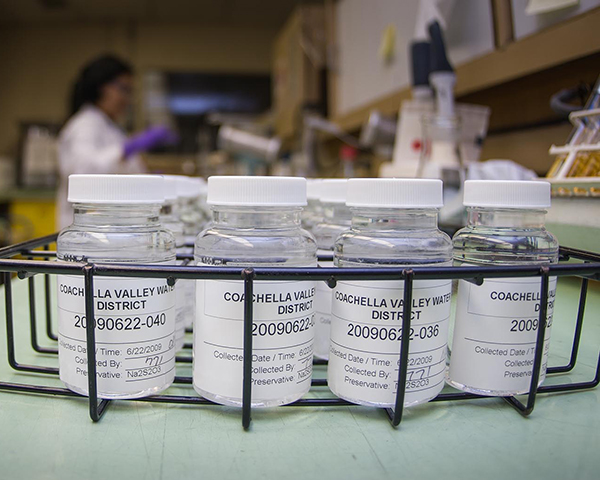
Coachella Valley Water District faces the largest program.
The district reports that 33 of the 92 wells in its Cove drinking-water system exceed the new limit. Chromium-6 concentrations across those wells average 9.4 ppb and range from zero to 22 ppb.
CVWD submitted a compliance plan to the state in October 2025 and says it has not yet received approval. The district currently estimates that compliance will cost more than $350 million and has warned that the investment will significantly affect future water rates.
Indio Water Authority faces another large concentration of affected wells. The authority has estimated its three-phase treatment program at $130 million.
Indio was the first Coachella Valley provider to install chromium-6 treatment, placing ion-exchange systems into service in 2015. Those facilities currently treat three wells. Additional treatment, new facilities and system upgrades are expected to be constructed in phases.
The scale of the undertaking is illustrated by IWA’s projected timeline. Once funding is secured and design begins, the authority says completing treatment for all affected wells could take approximately 10 years.
Mission Springs Water District, serving Desert Hot Springs and surrounding communities, has reported four affected wells and an estimated treatment and well-clustering cost of approximately $25 million. The district has removed affected wells from service while evaluating and implementing treatment options.
Coachella Water Authority says five of its wells are affected. Its plans include ion-exchange treatment, and the city has warned that individual treatment facilities can require substantial capital investment and millions of dollars in annual operation and maintenance.
A Coachella chromium-6 treatment project carrying an estimated cost of $50 million appears in California’s Drinking Water State Revolving Fund project inventory. The listing identifies the service area as disadvantaged, an important designation when the state evaluates funding assistance. Inclusion in the inventory, however, is not the same as receiving a grant or loan award.
Myoma Dunes Mutual Water Company presents perhaps the clearest example of small-system economics. The company serves portions of Bermuda Dunes and La Quinta with a comparatively small customer base. All five of its wells have been reported above the new standard, with estimated compliance costs of $10 million to $15 million.
A large agency can spread a treatment project across tens of thousands of accounts. A small mutual water company cannot. Even a less expensive project can impose a greater burden per customer.
Desert Water Agency is the regional exception. Its latest water-quality reporting says chromium-6 has not been detected above the state limit, and the agency has not announced a comparable treatment program.
Treatment is not a one-time construction cost
Most public discussion has focused on the price of building treatment plants. The longer-term operating costs may prove equally significant.
Ion exchange, one of the principal treatment technologies, passes groundwater through tanks containing specialized resin. Chromium-6 ions attach to the resin and are removed from the water. The process requires treatment vessels, pumps, controls, backup capacity, resin replacement or regeneration and management of the resulting waste stream.
Reduction-coagulation-filtration uses chemicals to convert chromium-6 into chromium-3, which can then be captured and filtered from the water. The process requires chemical storage, dosing systems, filtration equipment, residuals handling and extensive operational oversight.
Other strategies include blending water from high-chromium wells with water from lower-concentration sources, connecting groups of wells through new pipelines, drilling replacement wells into different aquifer layers and removing certain wells from regular service.
Each approach carries trade-offs. New wells may avoid treatment but can cost millions of dollars without guaranteeing acceptable water quality. Blending requires pipelines, storage and carefully controlled flows. Closing wells can reduce system capacity during the hottest periods, when water demand is highest.
Treatment also consumes electricity.
A state environmental review, drawing from an earlier CVWD concept involving treatment at 30 well sites, estimated that annual electricity consumption at the affected facilities could rise from approximately 21,000 megawatt-hours to as much as 41,000 megawatt-hours, depending partly on the method used to dispose of treatment brine.
The eventual projects may differ substantially from that earlier design. The estimate nevertheless illustrates why chromium-6 will become a permanent utility expense rather than a construction project that disappears from budgets once the ribbon is cut.
The affordability divide
The central public-policy question is no longer whether agencies must respond. It is who will finance the response and how the cost will be distributed.
Water providers can pursue grants, subsidized loans, federal assistance, bonds and other financing. State programs may provide greater support to disadvantaged communities and smaller systems with limited rate capacity.
Outside assistance will be critical in the eastern Coachella Valley, where some of the most affected systems also serve communities with lower household incomes.
But financing does not erase cost. Loans must be repaid. Treatment systems require continuing operation. Resin, chemicals, electricity, monitoring, maintenance and staffing cannot generally be financed through one-time grants forever.
Rate increases will require cost-of-service analyses and public proceedings under Proposition 218. Agencies have not yet established the final chromium-6 charge for an average household, and any estimate offered today would be premature.
Businesses should nevertheless pay attention. Water-rate increases affect operating expenses directly, particularly for hotels, restaurants, laundries, health care facilities, multifamily housing, landscaping-intensive properties and other large users.
There is also an opportunity cost. Money borrowed or reserved for chromium-6 treatment is money that cannot simultaneously finance new wells, storage reservoirs, emergency interconnections, conservation programs or system expansions needed to support development.
A legal bridge, not a financial solution
The chromium-6 rule has already survived one cycle of litigation and revision.
California adopted an earlier 10 ppb standard in 2014. A court invalidated it in 2017 after finding that the state had not adequately documented the economic feasibility of compliance.
The State Water Board conducted a new economic review and readopted the standard in 2024. Water providers are again challenging the regulation, arguing in part that its economic and affordability consequences were not adequately considered.
State lawmakers created a limited bridge in 2025 through Senate Bill 466. The law generally prevents a public water system that complies with California’s total chromium standard from being deemed in violation of the chromium-6 standard while the state is reviewing its submitted compliance plan or while the system is implementing an approved plan.
That protection is important for agencies waiting on state action. It does not repeal the standard, build treatment facilities or protect customers from the resulting costs.
Once a compliance plan is approved, its construction and implementation dates become enforceable. The agencies must still finance, design and operate the projects.

Bob Marra is the CEO/Publisher of GPS Business Insider and GPS Market Intel. He has been studying, writing and giving presentations about business, economic and public affairs news and issues and the local economy in the Greater Palm Springs/Coachella Valley region for more than 20 years.