June is never a normal month in Greater Palm Springs.
It is the month when the desert’s economic center of gravity starts shifting from peak-season intensity to summer survival. Seasonal residents have left. Visitor volume thins. Some restaurants reduce hours. Some businesses close temporarily. Hotels and vacation rentals compete harder for price-sensitive summer travelers. Employers in hospitality, food service, retail and personal services often operate with fewer shifts and leaner staffing.
So when the region’s unemployment rate jumps in June, the first question is not whether the local economy suddenly cracked.
The better question is how much of the increase reflects the valley’s normal summer contraction, and how much may be something more serious.
The answer in the latest data is mixed.
Across the nine Greater Palm Springs cities, unemployment rose sharply in June after a stronger May. The regional jobless rate climbed to roughly 6.2%, up from about 5.0% in May, according to a GPS Business Insider calculation based on city-level labor force and unemployment figures from the California Employment Development Department.
The increase was broad. Every city in the region posted a higher unemployment rate than in May.
But the summer context matters. Greater Palm Springs has one of the most seasonal employment bases in California because so much of the local economy is tied to visitors, events, second-home activity and climate-driven travel patterns. That does not make the June increase meaningless. It makes it more important to read correctly.
A summer jump in unemployment is not surprising here. The scale of this one, combined with a weakening national jobs picture, deserves attention.
A broad June reversal
Greater Palm Springs had a combined labor force of 178,500 in June, up from 177,000 in May. But the number of employed residents fell from 168,600 to 167,400.
At the same time, the number of unemployed residents rose from 8,500 to 11,100.
That is the central fact in the June report. The valley did not simply add more people to the labor force. It also had fewer people employed.
The June increase followed a May report that showed improvement across all nine cities. One month later, all nine moved the other way.
Coachella remained the region’s highest-unemployment city, rising from 7.5% in May to 8.9% in June. Rancho Mirage remained second highest, moving from 6.9% to 7.9%.
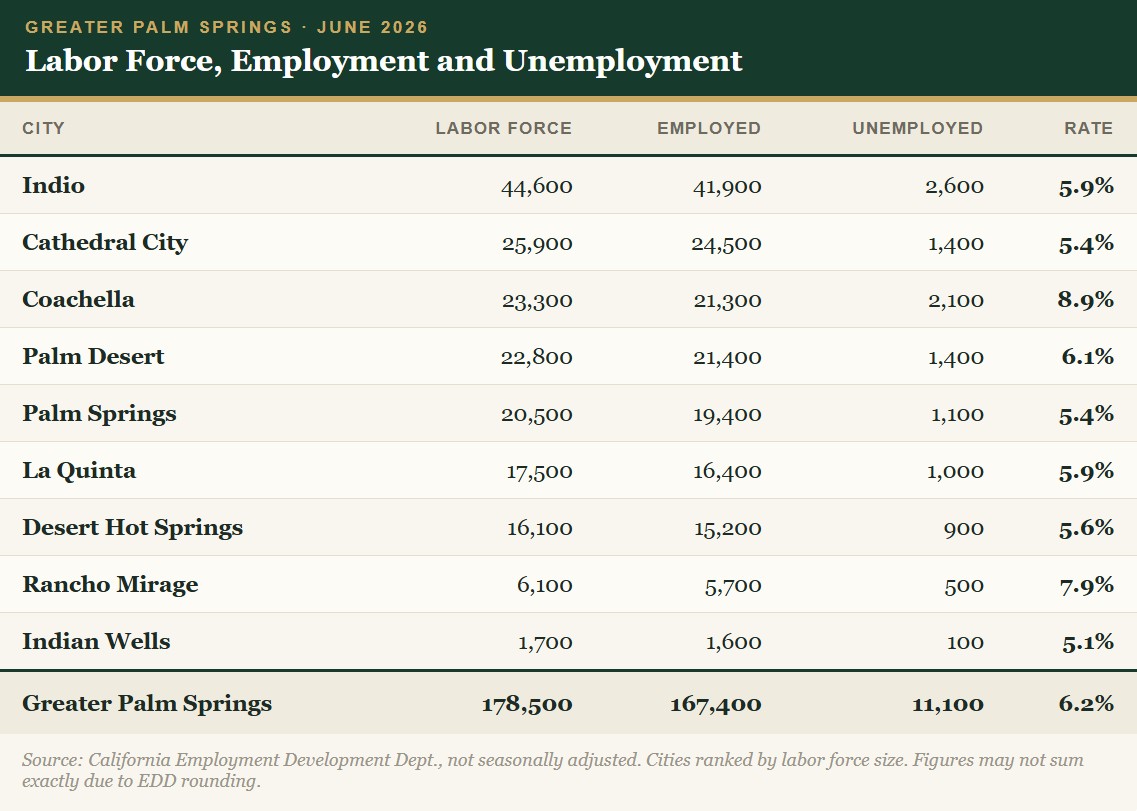
Palm Desert rose from 4.5% to 6.1%. Indio climbed from 4.5% to 5.9%. La Quinta rose from 4.4% to 5.9%. Desert Hot Springs moved from 4.6% to 5.6%. Palm Springs rose from 4.4% to 5.4%. Cathedral City increased from 3.6% to 5.4%. Indian Wells had the lowest June rate among the nine cities at 5.1%, up from 4.4%.
The breadth of the increase is the headline. The seasonality is the interpretation.
Summer changes the employment base
Greater Palm Springs cannot be analyzed like an inland logistics market or a large urban job center.
It is a visitor economy with a permanent resident base layered underneath it. Tourism, hospitality, food and beverage, lodging, recreation, retail, events, health care, local government and construction all matter. But the visitor-facing side of the economy plays an outsized role.
Visit Greater Palm Springs’ 2025 tourism impact report found that the region welcomed 15 million visitors, generated $7.8 billion in visitor spending and supported 52,352 total jobs. The report also found that visitor activity supported 24.4% of all jobs in Greater Palm Springs, roughly one in four.
That explains why summer labor-market readings require careful handling.
When the visitor economy slows, the local job base does not simply soften at the margins. It can temporarily contract across multiple customer-facing industries at once. Restaurants, hotels, vacation rentals, attractions, event venues, personal services, retail centers and smaller local operators all feel the seasonal pullback.
In 2025, the nine-city region also saw unemployment rise sharply from May to June. Using the rounded city-level totals, the Greater Palm Springs unemployment rate rose from about 5.3% to 6.6%. The labor force grew by roughly 1,300, employment fell by about 1,500, and the number of unemployed residents increased by about 2,400.
The pattern repeated in 2026. From May to June, the labor force increased by about 1,500, employment fell by about 1,200 and the number of unemployed residents increased by 2,600, pushing the regional rate from about 5% to roughly 6.2%.
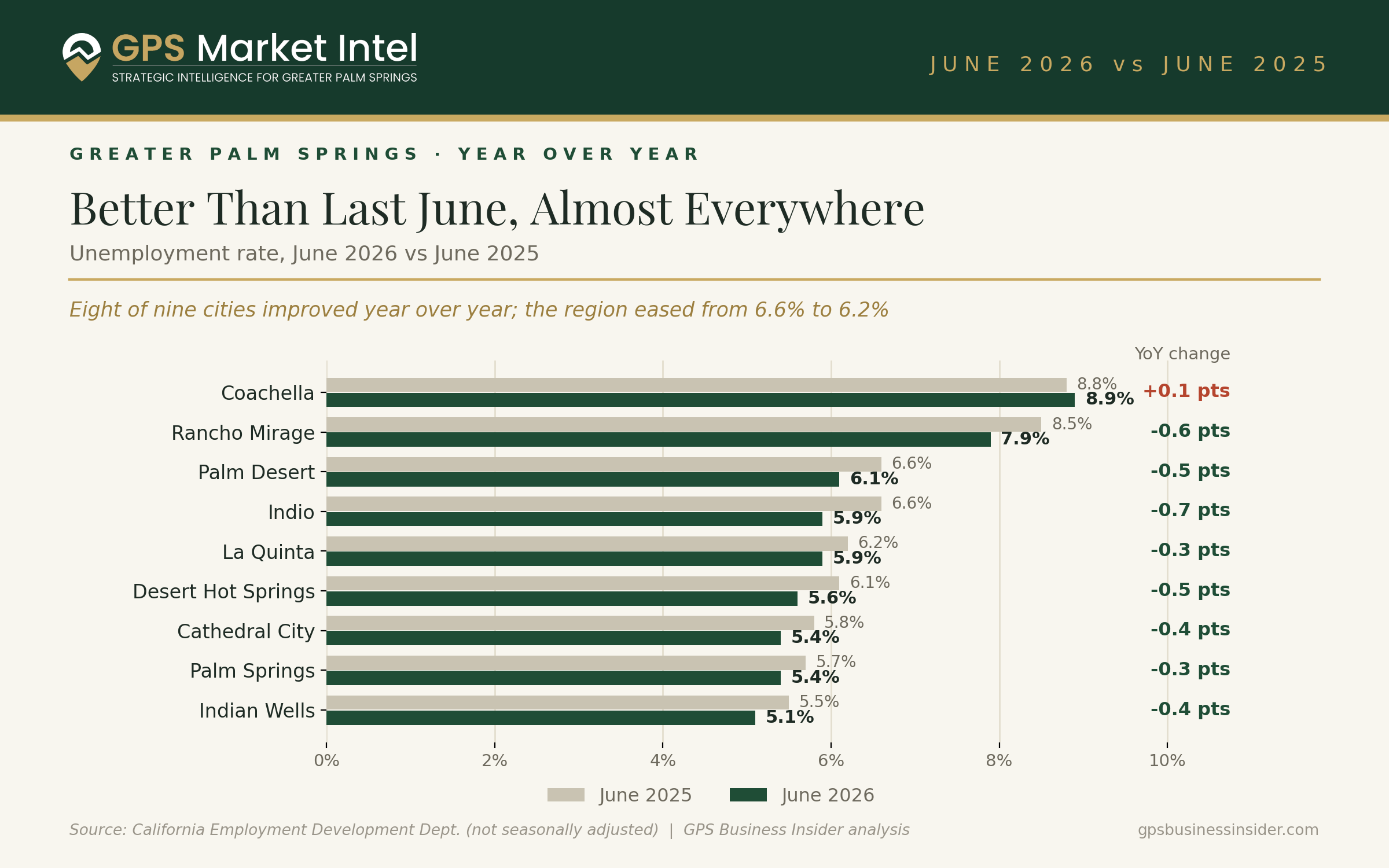
The prior-year city detail reinforces the seasonal point. In 2025, every Greater Palm Springs city posted a higher unemployment rate in June than in May: Cathedral City rose from 4.1% to 5.8%; Coachella from 8.0% to 8.8%; Desert Hot Springs from 5.0% to 6.1%; Indian Wells from 4.7% to 5.5%; Indio from 5.0% to 6.6%; La Quinta from 4.5% to 6.2%; Palm Desert from 4.7% to 6.6%; Palm Springs from 4.6% to 5.7%; and Rancho Mirage from 7.3% to 8.5%.
That year-over-year comparison is essential because it shows that a June increase is part of the region’s normal seasonal pattern, not a surprise created entirely by the current economy. The 2026 difference is the context. The local jobless rate again rose sharply from May to June, but this time it happened alongside a weaker national jobs report, downward payroll revisions and a broader loss of labor-market momentum. That makes the 2026 summer increase more important to watch, even if the seasonal direction itself is not unusual.
Tourism data shows the summer gap
The same pattern appears in tourism-related data.
In 2025, Greater Palm Springs generated $9.6 billion in total tourism economic impact. Visitor spending supported more than 41,000 direct jobs, including 18,334 direct jobs in food and beverage, 7,559 in recreation and entertainment, 6,065 in lodging and 5,292 in retail.
Those are exactly the industries most exposed to seasonal demand.
Short-term rental data clearly shows the summer gap. Visit Greater Palm Springs reported that professionally managed vacation rentals in the Coachella Valley had 21.9% paid guest occupancy in June 2024. For the three summer months of June, July and August 2024, average paid guest occupancy was 20.3%.
Those numbers do not describe the entire tourism economy. Hotels, resorts, casinos, restaurants, attractions and airport traffic each have their own patterns. But they do help explain why the desert economy behaves differently in June than it does in March, April or November.
A 6.2% unemployment rate in June is not automatically the same warning sign it would be in peak season. But it still tells readers something important: the local economy entered summer with less employment cushion than it had one month earlier.
The valley is still not one labor market
The regional average also masks major city-level differences.
Coachella’s 8.9% unemployment rate was nearly four points higher than Indian Wells’ 5.1%. Rancho Mirage remained unusually elevated at 7.9%, a reminder that unemployment rates are based on resident labor-force status, not simply a city’s wealth or fiscal profile.
Indio and Coachella together represented about 38% of the region’s labor force in June, but about 42% of its unemployed residents. That concentration is not new, and it does not mean the east valley alone drove the June increase. Palm Desert, La Quinta, Cathedral City, Palm Springs and Desert Hot Springs all posted meaningful increases.
But it does show where employment stress remains most concentrated.
The West Valley has more of the resort, hospitality, retail, health care and professional services base. The east valley has a larger working-age labor pool, more agricultural and service-sector exposure, and more residents tied to physically demanding and seasonal work. Those differences matter when unemployment changes quickly.
For policymakers, the lesson is straightforward. The regional unemployment rate is useful, but it is not sufficient. Greater Palm Springs needs city-level analysis because the labor market looks different depending on whether the reader is focused on Coachella, Indio, Palm Desert, Palm Springs, Cathedral City or Rancho Mirage.
Still higher than county and state
Greater Palm Springs also moved above key benchmarks in June.
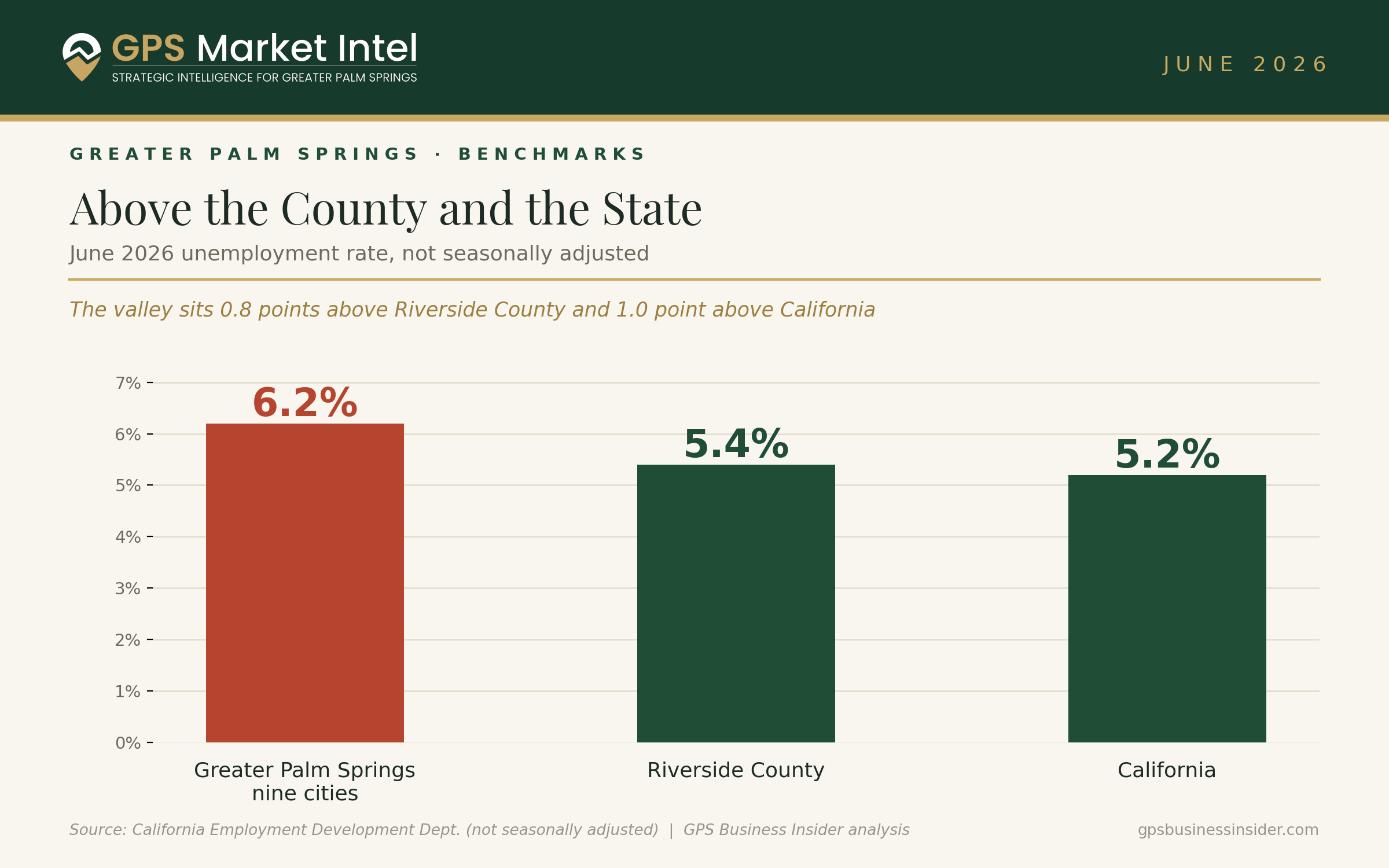
Riverside County’s unemployment rate was 5.4% in June. California’s comparable not-seasonally-adjusted rate was 5.2%. The nine-city Greater Palm Springs rate was roughly 6.2%.
That put the valley about eight-tenths of a point above Riverside County and about one full point above California.
The state’s broader labor picture was mixed. California’s seasonally adjusted unemployment rate dropped to 5.2% in June, its lowest level since May 2024. But the state also lost 2,900 nonfarm payroll jobs during the month, and May was revised downward to show a loss of 15,600 jobs.
California’s job gains were narrow. Private education and health services added 15,500 jobs. Leisure and hospitality added 1,100 jobs, but the state noted that the gain was weaker than usual for this time of year and that accommodation and food services posted losses in some restaurant and food-service categories. Government posted the state’s largest monthly loss, down 7,600 jobs, partly because of seasonal reductions as schools paused for summer.
That is an important statewide signal for Greater Palm Springs. The valley’s visitor economy benefits when leisure, hospitality, restaurants, health care and service jobs are expanding broadly. In June, the state’s job growth was not broad. It was concentrated.
The national picture is no longer a tailwind
The national backdrop makes the June local data more significant.
The latest Bureau of Labor Statistics report showed the U.S. economy lost 23,000 jobs in July. The unemployment rate edged down to 4.1%, but that was not the clean positive signal it might appear to be.
The labor force participation rate fell to 61.4%. Since January, the participation rate has declined by 0.7 percent, and the employment-population ratio has decreased by 0.5 point.
In plain English, fewer people are participating in the labor market. A lower unemployment rate is less reassuring when it is partly tied to a smaller active workforce.
The revisions were equally important. BLS revised May job growth down from 129,000 to 63,000 and June job growth down from 57,000 to 20,000. Combined, the two months were 103,000 jobs weaker than previously estimated and reported.
That substantially changes the national read.
July losses were concentrated in categories that matter to local readers. Local government education lost 50,000 jobs. Retail trade lost 19,000. Financial activities continued to trend down, losing 14,000 jobs in July and falling by 121,000 jobs since May 2025. Healthcare added 22,000 jobs, but that was slower than its average monthly gain of 36,000 over the prior year.
The average workweek remained unchanged at 34.3 hours. Average hourly earnings rose by just 2 cents to $37.62, though they were up 3.2% from a year earlier.
The BLS Job Openings and Labor Turnover Survey added another layer. Job openings were little changed at 7.4 million in June, hires held at 5.3 million, and layoffs were unchanged at 1.8 million. That is not a collapse. But it is also not a hot labor market.
For Greater Palm Springs, the national data matters because the valley sells discretionary experiences: hotel stays, restaurant meals, golf, festivals, wellness, shopping, vacation rentals, entertainment and seasonal living. When the national job market weakens, consumers and businesses eventually become more cautious.
That does not immediately mean fewer visitors. But it reduces the margin for error.

Bob Marra is the CEO/Publisher of GPS Business Insider and GPS Market Intel. He has been studying, writing and giving presentations about business, economic and public affairs news and issues and the local economy in the Greater Palm Springs/Coachella Valley region for more than 20 years.