Four Coachella Valley cities now restrict or prohibit data centers. But even where the zoning door remains open, the economics of supplying enormous amounts of electricity may leave developers with few realistic options.
Greater Palm Springs is rapidly closing territory to data centers.
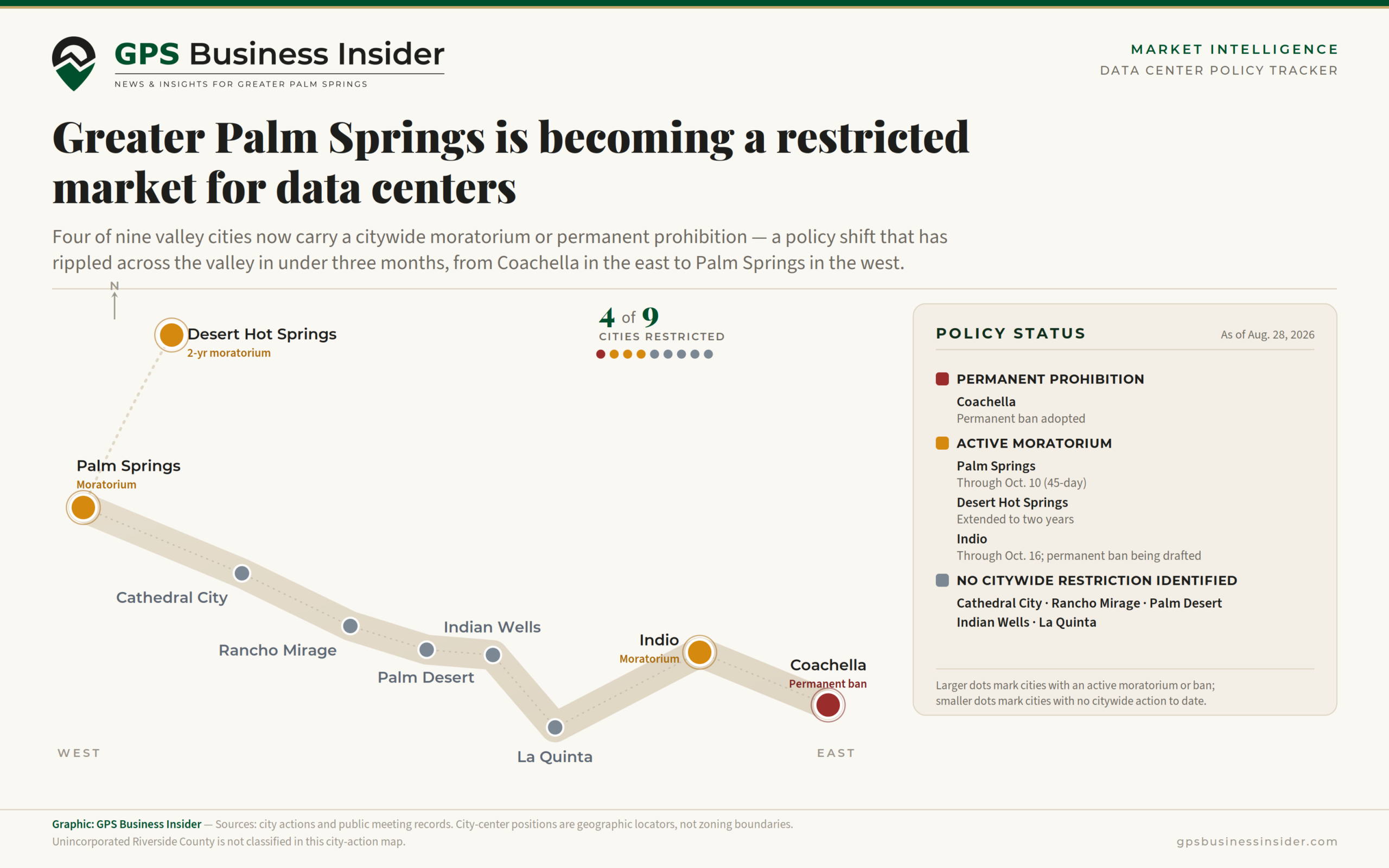
Coachella has enacted the Coachella Valley’s first permanent prohibition. Palm Springs adopted a 45-day moratorium this week. Desert Hot Springs has extended its moratorium for as long as two years, and Indio is using its temporary prohibition to prepare what could become the valley’s second permanent ban.
Four of the region’s nine cities now have a citywide restriction on one of the fastest-growing forms of industrial development in the country.
That appears to leave Cathedral City, Rancho Mirage, Palm Desert, Indian Wells and La Quinta, along with portions of unincorporated Riverside County, without comparable citywide restrictions.
But the regulatory map tells only part of the story.
As GPS Business Insider examined in July, the Coachella Valley has another potentially formidable barrier to large data centers: the cost and availability of electricity. Read GPS Business Insider’s earlier analysis of the Coachella Valley data-center power barrier
The increasingly important question is therefore not simply where a data center could still be proposed.
It is where one could actually work economically.
The regulatory map is shrinking
The policy shift has unfolded quickly.
Coachella’s City Council voted unanimously Aug. 26 to permanently prohibit data centers, completing a reversal that began after public opposition engulfed the proposed Coachella Valley Technology Campus. Earlier in the summer, GPS Business Insider chronicled how the controversy had expanded from a single project into a broader eastern Coachella Valley policy debate. Read the earlier GPS Business Insider report on the eastern valley’s data-center restrictions
Palm Springs acted the same day, imposing a 45-day moratorium while the city considers whether to prohibit data centers or regulate them through its zoning code.
Indio acted without a pending data center application. The city imposed a moratorium in June and subsequently moved toward a permanent policy. The city said when it adopted the initial pause that it wanted time to evaluate strict regulations, a longer moratorium or a complete prohibition before an application arrived.
Desert Hot Springs similarly acted before an advanced project appeared, giving itself up to two years to examine power demand, cooling, water, noise, backup generation, air quality and infrastructure.
Together, the four actions are beginning to resemble a regional economic-development policy, even though Greater Palm Springs has never conducted a regional process to decide whether it wants data centers, where they might be appropriate or what benefits would justify their impacts.
Yet even jurisdictions that remain open to the industry face another test.
Put a hypothetical data center in North Palm Springs
Consider what could be one of the valley’s more logical locations for industrial development: North Palm Springs.
Assume a developer proposed a 100-megawatt data center on appropriately zoned industrial land and that Southern California Edison determined the project could be served at subtransmission voltage.
A customer of that size would fall within SCE’s large-power rate structure. SCE’s current rate comparison, effective June 1, puts the total bundled cost for a representative high-load-factor customer on that schedule at approximately 12.73 cents per kilowatt-hour.
A 100-megawatt data center operating at a 90 percent annual load factor would consume approximately 788 million kilowatt-hours a year.
At 12.73 cents per kilowatt-hour, the implied annual electricity cost would be about $100 million.
That is before considering any extraordinary infrastructure the project might have to finance, specialized interconnection requirements or other project-specific costs.
And electricity prices are not merely another line in a data center operating budget. Power is essentially the raw material of the business.
Every 1-cent-per-kilowatt-hour difference on that hypothetical North Palm Springs facility represents nearly $7.9 million a year.
The national comparison remains difficult
The latest federal data put the average U.S. industrial electricity price at 9.17 cents per kilowatt-hour in June.
Texas averaged 6.58 cents. Washington was 7.20 cents and Oregon 8.83 cents.
Those statewide averages are not offers available to a particular data center developer, just as California’s 20.74-cent statewide industrial average is not the appropriate rate for the hypothetical North Palm Springs project.
But they demonstrate the scale of the competitive issue.
At 12.73 cents per kilowatt-hour, the 100-megawatt North Palm Springs example would carry an electricity bill approximately $28 million a year higher than the same amount of electricity purchased at the current U.S. industrial average.
Compared with Texas’ June industrial average, the difference would approach $48.5 million annually.
A developer may like a parcel, a tax environment or proximity to Southern California customers. But a hyperscale facility consuming hundreds of millions of kilowatt-hours every year cannot easily overcome a structural electricity-cost disadvantage.
Coachella tried to solve the power problem
The proposed Coachella Valley Technology Campus was presented as potentially requiring approximately 270 to 300 megawatts.
At that scale, conventional electricity pricing presented an obvious challenge.
The proposed solution was unusual: create a Coachella municipal electric utility capable of purchasing wholesale electricity, building infrastructure and selling power within a new service area. The data center would have provided the enormous anchor load needed to support the system.
GPS Business Insider detailed that strategy earlier this year, including the relationship between the technology campus, new substations and the city’s effort to establish a limited municipal electric utility in its eastern growth areas. Read the GPS Business Insider analysis of Coachella’s power strategy
Project concepts also contemplated dedicated energy infrastructure that could include microgrids, batteries, fuel cells and other resources. The strategy was essentially an effort to change the power economics rather than accept the rates available through a conventional utility arrangement.
Whether it could have succeeded was never established.
Coachella ended its agreement with the developer before the public saw a completed wholesale power agreement, final system studies, a definitive all-in electricity price or a full allocation of the financial risks. And, apparently, no one bothered to consider a significantly smaller version of the project that would have accordingly reduced the scale of the negative impacts typically associated with data centers.
But the abandoned project demonstrated the kind of strategy that could bring the industry back somewhere else in the valley.
The next serious proposal may not simply ask a utility for 100 or 300 megawatts under an existing rate structure. It could arrive with dedicated generation, wholesale procurement, storage, a microgrid or another customized power plan designed specifically to overcome the region’s disadvantage.
That is precisely why local land-use policy still matters.
Five cities without bans are not five obvious opportunities
It would be a mistake to look at the current map and conclude that Cathedral City, Rancho Mirage, Palm Desert, Indian Wells and La Quinta represent five open data-center markets. They do not.
Existing zoning and entitlement requirements still apply.
More importantly, a developer would have to locate land close enough to electric infrastructure capable of supporting an extraordinary new load, then determine whether the delivered price of that electricity could compete nationally.
For some jurisdictions, land availability alone may sharply limit the possibilities. For others, power could eliminate a site long before a development application reaches City Hall.
The valley increasingly has two separate filters.
The first is economic: Can a developer assemble enough electricity at a competitive long-term price?
The second is political: Will the jurisdiction allow the facility even if the developer solves the power problem?
Coachella has answered the second question with a permanent no.
Indio appears headed in the same direction.
Desert Hot Springs has given itself two years to decide.
Palm Springs has now started its own review.
In the eastern valley, the Imperial Irrigation District has developed another layer of protection through large-load policies intended to prevent extraordinarily large users from shifting infrastructure, power-procurement or reliability costs onto existing customers. GPS Business Insider previously examined how those requirements complicated the economics of the Coachella proposal. Read the analysis of IID’s large-load tariff and data centers
The industry will keep looking for power
The issue is unlikely to disappear.
The California Energy Commission says more than 200 active data centers are operating in the state. In early 2026, they accounted for about 1,000 megawatts, or 2 percent of peak demand on the California Independent System Operator grid.
The commission projects that demand could increase to roughly 4,500 megawatts, or 9 percent of peak demand, by 2040 as artificial intelligence and other computing-intensive industries expand. See the California Energy Commission’s data-center electricity assessment
That means communities with large parcels, transmission infrastructure and access to generation will continue to receive attention.
Greater Palm Springs possesses some of those attributes. The region is also pursuing a broader strategy to diversify beyond tourism and hospitality by attracting investment in clean energy, advanced manufacturing, biotechnology, agtech and other higher-wage sectors. Read GPS Business Insider’s coverage of the Greater Palm Springs economic-development strategy
What the region lacks is cheap electricity on the scale available in several competing data-center markets, along with a regional policy for deciding whether overcoming that disadvantage would be desirable in the first place.

Bob Marra is the CEO/Publisher of GPS Business Insider. He has been studying, writing and giving presentations about business, economic and public affairs news and issues and the local economy in the Greater Palm Springs/Coachella Valley region for more than 20 years.