A new concept would keep the shopping center’s core while adding housing, commercial development and gathering spaces. A separate effort seeks a replacement anchor for the city-owned Sears building, but financing, development details and construction dates remain unresolved.
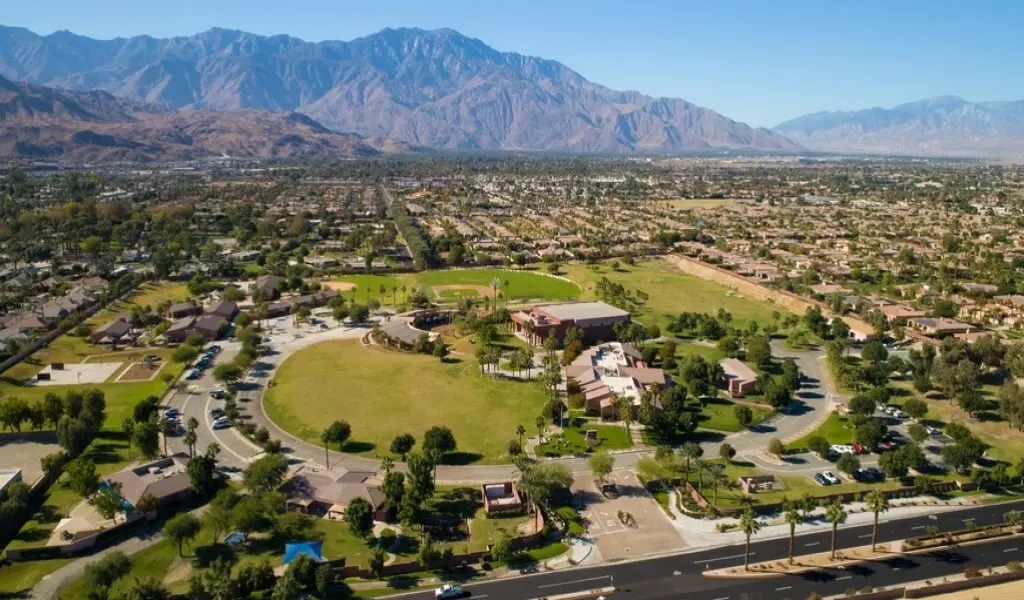
The shopping mall at Highway 111 and Monterey Avenue has anchored this city’s commercial core for more than four decades, first as the Palm Desert Town Center, then as Westfield Palm Desert, and since 2017 as The Shops at Palm Desert. On Thursday, Nov. 12, the Palm Desert City Council will get its most detailed public look yet at what the property’s owner wants it to become: The Village at Palm Desert, a mixed-use district that would keep the mall’s commercial core while surrounding it with housing, new commercial buildings along Highway 111 and a public plaza designed for desert living.
The 3:15 p.m. study session at Palm Desert City Hall is a planning milestone, not a decision point. The agenda states that no action will be taken, and the staff recommendation is simply to receive and file the update. The formal document that would make the concept real, a specific plan prepared by property owner Pacific Retail Capital Partners, is not expected to reach the city for review until spring 2027.
Even so, the presentation headed to the council carries considerably more substance than a rebranding announcement. It lays out a proposed zoning framework for the 64-acre property, a quarter-by-quarter entitlement schedule running into 2028, and a candid accounting of the constraints that have kept one of the Coachella Valley’s most prominent commercial properties in a holding pattern since Sears closed in January 2020. It also surfaces a development that could move on its own track: the city has engaged a developer to help attract a new anchor tenant to the former Sears building that Palm Desert itself owns.
What The Village at Palm Desert Would Include
The heart of the proposal is a land-use framework that divides the property into ten planning areas. The existing mall, at 34.34 acres, would remain a commercial core. Roughly 15.4 acres spread across five planning areas around that core would be designated mixed use, able to accommodate commercial or residential development. Nearly 9 acres along Highway 111 would stay commercial, including new retail pads fronting the corridor. The most consequential piece may be a 9.18-acre area on the property’s northern parking fields, labeled the Center Neighborhood, which Pacific Retail identifies as the starting point for a future residential parcel sale.
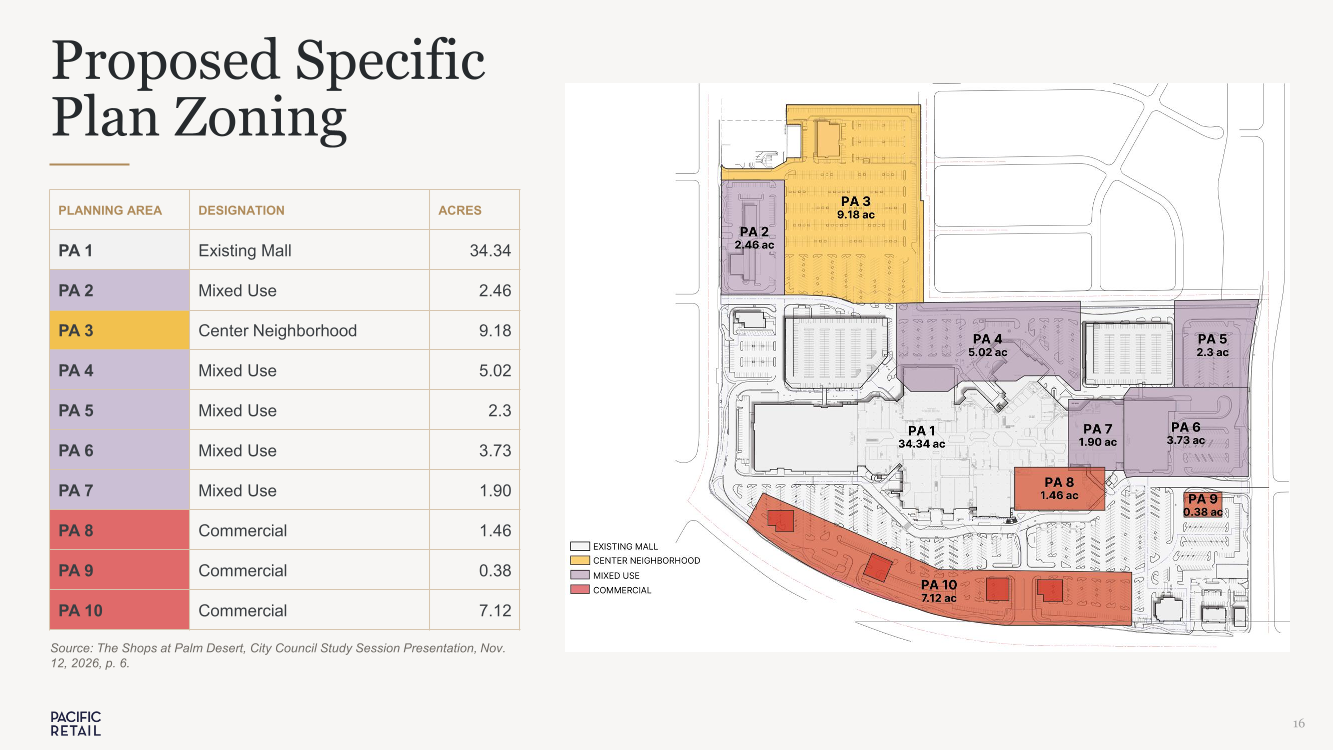
Pacific Retail’s proposed Specific Plan zoning divides the mall property into ten planning areas. The existing mall would remain a 34-acre commercial core, ringed by five mixed-use areas, with new commercial pads along Highway 111 and a 9.18-acre Center Neighborhood on the north parking fields set aside for future housing. Source: Pacific Retail Company presentation, Palm Desert City Council study session, Nov. 12, 2026.
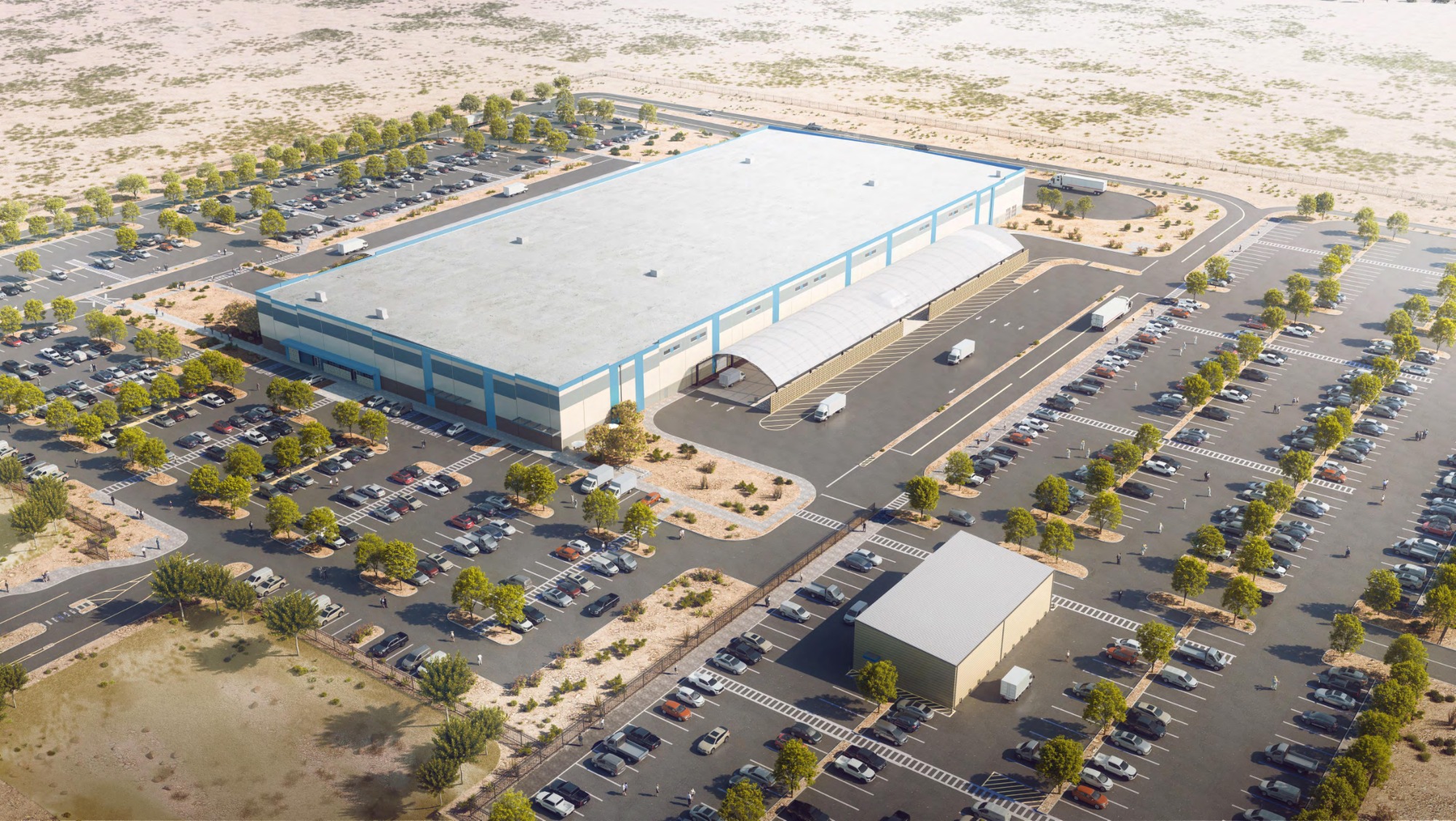
The presentation describes a walkable district where homes, shops, dining and a public plaza sit a short walk apart, linked by tree-lined paseos. The plaza, set on the upper level beside new homes and shops, is pitched as a gathering place with lawn and cafe seating, play space, live music, farmers markets and shaded courtyards.
What the framework does not yet contain is just as notable. There is no total housing-unit count, no residential density or building-height limit, no commitment on apartments versus condominiums or townhomes, no affordable-housing component, no development budget, no signed residential partner and no construction date. Those omissions define the project’s current stage: this is a framework intended to make future investment possible, not a financed construction program. Even the acreage requires care.
A New Anchor Search for the City-Owned Sears Building
Buried in the staff report is a development that could produce visible change on its own timetable. Palm Desert acquired the 123,946-square-foot former Sears building and its 7.46 acres in December 2022, giving the city a direct ownership stake in the mall it regulates. In April 2026, the California Department of Housing and Community Development authorized the city to sell the site after Palm Desert completed the process required under the Surplus Land Act. The city then ran a request-for-proposals process and has engaged with a qualified developer to attract a new anchor tenant to the building. A property disposition and development agreement is expected to come before the council as part of a future transaction.
The report does not name the developer or the prospective anchor. The city’s earlier public solicitation sought an experienced, financially capable buyer who could work with multiple mall owners and amend the reciprocal easement agreements that govern the property. That requirement is a reminder of how much coordination any single transaction at this mall involves.
The Sears effort and the broader Specific Plan are related but distinct. One is a specific transaction involving city-owned real estate. The other is a planning framework covering the entire property. Whether the anchor deal can close before the Specific Plan is approved is one question the study session could clarify.
Why Palm Desert Mall Redevelopment Has Taken Years
Residents who have watched the property since Sears closed could be forgiven for asking why so little has visibly changed. The presentation materials offer the most complete public answer to date, and it starts with ownership. Pacific Retail controls the main mall, a small parcel acquired from the previous owner in 2019, the Citibank pad on the property’s west side and the land under the former Sears Auto Center. Macy’s owns its 196,285-square-foot store and nearly 7 acres. JCPenney owns its store and 6.64 acres. The city owns the former Sears. And Transformco, the successor to Sears Holdings, controls the auto center improvements under a ground lease that does not expire until 2101.
Layered over that patchwork is a web of reciprocal easements, protected parking fields, no-build areas, exclusive zones and critical access ways that the owner’s own constraints map describes as the legal and operational framework that must be strategically addressed to unlock future redevelopment. A parking lot that looks underused from Monterey Avenue may not be available to build on without an anchor owner’s consent.
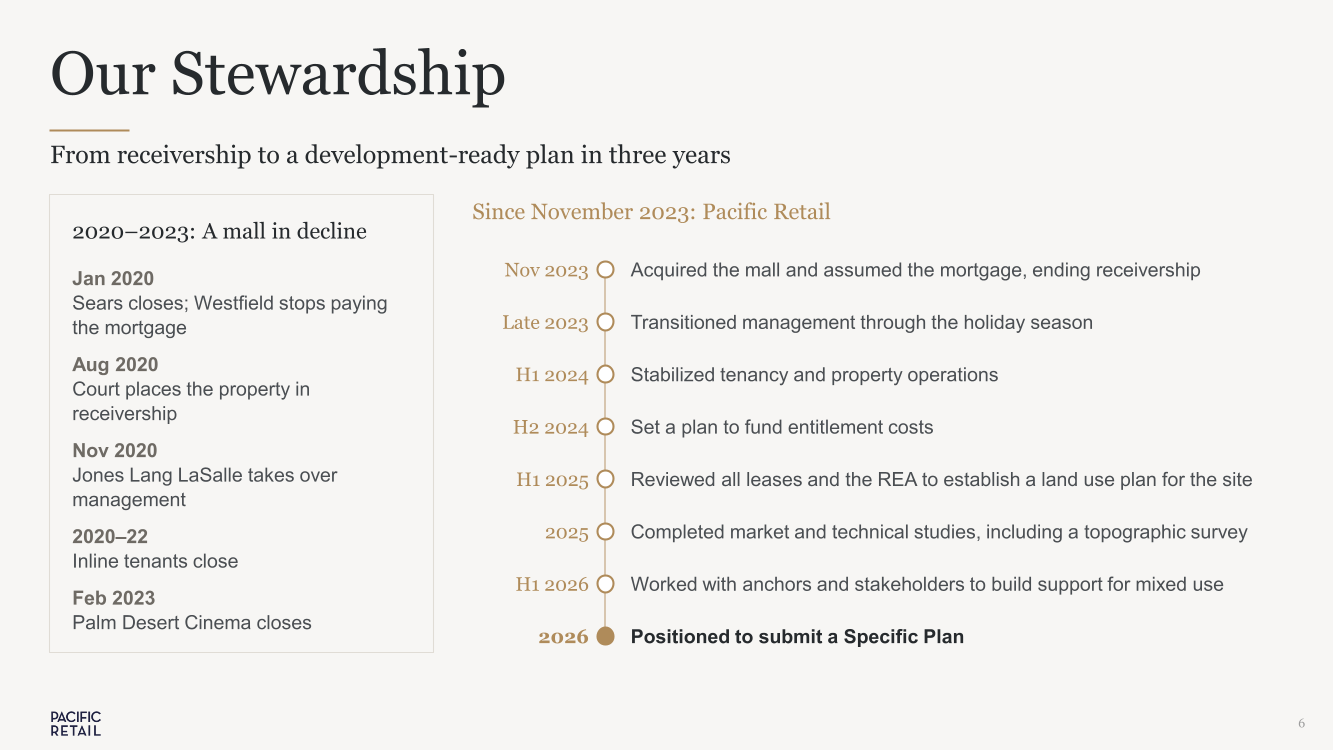
The property’s financial history added its own drag. Westfield stopped paying the mortgage when Sears closed in January 2020, a court placed the mall in receivership that August, and inline tenants emptied out over the following two years, with the Palm Desert Cinema closing in early 2023. Pacific Retail acquired the mall in November 2023 and assumed the existing mortgage, ending the receivership. A mortgage-servicing report filed with federal securities regulators in early 2025 describes a loan modification that extended the maturity by two years with additional options while redevelopment diligence continued.
The timetable has slipped accordingly. The city’s 2024 annual report on council goals anticipated a formal planning application in the second quarter of 2025. The new staff report puts formal submission in spring 2027, roughly two years later.
Pacific Retail’s account of the intervening period points to the time needed to stabilize operations, arrange entitlement funding, review every lease and easement, complete market and technical studies, and build anchor support for mixed uses.
An Operating Mall With a Soft Core
The most revealing operating number in the packet is one Pacific Retail volunteers itself: 28 percent of the mall’s leasable space is vacant or occupied under temporary leases. That is not a conventional vacancy rate, since it combines empty space with space filled by short-term tenants, and the presentation does not break out the split. But it establishes that more than a quarter of a nearly 985,000-square-foot center lacks permanent tenancy, three years into the new ownership.
The owner sets that figure against a national backdrop. United States mall vacancy ran about 8.5 percent in mid-2026, roughly double the 4.4 percent rate for retail overall, as department-store closures leave anchor boxes that are hard to re-lease as retail. Pacific Retail counts more than 190 American malls with announced plans to add housing, and it names examples from Westfield Garden State Plaza in New Jersey to MainPlace Mall in Santa Ana, where 309 units are open, and 408 are under construction.
The Economics of Adding Housing to a Shopping Center
The development logic is straightforward. Keep the retail that still produces sales, put underused parking fields to work as homes and new commercial pads, and give people more reasons to visit than a shopping trip. Residents would supply daily foot traffic for the restaurants, wellness businesses and neighborhood retail the owner says it is targeting, including specialty food, family entertainment, a co-op marketplace and everyday services. Entertainment and events would carry the evenings.
Southern California offers a close precedent. At Brea Mall in Orange County, an approved redevelopment replaces the former Sears store and surrounding parking with roughly 380 apartments plus retail, dining and outdoor gathering space while the mall stays open. That is the model Pacific Retail is describing in Palm Desert, a working mall densified at its edges rather than a dead one scraped clean. A precedent is not proof, and the feasibility questions in the desert are real. What rents would new housing need to command, and how deep is demand at those prices? Would new retail grow the region’s spending or shift it from El Paseo and other nearby districts? And can shaded paseos and a plaza actually function through a Coachella Valley summer, when the design promise of walkability meets 115-degree afternoons?
The parcel-sale strategy itself says something about how the economics are likely to work. Pacific Retail’s schedule shows a residential parcel sale beginning with the Center Neighborhood in the first half of 2028, which suggests the mall owner intends to entitle the land and sell development-ready parcels to homebuilders rather than build housing itself. That approach brings in capital and specialist builders, but it also means the housing timeline will depend on buyers not yet identified.
What Palm Desert Could Be Asked to Contribute
Palm Desert wears two hats at this property, land-use regulator and landowner, and the distinction matters for taxpayers. The staff report’s statement that Thursday’s item has no financial impact applies only to receiving the update. It says nothing about what redevelopment itself might eventually cost the public. The city’s 2026 council work plan contemplates evaluating infrastructure improvements and potential incentive agreements to support mall redevelopment, language that authorizes study, not spending, but that signals where future requests could land.
The unanswered public-money questions are concrete. What did the city pay for the Sears building in 2022, and what has it spent carrying the property since? What sale terms is it negotiating now? What infrastructure contributions or tenant incentives might be requested as the Specific Plan advances? And what enforceable public benefits, from plaza access and programming to fiscal returns, would the city secure in exchange? The answers will determine whether the Village is a private project the city enables or a public-private venture the city helps finance.
The Decisions Still Ahead
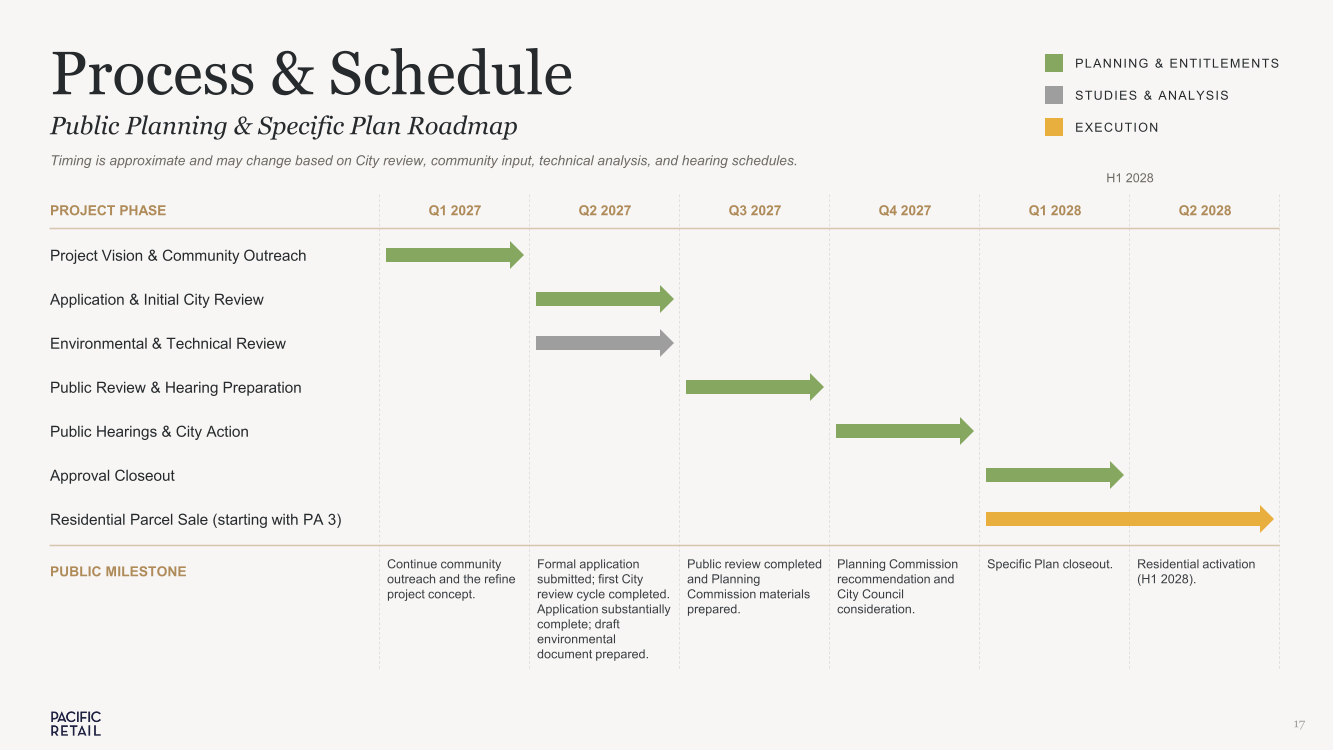
Pacific Retail’s roadmap puts community outreach and concept refinement in the first quarter of 2027, formal application and environmental review in the second quarter, public hearings and Planning Commission and council action in the fourth quarter, approval closeout in early 2028 and the first residential parcel sale in the first half of 2028. The owner labels all of it as approximate and subject to city review, community input, technical analysis and hearing schedules, and the eventual Specific Plan must still clear environmental review under CEQA. Between now and then, the council will also face the Sears disposition and development agreement, the first binding decision in the entire effort and the one most likely to reveal names, numbers and dates.
Thursday’s session is the public’s first chance to hear council members test the plan. The meeting begins at 3:15 p.m. in the Council Chamber at 73-510 Fred Waring Drive. Residents can attend in person, watch live on the city’s website or via Zoom, or email comments to CityClerk@palmdesert.gov before 10 a.m. on meeting day to have them entered into the record.

Bob Marra is the CEO/Publisher of GPS Business Insider and GPS Market Intel. He has been studying, writing and giving presentations about business, economic and public affairs news and issues and the local economy in the Greater Palm Springs/Coachella Valley region for more than 20 years.