For East Valley builders whose projects depend on getting electricity to undeveloped land, Imperial Irrigation District General Manager Jamie Asbury offered an encouraging message: the region’s power constraints have solutions, and several are moving from agreements and engineering into working infrastructure.
Speaking at the Desert Valleys Builders Association’s Nov. 12 luncheon at Woodhaven Country Club in Palm Desert, Asbury described a utility working with cities, Riverside County and developers to expand substations, share construction costs and prepare for the next round of Coachella Valley growth.
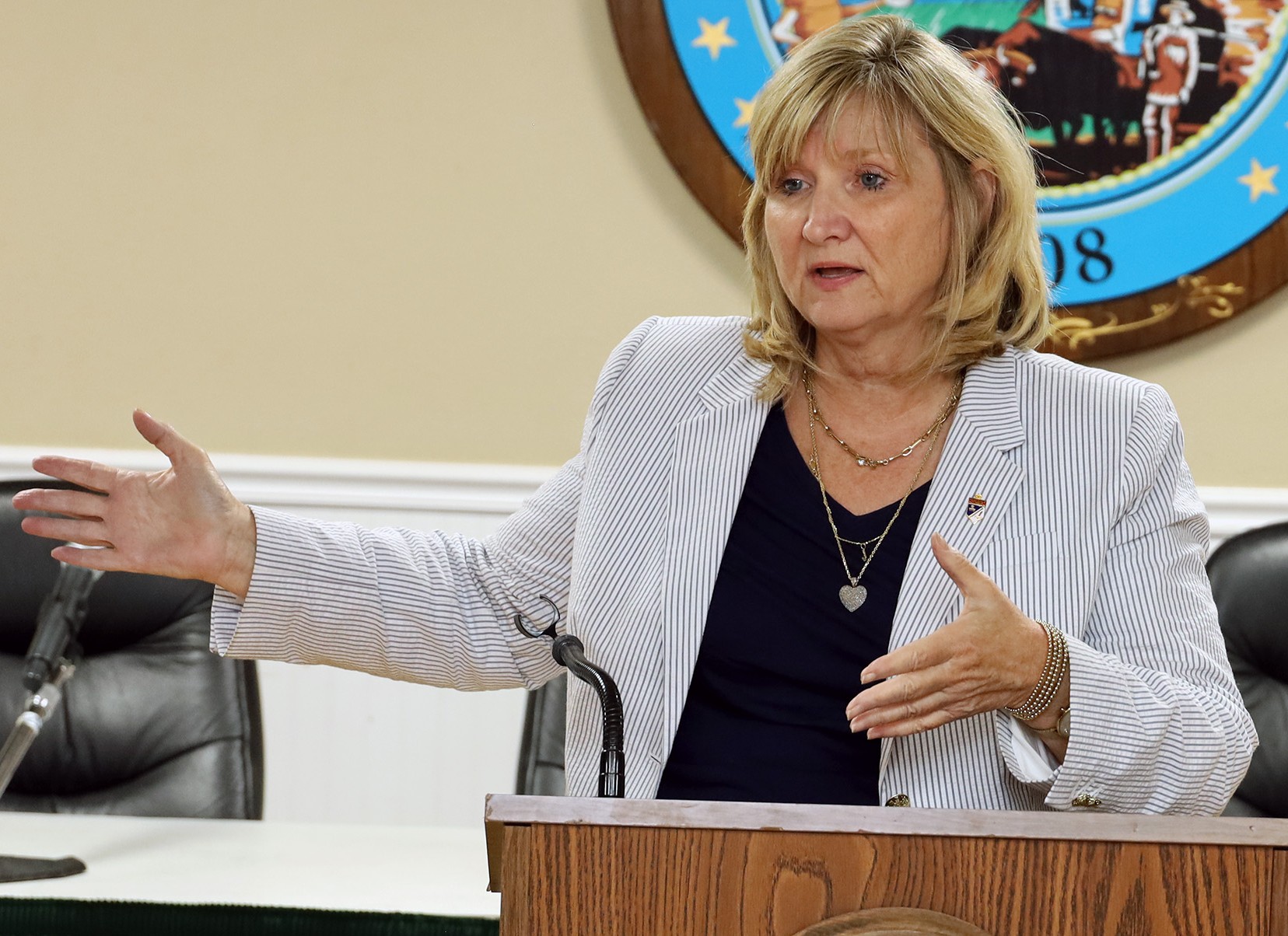
Jaime Asbury, General Manager, Imperial Irrigation District
“I don’t look at the problems that we have here as things that can’t be solved,” she said. “There’s a solution for everything.”
Her presentation addressed one of the most consequential questions facing the eastern Coachella Valley: how to turn available land and development plans into homes and businesses when the electrical infrastructure serving them needs to catch up.
Asbury’s answer combined new investment with a more regional planning approach. Expand existing facilities where possible. Place new substations where they can accommodate additional growth. Work out financing with the communities and projects that need the capacity. And bring developers into the process early enough to identify what it will take to serve them.
The approach is already producing results in Indio, where the first of four major electrical projects has been completed. Other partnerships are advancing improvements in La Quinta, Coachella and the Thousand Palms area.
More Power Delivery Capacity for East Valley Development
A central distinction in Asbury’s presentation was the difference between access to electricity and the infrastructure needed to deliver it to a particular property.
“We have plenty of power,” she said, pushing back on the perception that IID simply has no electricity available for growth.
Asbury said roughly 3,000 megawatts of potential generation was in the interconnection process for IID’s high-voltage system. Those proposed resources represent options for future supply, rather than electricity already contracted and ready for every new development. Generators seeking a connection still need buyers for their output, and individual projects still need sufficient local delivery capacity.
That distinction matters for a region with large undeveloped parcels and widely varying infrastructure needs. A potential source of electricity does not, by itself, provide the transformers, distribution lines and connections required to energize a subdivision or commercial building.
Asbury said IID had reconsidered the region’s needs from a broader perspective, looking for opportunities to expand existing facilities rather than treating every development proposal as a separate substation problem.
“What can we do? What can we leverage?” she recalled the district asking.
Using an existing utility site can make permitting and construction more manageable. It also allows IID to add capacity where the underlying infrastructure is already in place, while reserving new substation development for locations that can support future expansion.
Indio Offers a Working Example
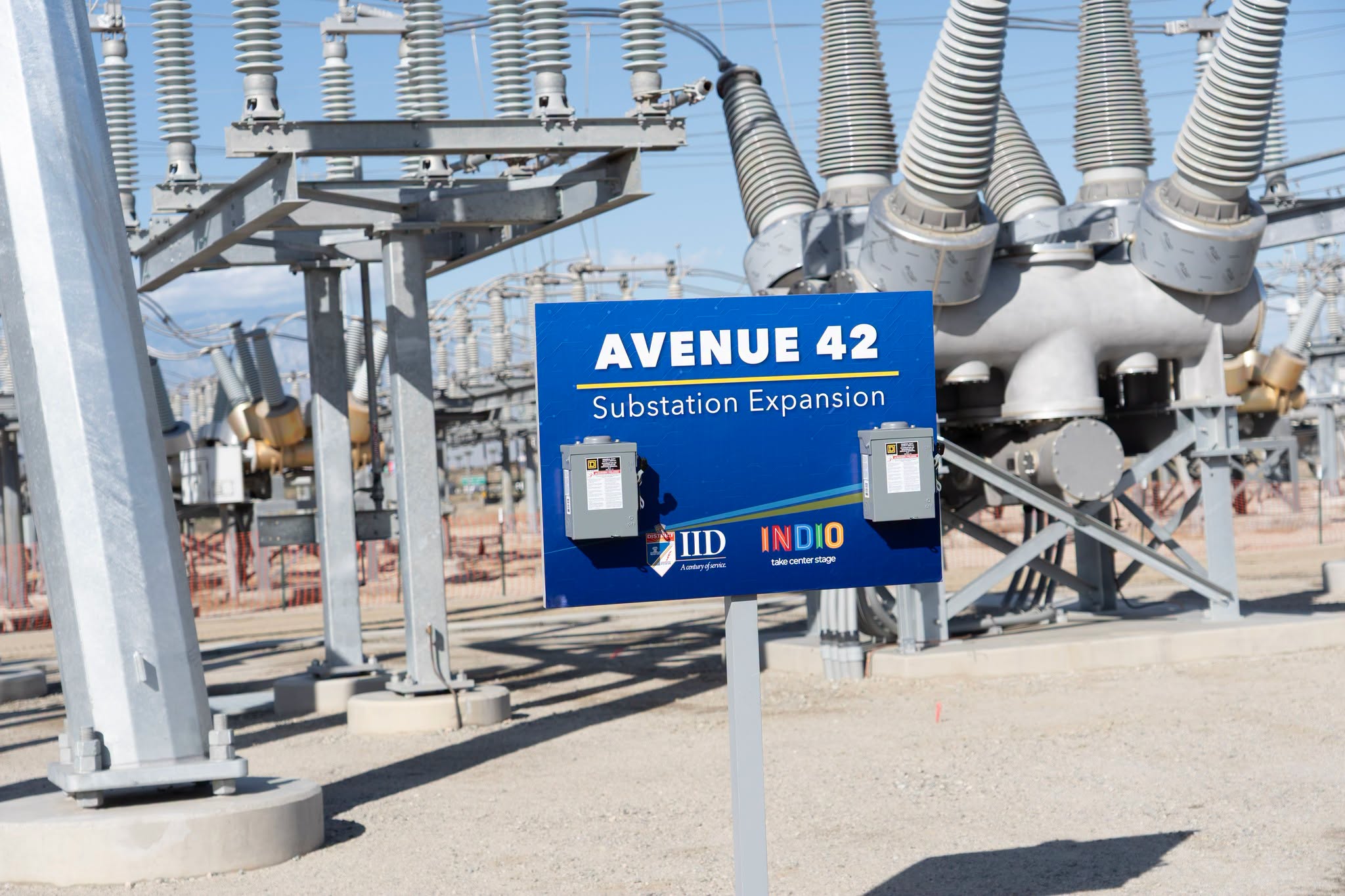
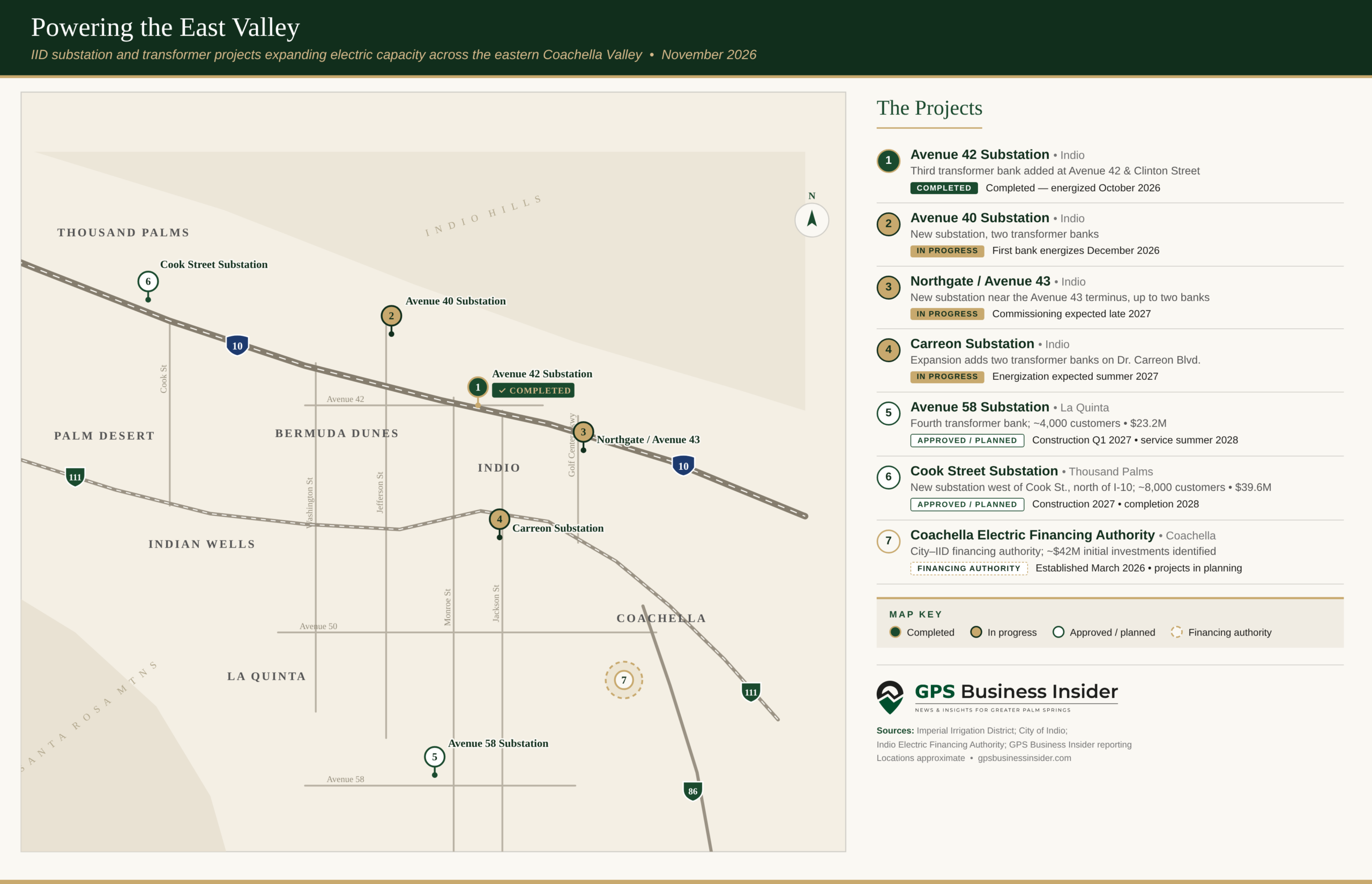
The most tangible evidence of that approach is in Indio, where the city and IID celebrated completion of the Avenue 42 Substation expansion on Oct. 20.
The project is the first of four planned through the Indio Electric Financing Authority, a partnership formed in 2023. Together, the improvements are designed to provide enough additional capacity for about 16,000 single-family homes, though the electricity can serve a mix of residential and business uses.
The remaining program includes a new Avenue 40 substation, an expansion of the Carreon substation and the Northgate/Avenue 43 project. Asbury cited the Indio partnership as an example of a community actively financing the infrastructure needed for its growth.
(Map of Indio’s IEFA substations here)
The financing authority spreads the cost of major improvements instead of leaving a single development to shoulder a substation’s entire expense. Indio’s infrastructure charge, collected on local IID bills, supports the financing. The utility remains responsible for its electrical facilities.
That model involves a local cost, but it also creates a practical path to build improvements that can serve multiple projects. Asbury credited local governments for helping IID find workable arrangements while considering the effect on customers elsewhere in its system.
La Quinta and Cook Street Projects Extend the Investment
The regional program reaches beyond Indio.
At the Avenue 58 Substation in La Quinta, IID has approved a fourth transformer bank intended to serve about 4,000 additional customers in the city and adjoining areas. The expansion was approved with an estimated cost of $23.2 million.
Twelve private developers are funding the project, with La Quinta and Riverside County providing financial backing to jumpstart it and cover any developer funding shortfall. IID’s published schedule anticipates construction beginning in the first quarter of 2027 and initial service connections by summer 2028.
Farther west, the planned Cook Street Substation in Thousand Palms brings together Palm Desert, Rancho Mirage, Riverside County, the Berger Foundation and private development interests. The estimated $39.6 million project is planned just west of Cook Street and north of Interstate 10.
(Map here)
IID’s published project description estimates capacity for approximately 8,000 residential and commercial customers. Partners’ funding shares reflect their capacity requirements, and the Berger Foundation is providing the site. The district’s published schedule calls for construction in 2027 and completion in 2028.
These projects illustrate how a broader group of beneficiaries can help move an expensive electrical improvement forward. The work also supports areas where development opportunities cross municipal boundaries, making cooperation between cities and the county particularly valuable.
In Coachella, IID and the city established the Coachella Electric Financing Authority in March. Initial infrastructure investments were estimated at approximately $42 million. The authority gives the partners a mechanism to finance electrical improvements through bonds and other financing arrangements, with projects identified jointly.
Equipment Costs Make Early Planning Essential
Asbury’s optimism came with a practical explanation of why electrical projects take time and why their costs have become harder to manage.
Some long-lead equipment, she said, now requires four or five years. In one procurement example, a five-month delay in resolving terms and conditions resulted in a 45 percent cost increase.
“Raw materials and equipment,” she said. “The lead times keep stretching, and the costs keep increasing.”
The implications extend beyond the substation itself. Developers may also need to fund the conduit and other facilities connecting their projects to the system. Asbury described arrangements in which an initial developer pays for shared infrastructure and receives reimbursements as later projects connect.
“You’re the first mover. You have to pay for all of it, but we will reimburse you as they start coming online,” she said.
Those arrangements require coordination over who needs capacity, when construction will occur and how costs will be recovered. Asbury said local governments have helped explore alternatives when the upfront expense would otherwise be prohibitive.
For builders, early discussions with IID can expose those requirements before financing and construction schedules are set around an assumed electrical connection date.
Securing Energy Supplies Alongside New Substations
IID is also adding supply resources to support reliability as demand grows.
Asbury pointed to geothermal purchases from BHE Renewables’ CalEnergy operations as part of that effort. IID’s published reports identify 86 megawatts under 10-year agreements, including 44 megawatts from “Salton Sea 4” and 42 megawatts from the Leathers facility. Deliveries are scheduled to begin Jan. 1, 2027.
The agreements provide renewable electricity around the clock, complementing resources whose output varies with weather and time of day. They also help IID meet California’s renewable energy requirements.
The district is also preparing to participate in Western electricity markets. Its energy-market modernization program targets participation in the Energy Imbalance Market and Extended Day-Ahead Market in 2028, supported by upgrades to control, communications, metering and energy-management systems.
Asbury described market participation as another opportunity to improve how IID buys and sells electricity and manages power costs. Any resulting savings would depend on actual market performance and the district’s costs.
Customers still face a scheduled rate increase. Under IID’s published rate plan, the residential base energy rate rises from 22.30 cents per kilowatt-hour in 2026 to 24.38 cents in 2027, with no further change to that base rate scheduled for 2028. Fixed charges and other applicable bill components are separate.
Asbury framed the investment decisions around IID’s obligation to recover the cost of providing service, maintaining its system and meeting regulatory requirements while planning for future demand.
What Developers Need to Bring to IID
For the builders in the room, Asbury’s most immediate advice concerned the information they provide and how consistently they stay in contact with the district.
A preliminary concept and an engineered project can have very different electrical requirements. IID needs accurate demand estimates and project details to determine whether existing facilities can serve a development or whether service must depend on an upgrade.
“We say yes, we can serve you, or we say we can serve you with conditions,” she said.
Those conditions can include completion of a substation expansion or other work. They affect project scheduling, so developers need to understand a service commitment in detail rather than treat it as a general assurance that power exists in the area.
Asbury also urged developers to keep IID informed when projects move slowly through approvals. In discussing service letters, she emphasized communication about a project’s status so the district can evaluate extensions and capacity needs as the system changes.
IID’s new-construction resources include its Developer Energy Planning Guide, proposal pricing information and project contacts. Developers can initiate requests through the district’s Customer Project Application Portal.
Asbury invited builders to raise unresolved service and communication problems directly with her, acknowledging that the process does not always work as smoothly as intended.
“You are what drives growth and development,” she told the audience.

Bob Marra is the CEO/Publisher of GPS Business Insider and GPS Market Intel. He has been studying, writing and giving presentations about business, economic and public affairs news and issues and the local economy in the Greater Palm Springs/Coachella Valley region for more than 20 years.