A new transformer at the Avenue 42 Substation adds power for about 2,500 homes. Three more projects financed through a city and utility partnership aim to raise that to 16,000 by late 2027.
For years, the obstacle to growth on the east end of the Coachella Valley has not been a shortage of electricity. It has been a shortage of substations and wires to deliver it.
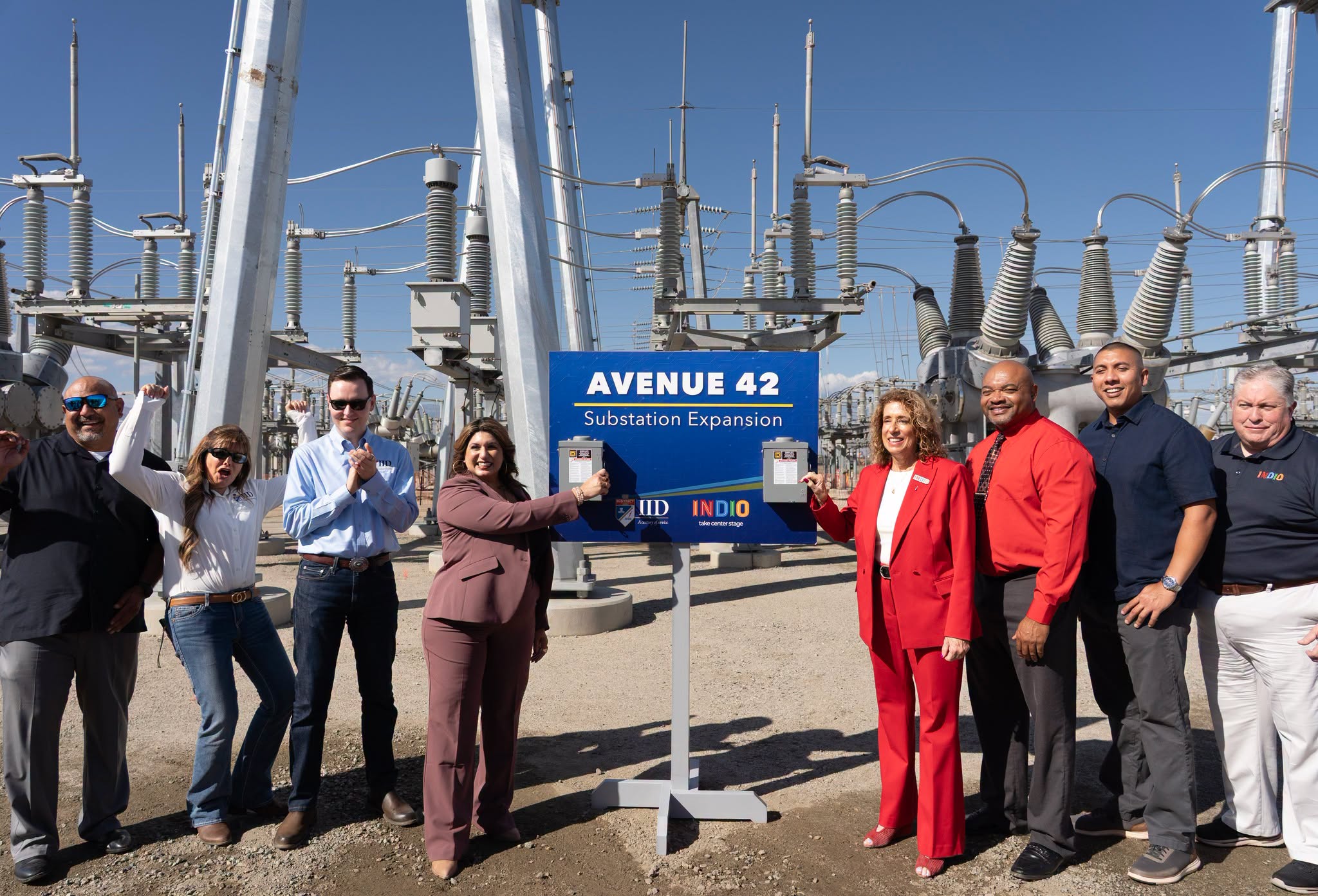
On Tuesday, the City of Indio and the Imperial Irrigation District took a major step toward closing that gap inside city limits, energizing a third transformer bank at the Avenue 42 Substation in north Indio. The 28 megavolt-ampere (MVA) addition provides enough capacity to serve about 2,500 new homes.
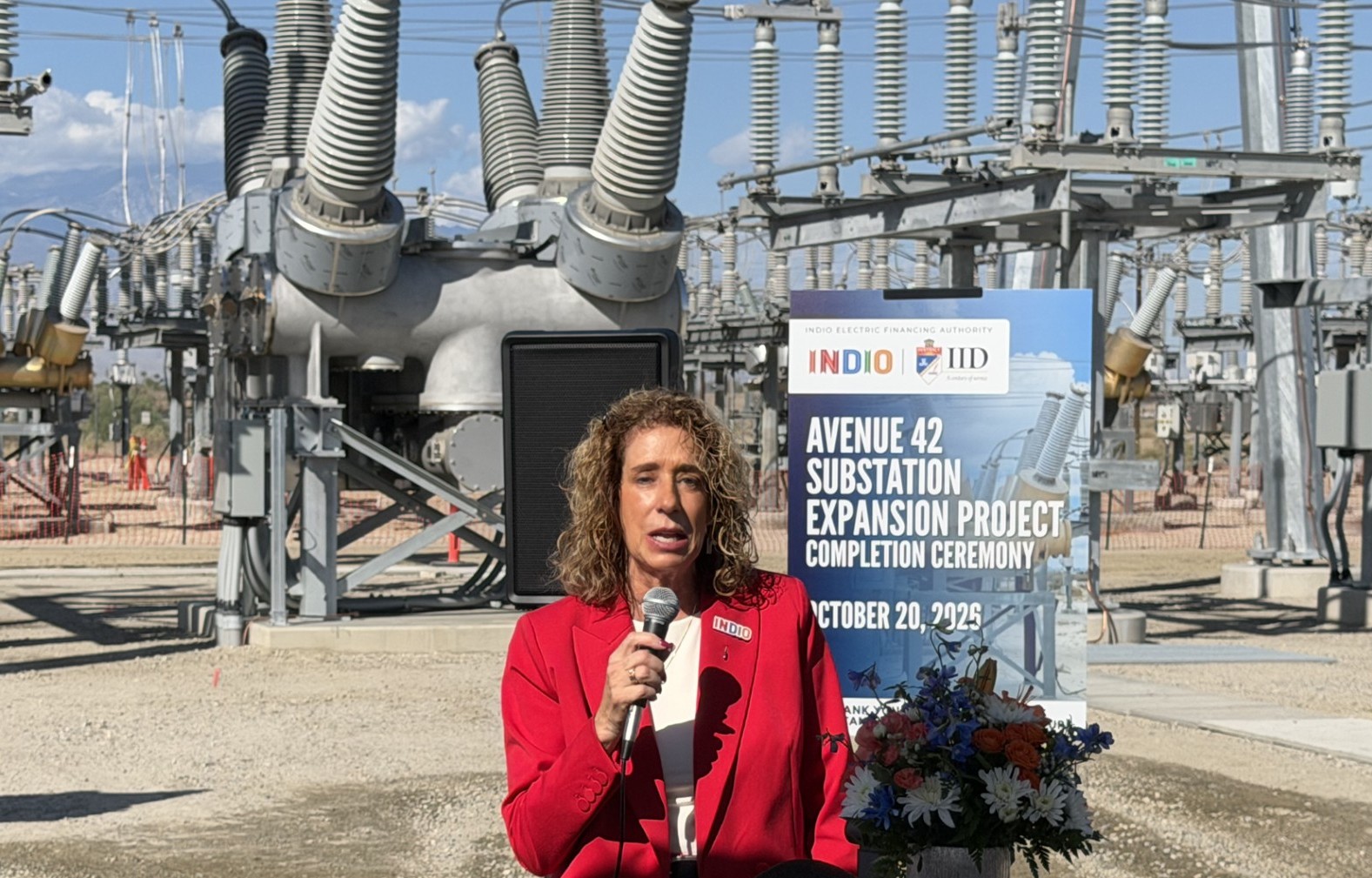
Indio mayor Elaine Holmes discusses the Avenue 42 power substation updgrade.
The Avenue 42 Substation expansion is the first of four projects planned through the Indio Electric Financing Authority, the joint powers authority the city and the utility formed in 2023. Together, the four projects are expected to add roughly 157 MVA, enough for the equivalent of about 16,000 single-family homes, by the end of 2027.
“While a substation may not be as visible as a new park, road or building, the investment we’re celebrating today is just as important, if not more so,” Mayor Elaine Holmes told a crowd of city and district officials. “It is what helps make all those other investments possible.”
There was no ribbon. “Traditionally, we celebrate the completion of a major project with a ribbon cutting,” said Maria Aliotti, Indio’s new assistant city manager, who emceed the event 15 days into the job. “But when you’re celebrating a project that’s all about power, we thought it was only fitting to do something a little different.” Members of the Indio City Council and the IID Board of Directors instead gathered at a ceremonial light switch to mark what Ms. Aliotti called “flipping the switch on Indio’s future.”
What the Avenue 42 Substation Expansion Delivers
Construction began after a joint groundbreaking on Jan. 6. Crews installed the new 28 MVA transformer, expanded the station’s transmission and distribution capacity, added voltage regulation and switchgear, and laid new conduit. The project was budgeted at about $12.1 million when the IID board approved the partnership agreements in 2023; recent public statements by city officials put the final tally at roughly $25 million. Henkels & McCoy served as the project contractor.
The finish line moved. In January, officials targeted completion by late August. The switch was thrown in October, and IID power department manager Matt Smelser, who opened the speaking program, didn’t elaborate on the reason. “We had a lot of issues, supply chain, etc.,” he said, “but we came together and got this done.”
That is no small caveat in the utility business. IID officials told regional leaders in 2025 that lead times for large power transformers were running 16 to 19 months, which has since stretched far beyond that, prompting the district to begin ordering equipment before projects are fully approved.
Ms. Holmes framed the upgrade as much a business decision as an engineering one. “Every new business, every housing development and community facility depends on reliable infrastructure,” she said. “By investing in the electrical capacity today, we’re helping to remove barriers to future development and creating a stronger foundation for economic growth.”
How the Indio Electric Financing Authority Pays for New Power
The Indio Electric Financing Authority, or IEFA, is the financial engine behind all four projects. The IID board voted in June 2023 to create the joint powers authority with the city, and later that year unanimously approved the agreements covering the four substations.
The structure is built around a principle IID General Manager Jamie Asbury summarized in 2023 as “growth pays for growth.” Indio assesses an infrastructure fee on IID electric customers within the city, which IID collects through its regular billing. That revenue backs bonds issued by the authority to build the projects. City reports say the charge works out to roughly $11 per household per month and is designed to keep the district’s base rate unchanged for its broader customer base.
The Indio City Council serves as the authority’s board, but the utility retains control. IID handles procurement, design, engineering, construction, operation and maintenance up to the point of connection, and every project requires approval by the IID board.
Ms. Holmes credited her colleagues on the dais. “It was this city council that had the vision and made the decision to establish the Indio Electric Financing Authority in partnership with IID,” she said.
Three More IEFA Substation Projects Are in the Pipeline
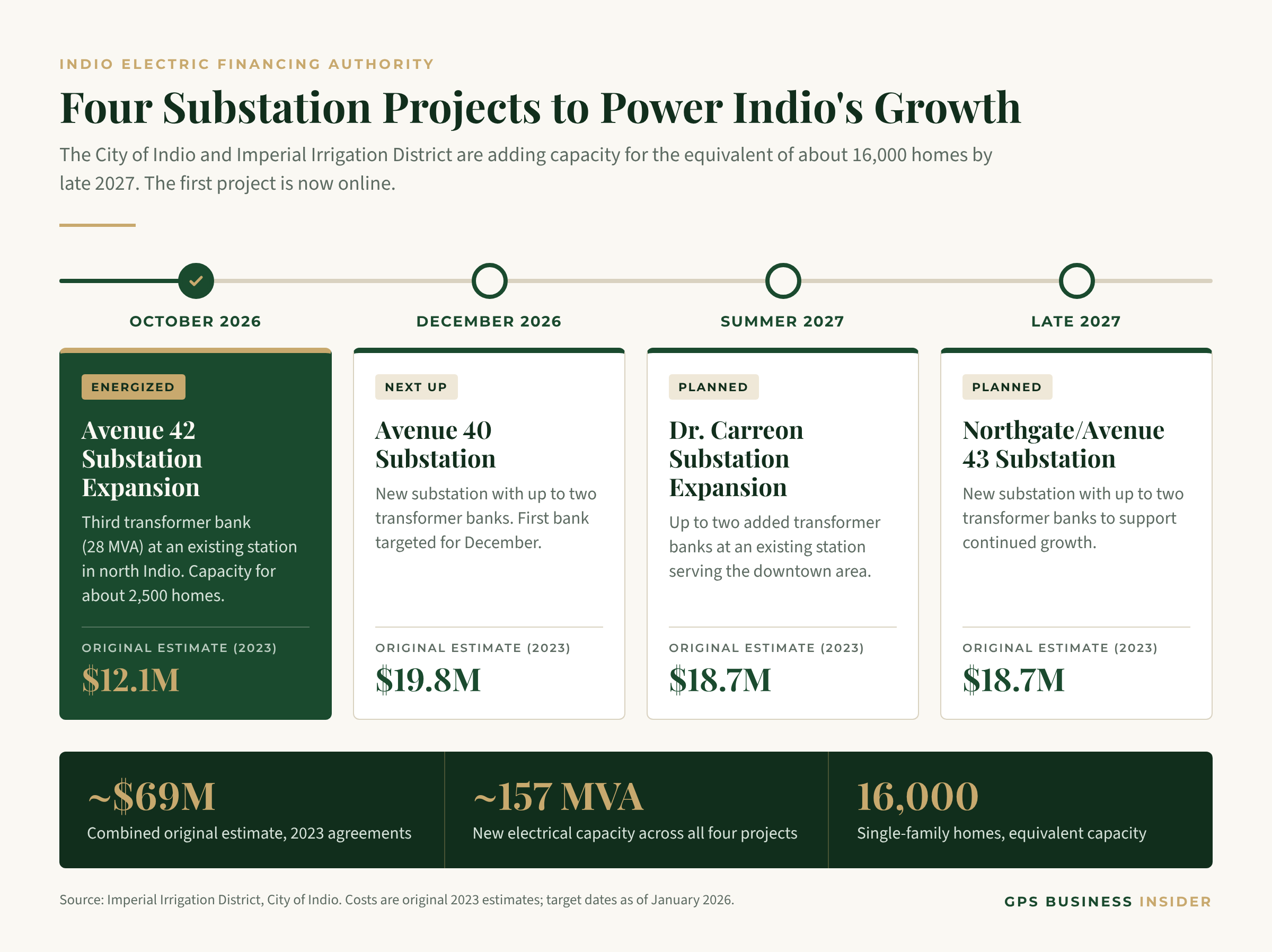
The remaining three projects are spread so that, in the mayor’s words, they “essentially will blanket or cover the entire city.” The schedule below reflects targets IID and the city released at the January groundbreaking, along with cost estimates from the 2023 agreements.
Combined, the four projects carried an estimated price of about $69 million in the 2023 agreements. IID officials said at the ceremony that the next completion celebration should come “in the near future,” and the Avenue 40 Substation is next in line.
The Carreon expansion matters especially for downtown Indio, where the city has courted restaurants, residential projects and mixed-use development. Ms. Holmes said the upgrade will “further strengthen” infrastructure “particularly in the downtown area.”
Why Grid Capacity Became the Coachella Valley’s Growth Bottleneck
Indio’s partnership is one answer to a constraint that has stalled projects across the eastern valley. IID has told developers and cities that the limit is grid and wire capacity, not the supply of power on the market. Much of the district’s Coachella Valley capacity was built between 2003 and 2009 and is nearing its ceiling, and the utility holds about 20 percent of capacity in reserve for reliability.
The cost of fixing that has landed on individual builders. Developers east of Washington Street have faced bills in the tens of millions of dollars to fund new substations, an amount few single projects can carry. IID has identified about $1.5 billion in upgrades needed across its territory to meet expected demand.
“Infrastructure is what solves the issues we’re dealing with today,” Ms. Asbury said in 2025.
Other cities are now following variations of Indio’s model. In May 2025, IID and the city of Coachella formed the Coachella Valley Power Agency, a joint powers authority administered during startup by the Coachella Valley Association of Governments. Under the agency, cities can submit upgrade proposals, and IID must respond within 60 days.
In November 2025, the IID board approved two more substation projects: the $39.6 million Cook Street Substation in unincorporated Thousand Palms, funded by Palm Desert, Rancho Mirage, Riverside County, the H.N. and Frances Berger Foundation and developers, and a $23.2 million expansion of the Avenue 58 Substation in La Quinta, paid for by 12 developers. Construction is expected to begin in 2027, with both in service by summer 2028.
IID’s $3 Billion Infrastructure Plan Across Two Valleys
Ms. Eugenio placed the Indio projects inside a larger capital program the district calls Powering Our Community Together. IID is advancing more than 270 planned infrastructure projects, representing more than $3 billion in investment over the next 15 years across its service area in both the Imperial and Coachella valleys.
The work ranges from capacity to replacement. In September, IID committed $23.5 million to replace aging transformers at the Monroe and La Quinta substations and the Coachella Switching Station, with the new units expected online in 2028 and 2029. The district is also moving ahead with a $36.7 million grid modernization project, supported by $18.3 million in federal funding, that consolidates core grid operations into a single platform.
“Our goal is not simply to keep pace with the growth, but to stay ahead of it,” Eugenio said. She said partnerships with Indio, neighboring cities and the county are “helping us identify creative financing solutions, coordinate infrastructure development, and ensure that as our communities grow, we are planning responsibly while protecting the interests of our existing customers.”
The long view comes with a deadline. IID serves the Coachella Valley under a 99-year agreement with the Coachella Valley Water District that dates to 1934 and expires in 2033, a horizon that hangs over every long-lived asset the district builds in Riverside County.
IID directors Alex Cardenas and Gina Dockstader, and Vice Chair JB Hamby, joined Karin Eugenio at the event, along with representatives for Assemblymember Jeff Gonzalez and State Senator Steve Padilla.
GPS Business Insider continues to track power capacity and its effect on development across the Coachella Valley. For data on housing, commercial development and growth across Greater Palm Springs, visit GPS Market Intel.

Bob Marra is the CEO/Publisher of GPS Business Insider and GPS Market Intel. He has been studying, writing and giving presentations about business, economic and public affairs news and issues and the local economy in the Greater Palm Springs/Coachella Valley region for more than 20 years.