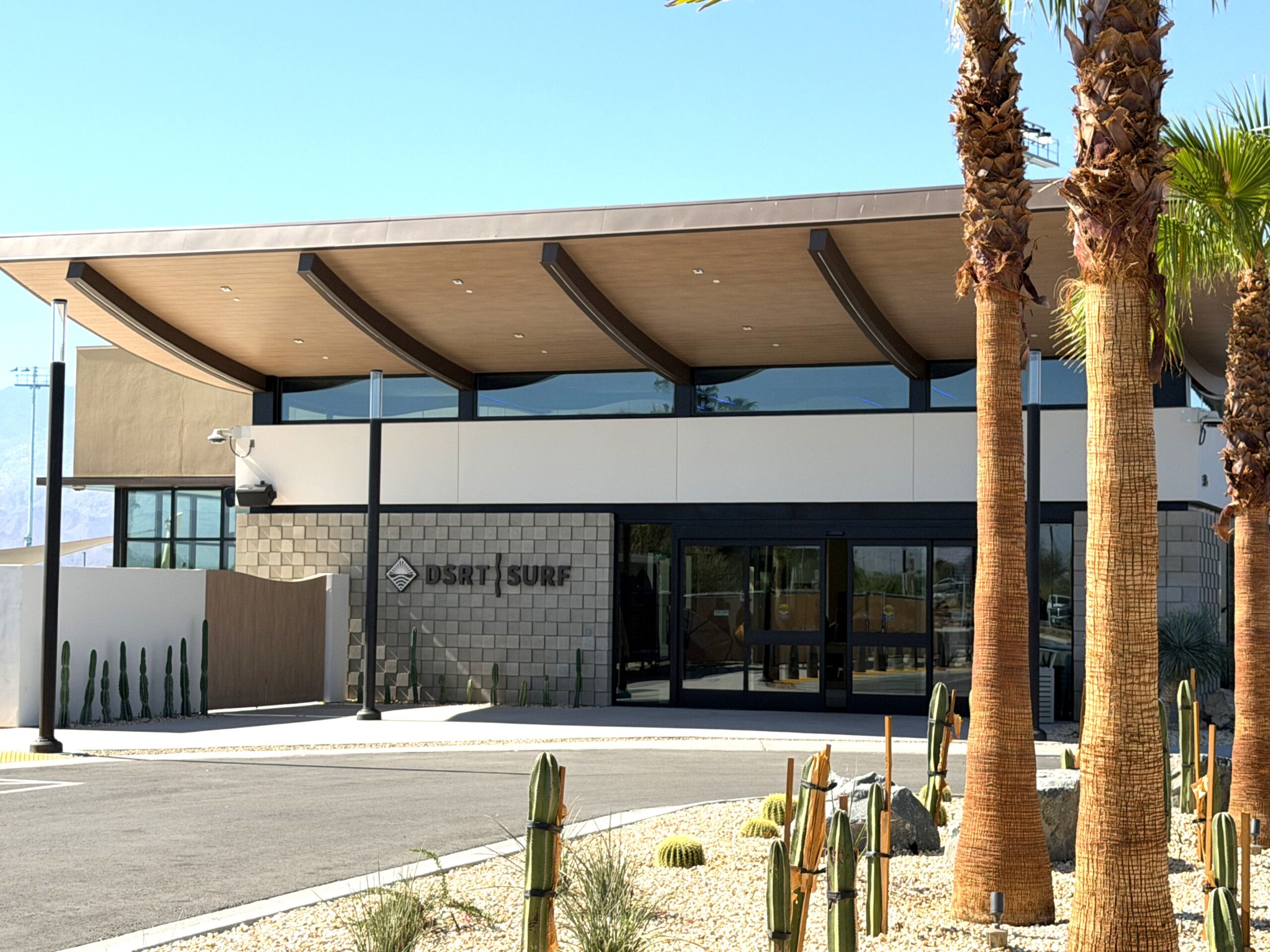
Amazon is officially up and running in Desert Hot Springs after a ribbon-cutting event and tour of its new logistics facility on Feb. 25, a launch local leaders hailed as a long-awaited economic shot in the arm for the city.
Inside the building, the operation looks like the modern Amazon machine: long runs of conveyor belts, constant motion, and a tight choreography of scanners, pallets and forklifts. The company calls the site an “Inbound Cross Dock,” designed to receive and consolidate goods before sending bulk shipments out to Amazon’s broader fulfillment center network – a step Amazon describes as part of its “middle mile.”
In less aggrandized, less corporate-speak words, products will be picked up by trucks at the ports of Long Beach and Los Angeles, driven past the existing 750 million square feet of oversaturated warehouse space in western Riverside County to the Desert Hot Springs warehouse, sorted as needed, loaded onto other trucks, and delivered to fulfillment centers in other regions.

City officials and Amazon leaders say the facility is already employing more than 1,500 workers and expects to surpass 2,000 as hiring finishes. Desert Hot Springs Mayor Scott Matas, speaking during the event, said locating jobs in a city where he says more than 10,000 people leave daily to work elsewhere in the region is a win for the city.
But the celebration comes with a big asterisk: the facility that opened is dramatically different from what Amazon and the city initially entitled, and the economic impacts will be minuscule by comparison. Consider also the daily truck trips and the extreme acceleration in the use of robotics and AI in warehousing, and one must wonder whether this warehouse is worth the net of it all.
From “one of the largest warehouses in the U.S.” to a cross-dock
In March 2022, Desert Hot Springs’ planning commission approved a massive, multi-story e-commerce warehouse proposal by Seefried Industrial Properties – a project described at City Hall and in local reporting as one of the largest distribution centers in the country.
Public reporting and city discussions around that original entitlement repeatedly framed the project as a fulfillment center-scale play: roughly 3.4 million square feet and about 105 feet tall, the kind of building that would have stood among the largest industrial facilities in California.
That is not what ultimately opened.
The building now open is about 635,000 square feet, which is still enormous, but only about one-fifth of the size discussed in early approvals. In raw terms, it’s a reduction of roughly 2.8 million square feet from what the public first heard, an approximately 80% cut in overall square footage.
Amazon has attributed the change to shifting “economic conditions,” and Desert Hot Springs approved an amendment to downsize the project.
Why the difference matters: “middle mile” isn’t a fulfillment center
To many residents, a warehouse is a warehouse. But in Amazon’s logistics world, the distinction between a fulfillment center and a middle-mile operation is the difference between where orders are officially cited for taxable sales purposes (a portion of which a city receives) and where freight is moved, and the city gets no revenue based on the products that are rerouted.
Amazon’s promotional materials describe fulfillment centers as their largest facility type, requiring the most employees to run core departments such as inbound, outbound, pick, pack, stow, and inventory control. By contrast, Amazon describes sortation-style facilities,” where goods arrive and are sorted for onward movement through the network.
That operational difference shows up in the economic math cities care about most: the long-term mix of jobs, the scale of management and support roles, and – most sensitive in Desert Hot Springs – the fiscal impact of point-of-sale taxation.

Desert Hot Springs Mayor Scott Matas
In a 2024 leaked internal community engagement plan for Southern California that was widely publicized at the time, Amazon public affairs staff explicitly noted that the Desert Hot Springs project “pivoted away from the original entitled fulfillment center project,” adding that the original plan “would have generated significant income into their general fund.” The document says the company’s strategy included “earning trust with the mayor as the downsized “middle mile” opening moved forward.
That internal acknowledgement aligns with what Matas has said publicly about the disappointment of losing the larger fiscal upside, which was once estimated at roughly $20 million per year. The cross-dock will yield property tax, a positive for the city, but a very small fraction of what was envisioned at the outset.
Speaking with KESQ in late 2024, Matas described the original promise as potentially “life changing” for city finances, pointing to Beaumont as an example of how a large fulfillment operation can transform a municipal budget. “If you tripled our budget… the things we could do with it would be incredible,” he said, adding that while the change was disappointing, the scaled-down project still meant real jobs for residents.
The jobs are real. The early expectations were bigger.
At the ribbon-cutting event, Amazon’s site leader said the Desert Hot Springs cross-dock will distribute inventory to 40 fulfillment centers across the company’s network and that roughly 70 trucks will arrive per day, a level of activity that city staff and Amazon said they have been planning around.
In the near term, that throughput can translate into steady employment for a city that has long chased a larger commercial tax base. Even critics of the project have tended to separate two questions: whether 1,500 to 2,000 jobs are valuable (they are), and whether this outcome matches the scale of what the public was initially sold (it does not).
The new facility’s hiring numbers, touted as climbing past 2,000 at full capacity, also create an unusual comparison: the original 2022 reporting cited about 1,800 full-time jobs for the enormous project then under review. But how many jobs will vanish as the technology of robotic automation and AI accelerates?
That does not automatically mean the economic impact is equivalent. A fulfillment center’s job ladder, department breadth, and the scale of supervisory and specialized roles can differ from a cross-dock operation, and Desert Hot Springs’ leadership has consistently emphasized that the revenue side of the equation was the more consequential loss.
The politics behind the pivot
The shift has also become part of the region’s warehouse politics, a flashpoint where land-use approvals, labor debates, and local budgets collide.
KESQ reported in December 2023 that Mayor Matas reacted to being mentioned in a leaked Amazon memo discussing the company’s public relations and community engagement strategy in Southern California. Matas told the station he wasn’t surprised corporations discuss community engagement but noted that winning support in Desert Hot Springs would require convincing the full council, not just the mayor.
Amazon, in that same internal planning document, framed the Desert Hot Springs opening as an effort to “earn trust” after the company moved away from the originally entitled fulfillment center – a rare instance where the company’s internal political calculus mirrors the public debate over what changed and why.
Amazon’s official, publicly stated reason for changing the facility’s configuration and scope was a change in “economic conditions” without elaborating. Many are questioning exactly what economic conditions have changed so drastically as to alter the plan so significantly in such a short time.
What comes next
For Desert Hot Springs, the opening is both a win and a reminder.
It is a win because a major employer has arrived, hiring is underway, and the facility appears poised to provide thousands of paychecks that, hopefully, will be sustained in Greater Palm Springs.
It is a reminder because the city’s most optimistic early scenario – the huge fulfillment center footprint that first drove entitlement and public excitement – is not what ultimately got built. Not even close.

Bob Marra is the CEO/Publisher of GPS Business Insider and GPS Market Intel. He has been studying, writing and giving presentations about business, economic and public affairs news and issues and the local economy in the Greater Palm Springs/Coachella Valley region for more than 20 years.