The long-planned project will replace a flood-prone crossing and strengthen a transportation corridor increasingly important to residential, commercial and industrial growth in the eastern Coachella Valley.
One of Coachella’s largest transportation projects is moving into construction, with the city awarding a nearly $49 million contract to replace the Avenue 50 low-water crossing with a permanent bridge.
The overall project is expected to cost about $61.5 million, including construction management and related expenses. Groundbreaking is scheduled for Oct. 15.
For Coachella, however, the significance of the project extends beyond replacing a roadway that can be disrupted when stormwater moves through the Coachella Valley Stormwater Channel.
The bridge is part of a broader effort to transform Avenue 50 into a more reliable and higher-capacity east-west transportation corridor as development continues across the city.
The Coachella City Council awarded the construction contract to Riverside Construction Company, a Southern California heavy civil contractor. Seven firms submitted bids for the project.
The contract award moves a project that has been discussed, designed and funded over many years into its most important phase: construction.
Replacing a vulnerable crossing
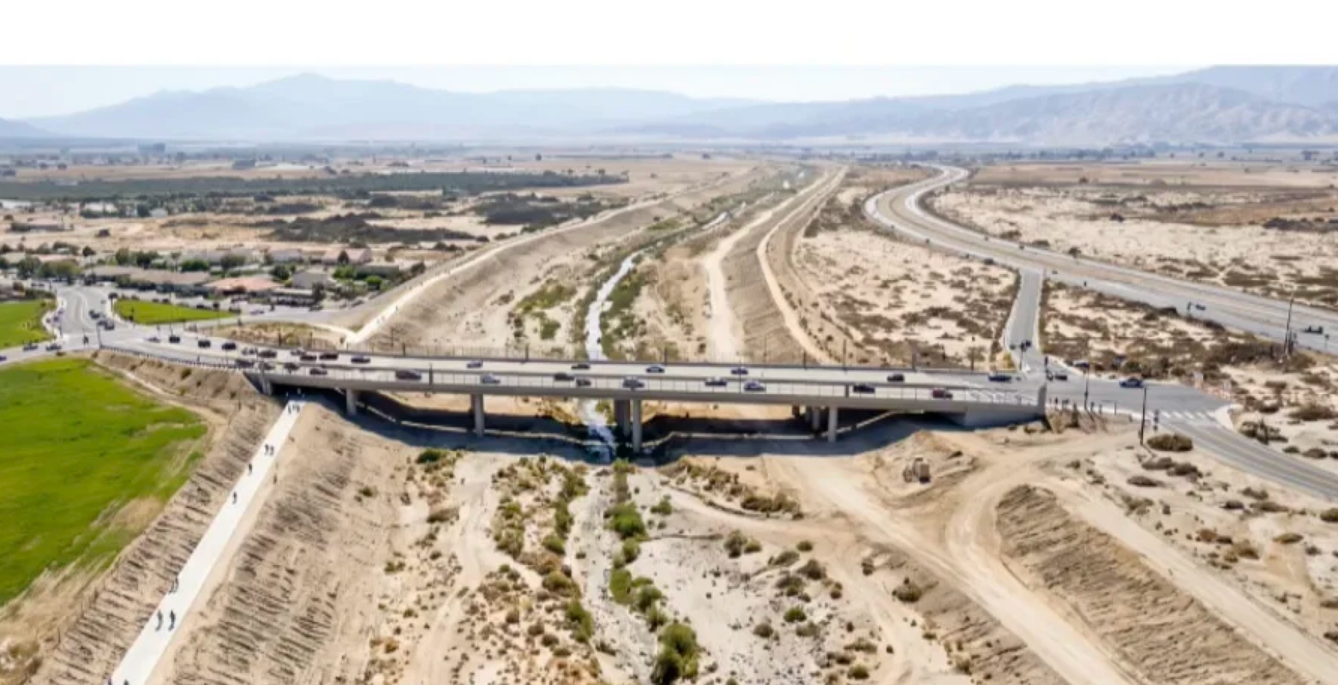
The existing Avenue 50 crossing runs through the stormwater channel and can become impassable during significant storm events.
The new bridge will eliminate that vulnerability and provide dependable year-round access across the channel.
The project calls for construction of a five-span bridge, along with roadway improvements on Avenue 50 and Tyler Street, a new traffic signal and utility work. A portion of CV Link, the regional bicycle, pedestrian and low-speed electric vehicle pathway, will also be reconstructed through the project area.
City officials expect bridge construction to take roughly two years.
The existing low-water crossing is expected to remain available through much of that period because the new bridge will be built on a shifted alignment, limiting what otherwise could have been a major disruption to local traffic.
The project is particularly important because Avenue 50 is becoming more consequential as Coachella grows.
The road provides access through areas where residential development is expanding and where additional commercial and industrial activity is planned or underway. Improving the corridor affects not only daily traffic but also access to employment areas, development sites and regional transportation routes.
That makes the bridge as much an economic-development project as a transportation improvement.
A larger Avenue 50 strategy
The bridge is one piece of a broader series of improvements that Coachella is advancing along Avenue 50.
The city is also pursuing widening improvements between Oates Lane and Tyler Street. City officials have discussed coordinating that work with bridge construction so the projects can eventually function as a continuous upgraded roadway rather than separate infrastructure investments.
Farther east, Coachella is advancing design work for a future interchange connecting Avenue 50 with State Route 86.
The interchange is not part of the bridge project and construction funding has not yet been secured. But the city has funding to advance its design, positioning the project to compete for future state, federal or regional transportation dollars.
If ultimately built, the interchange would create a more direct, grade-separated connection between Avenue 50 and one of the eastern Coachella Valley’s principal north-south transportation routes.
Taken together, the bridge, roadway widening and potential Highway 86 interchange illustrate how Coachella is trying to build transportation infrastructure ahead of continued growth.
Avenue 50 already connects established neighborhoods, agricultural land, employment areas and development sites. As additional housing and commercial projects are built, the road’s role as a cross-city corridor is likely to become more important.
The bridge removes one of the corridor’s most obvious physical limitations.
A major outside funding package
The size of the project also illustrates how cities increasingly rely on multiple sources of transportation funding to deliver major infrastructure.
Much of the Avenue 50 bridge cost is being covered through the federal Highway Bridge Program administered in California by Caltrans.
Approximately $49 million is associated with bridge-program funding, according to city information.
Another roughly $9.5 million is coming through the Coachella Valley Association of Governments, with additional local transportation and water-related funds accumulated for the project.
The financing structure allowed Coachella to assemble a project of a scale that would be difficult for the city to fund on its own.
It also demonstrates the long lead time involved in major public infrastructure.
The bridge has been in development for more than a decade, moving through environmental review, engineering, right-of-way work, utility coordination and funding approvals before reaching construction.
Federal bridge funding authorization dates back to 2014.
By the time a project of this scale reaches the construction stage, much of the work has already occurred outside public view.
The contract award changes that.
Residents and businesses will now begin to see the physical results of years of planning and funding work.
Infrastructure following growth
Coachella’s population and development footprint have expanded substantially over the past two decades, and much of the city’s future growth potential lies in areas where roads, utilities and other infrastructure must continue to catch up.
That dynamic is particularly important in the eastern Coachella Valley, where large undeveloped parcels remain available for residential, commercial and industrial development.
Transportation capacity can directly affect the economics of those sites.
Developers and employers consider roadway access, travel times, freight movement, utility capacity and connections to regional highways when evaluating locations. Public agencies similarly have to consider how emergency services, transit and everyday traffic will function as new neighborhoods and employment centers are added.
The Avenue 50 project addresses several of those issues at once.
It provides reliable passage over the stormwater channel, increases roadway capacity and improves a route that could eventually connect more directly with Highway 86.
It also fits with Coachella’s broader investment in infrastructure intended to support growth rather than wait for congestion and access problems to become more severe.
The City of Coachella has been pursuing several large infrastructure initiatives at the same time, including roadway, water, wastewater and electrical-system projects needed to accommodate development.
That makes the Avenue 50 bridge part of a larger story about how the city is preparing for its next phase of growth.
Construction now becomes the story
The city formally solicited bids for the project this summer, with bidding closing Sept. 3.
The competitive process produced seven bids before Riverside Construction Company was selected.
The construction contract represents approximately $48.7 million of the project’s total cost, with the balance covering construction management, contingencies and related expenses.
The bridge itself will be built while related improvements are coordinated around it, including roadway realignment, utilities and CV Link.
For businesses and property owners along the corridor, the construction period will bring temporary inconvenience but also a clearer picture of what Avenue 50 is becoming.
The road is gradually being repositioned from a largely local route interrupted by a flood-prone crossing into a more dependable east-west arterial serving one of Coachella’s primary growth areas.
Groundbreaking on Oct. 15 will mark the point when that transformation becomes visible.