The proposed Highway 86 development could generate an estimated 740 jobs, but its long-term entitlements, fee protections and planned IID substation still await City Council review.
A plan to turn a vacant stretch of land along Highway 86 into one of Coachella’s larger new employment centers will have to wait for a City Council decision.
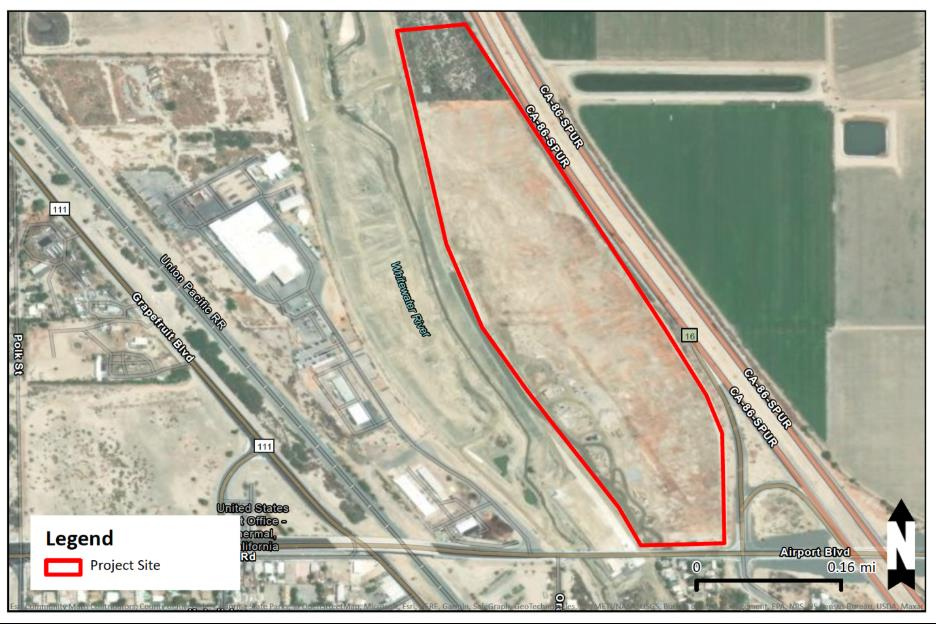
The proposed business park site occupies vacant land between Highway 86 and the Coachella Valley Stormwater Channel, immediately north of Airport Boulevard. (City of Coachella)
The proposed Coachella Airport Business Park would occupy 42.69 acres at the northwest corner of Airport Boulevard and State Route 86, with approximately 625,000 square feet of warehouses, small-business space, storage facilities and roadside commercial uses. City planners estimate the project could support about 740 jobs, although no specific tenants have been identified.
The City of Coachella had placed the project on its Oct. 14 City Council agenda for consideration, when council members were to weigh its environmental impact report, zoning changes, development agreement and other entitlements. The council pulled the item from the agenda for consideration at a future meeting. The council has not approved those requested land-use actions.
That delay leaves a consequential development proposal in a familiar position: advanced enough to have detailed site plans and a favorable Planning Commission recommendation, but still short of the approvals needed to move toward construction.
Planning Commission Backed the Coachella Business Park in May
On May 6, Coachella’s Planning Commission voted 3-1 to recommend approval of the project. The vote forwarded the proposed land-use approvals and development agreement to the City Council rather than granting final approval. Commissioners also left additional discussion of labor union participation and community outreach to the council’s discretion.
The applicant is Empire Airport LLC, associated with Los Angeles-based Haagen Company, which has marketed the property as a mixed-use industrial and commercial development. The concept dates back several years. Coachella’s publicly posted development inventory still lists an older project size, while the October council staff report contains the latest proposed building program.
What the 625,000-Square-Foot Project Would Include
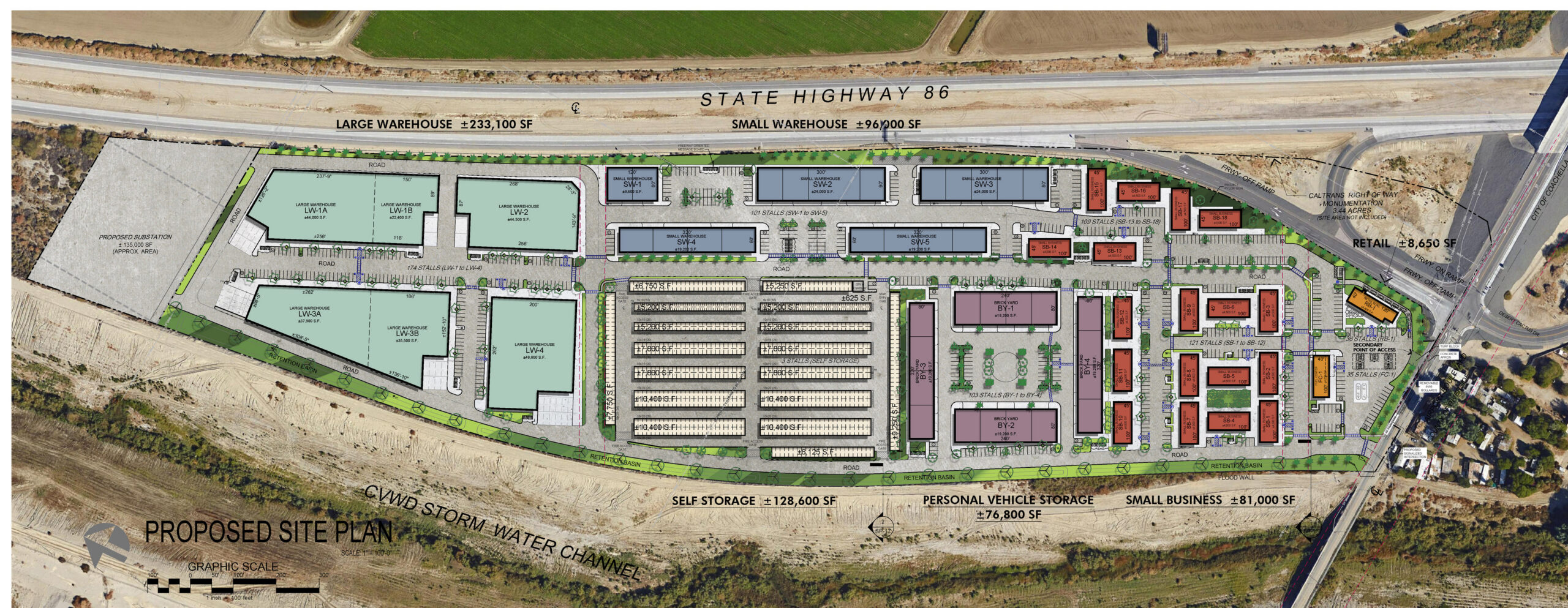
The master plan would divide the site into eight parcels, with the possibility of condominium-style ownership of individual buildings. Its largest component is warehouse space: approximately 233,100 square feet in six larger buildings and another 96,000 square feet in five smaller buildings.
The plan also calls for 81,000 square feet of office and small-business space in 18 buildings, 128,600 square feet of self-storage, and 76,800 square feet for personal-vehicle storage. At the south end, a 4,000-square-foot convenience store and service station with 12 fuel pumps would sit near a 4,650-square-foot retail or drive-through restaurant building.
The largest warehouses would occupy the northern portion of the property, while smaller business spaces and customer-oriented services would be closer to Airport Boulevard. A signalized main entrance off Airport Boulevard would connect to an internal loop road serving the buildings. The proposal includes 682 parking spaces.
The requested approvals would also permit commercial cannabis businesses in the development’s manufacturing-service portion. No cannabis operator is identified, and any future occupants would remain subject to applicable licensing, indoor-operation and odor-control requirements.
A Development Agreement Could Protect Approvals for 20 Years
One of the most important documents for consideration is a proposed development agreement that gives the developer enough time to complete a project that could be built in stages over many years.
The agreement provides an initial 10-year term. It could extend another 10 years if the developer obtains permits and begins specified Phase 1 infrastructure improvements, including site grading, during the first term. The project’s subdivision map, conditional-use permits and architectural approvals would generally remain effective during the agreement’s term.
That is a substantial period of regulatory certainty for a project without announced tenants. It could make long-range investment and marketing easier, but it would also lock in key land-use rights well before the city could verify the full economic benefits, including the projected jobs.
A related zoning change would replace the property’s heavy-industrial designation with manufacturing-service zoning across most of the site and general-commercial zoning on roughly 2.2 acres near Airport Boulevard. City planners say the change better fits the scale and appearance of the proposed business park and the city’s development plans for the corridor.
Electric Power and a New IID Substation Are Part of the Plan
The project’s electrical infrastructure could have implications beyond its property lines. The developer proposes to make available about 5.6 acres it owns immediately north of the business park for a potential new Imperial Irrigation District substation. The environmental study examined a roughly four-acre substation footprint within that land.
The proposed agreement would require the developer to pay its fair share of the new facility’s costs, with provisions for potential cost sharing or reimbursement from other parties that benefit from its capacity. The documents do not establish that IID has funded or scheduled construction of the substation.
The distinction matters in an eastern Coachella Valley where new substations increasingly depend on joint financing. As GPS Business Insider previously reported, Coachella and IID have been pursuing financing mechanisms for other electric-system expansions. The Airport Business Park substation is a separate proposed facility, and the project documents do not demonstrate that those broader financing arrangements will pay for it.
Development Fees, Road Improvements and City Revenue
Under the proposed agreement, the city’s existing development-impact fee rates would be frozen for five years. A provision in the draft agreement could produce an additional five-year freeze tied to the commencement of Phase 1 vertical construction, with rates established under the terms of that extension. The agreement also contemplates possible credits for eligible public improvements.
The developer would be responsible for improvements along its side of Airport Boulevard, including the road approach and a new traffic signal at the primary entrance. The project is also designed to accommodate the city and Riverside County’s planned improvements to the nearby Airport Boulevard bridge.
The city expects property and sales taxes, construction-related fees and a share of advertising revenue from a proposed electronic billboard facing Highway 86. It would also receive free advertising time on the sign.