For months, city of Coachella officials and their private partner pitched the city’s municipal power plan as a once-in-a-generation infrastructure play, a way to solve long-running electric constraints in the city’s eastern growth areas while creating a new revenue stream for City Hall.
Lately, that vision has been colliding with an angry public, a rattled council, and a basic political question that was easy to overlook when the agreement was approved in February: What happens if the city decides it no longer wants to go forward?
That question moved to the center of Coachella politics on May 27, when the City Council, after hours of public criticism over a proposed data center campus tied to the municipal utility effort, voted to retain outside legal counsel to review the development agreement it had signed with Stronghold Power Systems. The move came as council members also signaled support for a moratorium on data centers, capping a meeting that ran late into the night and made clear that the project now faces a level of resistance city leaders can no longer wave away as background noise.
The shift was striking because only a few months ago, the Stronghold agreement was presented as a milestone in the city’s effort to create a limited municipal electric utility. The arrangement gave Stronghold, through an affiliate, the role of turnkey provider for the Coachella Municipal Utility, handling the design, permitting, financing, construction, operation and maintenance of infrastructure for an east-side development zone. City officials retained oversight, billing and rate-setting authority.
At the time, the utility was framed as a solution to a chronic local problem. Coachella has long argued that eastern greenfield areas have struggled to attract the necessary electric infrastructure under the existing system tied to Imperial Irrigation District (IID), especially where new substations and distribution lines would have to be built before large-scale residential, commercial or industrial growth could occur. The municipal utility was supposed to offer a different path.
But what became increasingly clear, both in city materials and in public presentations, was that the first serious customer for that utility would not be housing or small-business growth. It would be a massive, proposed data center complex.
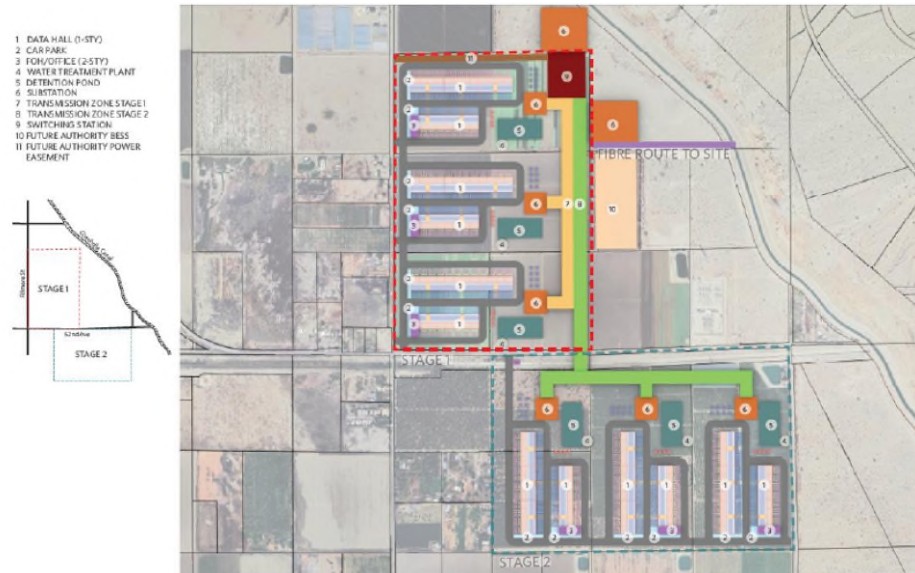
That project, known as the Coachella Valley Technology Campus, is planned for 240 acres in its first phase near Avenue 52 and Fillmore Street. City documents and project materials describe six data center buildings, nearly one million square feet of development and as much as 300 megawatts of electric demand, along with three large microgrids powered by fuel cells, battery storage and related infrastructure. In plain terms, it is the kind of power-hungry project that can anchor an entire utility buildout.
That is also what turned a technical infrastructure agreement into a political flashpoint.
In recent weeks, Coachella residents and organizers from across the eastern valley have mounted an increasingly visible campaign against the proposed data center project, arguing that the city moved too far, too fast, without giving the public a clear understanding of what was being contemplated. At a town hall earlier this month, residents pressed city officials and Stronghold representatives with questions about water, air quality, backup generation, farmland, noise, public health, tax benefits and the broader logic of tying the city’s energy future to a hyperscale computing campus.
Those concerns only intensified by the time the council met on May 27. Hundreds of people gathered outside City Hall. Dozens addressed the council directly. For roughly five hours, speaker after speaker described a sense of betrayal, saying the agreement may have been approved as part of a municipal utility plan, but that the real-world consequence was to open the door to one of the largest data center proposals ever floated in the region and Southern California.
For some residents, the issue was environmental. Coachella and the wider eastern valley already live with water insecurity, extreme heat, air quality concerns and infrastructure stress. For others, the issue was democratic. They argued that the city entered into a complicated public-private partnership before the public had a full picture of what Stronghold’s development plans entailed, who the eventual data center users might be, or what demands the project could place on local resources.
There was also growing frustration over the city’s public messaging. Officials repeatedly emphasized that no data center had yet been approved and that environmental review still lies ahead. Critics countered that the distinction, while legally important, missed the bigger point. In their view, the city had already committed itself to a development framework in a written agreement they approved, whose economics depend heavily on a giant data center campus going forward.
That is why the outside legal review matters.
Officially, the May 27 agenda item was framed as a third-party peer review of the municipal utility development agreement with Stronghold. On paper, that sounds narrow and procedural. Politically, it is much more than that. It reflects a council that now appears to be probing not just what the agreement says, but what room the city still has if it wants to slow the project, reshape it, or abandon it. At the same time, it’s a review that may indicate potential financial liability on the part of the city to Stronghold, with which it agreed to partner on the project.
The concern is not abstract. In a staff report, the city disclosed that Stronghold’s legal counsel sent a May 12 letter to Coachella expressing concern about the tone and substance of the public debate at the town hall and seeking written reassurance that the city intended to comply with the agreement. The report said Stronghold raised that concern in the context of ongoing expenditures it says it is making on the utility effort, including work related to interconnection with Imperial Irrigation District.
That letter changed the stakes.
It suggested that the city is no longer just managing public anger or a difficult land use fight. It is potentially navigating the early contours of a contractual dispute with the company it chose to implement one of the most ambitious infrastructure strategies in its recent history.
The council’s turn toward caution was matched by its turn toward politics. By the end of the May 27 meeting, all four council members had signaled support for a moratorium on data centers, and staff were directed to return with an emergency ordinance for possible consideration. The details remain to be worked out, but the message was unmistakable: a project once pitched as part of Coachella’s economic and infrastructure future has become a symbol of public overreach.
That political reversal did not happen in a vacuum. Opposition has grown beyond city residents alone. People from elsewhere in the valley have spoken out, especially because a possible second phase of the project has been discussed on county land outside the current city limits. Farmworker advocates and community groups have warned that eastern valley communities too often become test sites for projects that promise growth but leave local residents carrying the burdens. Even Riverside County Supervisor V. Manuel Perez, who had previously expressed support, later withdrew that backing as concerns mounted and the project’s review process came under greater scrutiny.
The city’s dilemma is now harder to hide. Coachella still has a genuine infrastructure problem to solve. Officials have long argued that power constraints in the eastern part of the city are real, that IID has not moved fast enough to support future growth, and that local control over utility development could become an important planning tool. None of that disappears because the public recoils from data centers.
Stronghold and its supporters still argue that the project could bring transformational revenue and help build a system capable of supporting future growth. Their case is that Coachella has an opportunity to leverage a major private investment to address a structural public need. In another political climate, that argument might have carried the day.
Right now, it is colliding with a different civic mood. Residents are asking why a city that says it wants more control over its future appears to have bound itself so tightly to a private development strategy before the public had weighed in. They are asking whether the promised benefits are real, whether the risks have been fully accounted for, and whether officials understood the scale of the backlash they were inviting.
Those questions are no longer coming from the margins. They are driving the city’s agenda.
What happens next will depend on more than environmental review or contractual analysis. It will depend on whether Coachella’s leaders decide the Stronghold agreement can still be salvaged, whether they believe it should be, and whether a municipal utility plan once sold as a path to local self-determination can survive becoming, in the public mind, a cautionary tale about how major projects get made.
For now, the council has done something important, even if belatedly. It has acknowledged that this is no longer just an energy strategy. It is a crisis of public confidence and one that could reshape not only the future of the proposed data center campus, but the city’s entire approach to growth, infrastructure and local control.

Bob Marra is the CEO/Publisher of GPS Business Insider. He has been studying, writing and giving presentations about business, economic and public affairs news and issues and the local economy in the Greater Palm Springs/Coachella Valley region for more than 20 years.