Coachella and Indio have approved temporary moratoriums, while IID is advancing a large-load tariff that could reshape the economics of data center development across the desert.
The Coachella Valley’s data center debate has moved with unusual speed from obscure infrastructure planning to the center of local politics, and the message now emerging from public agencies across the desert is difficult to miss.
This is no longer a fight over one project.
In less than two weeks, Coachella and Indio have each adopted 45-day moratoriums on new data center applications. Coachella went further, voting to terminate its agreement with Stronghold Power Systems, the company behind the proposed Coachella Valley Technology Campus. The Imperial Irrigation District, which supplies power to large portions of the eastern Coachella Valley and Imperial Valley, has moved separately to advance a new large-load tariff designed to keep the costs and risks of major electric users from being shifted to existing ratepayers.
Taken together, the actions amount to something larger than a pause. They look like the beginning of a regional doctrine.
The desert may have land. It may have sun. It may have transmission assets, development pressure and a growing need for new sources of public revenue. But local governments and utility officials are signaling that artificial intelligence infrastructure will not be treated as ordinary economic development simply because it arrives wrapped in the language of technology, investment and future-facing industry.
In Coachella, that shift was loud, public and unmistakable.
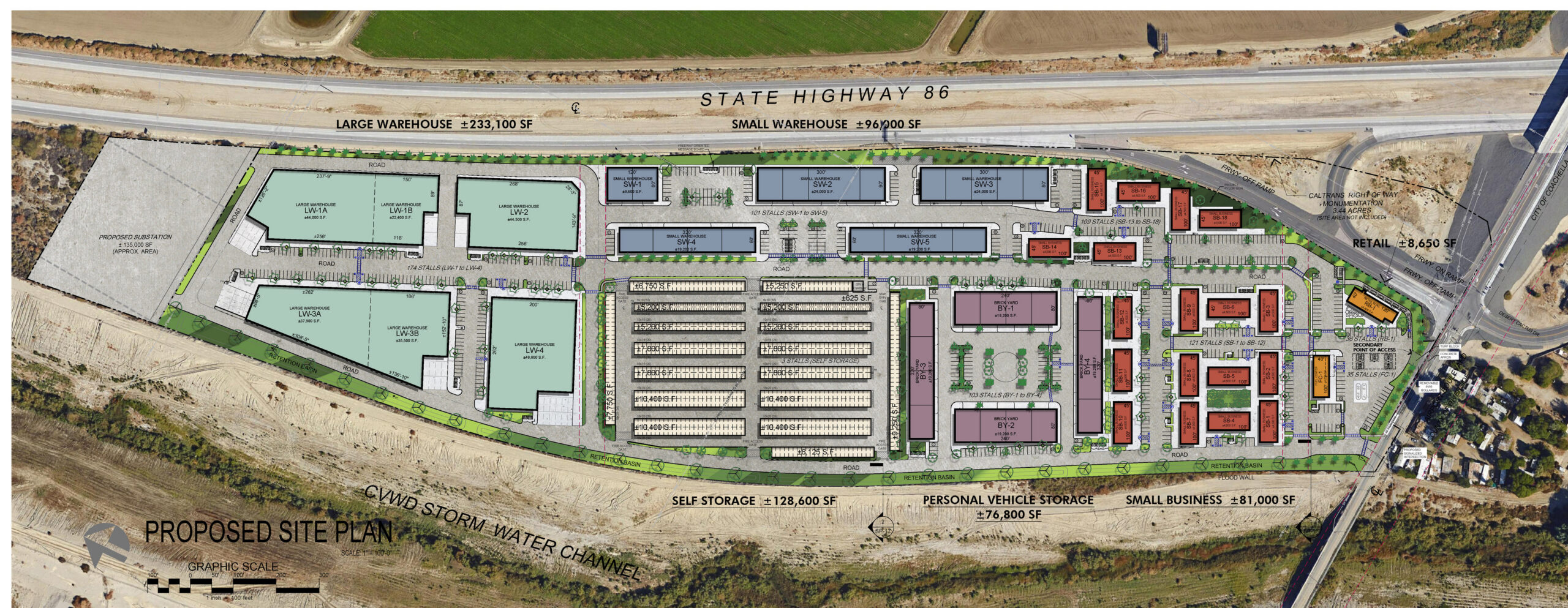
The City Council voted unanimously at a special meeting last week to impose a temporary moratorium on new data center applications and terminate its agreement with Stronghold Power Systems, ending, at least for now, the proposed technology campus that had become one of the most controversial development concepts in the Coachella Valley. The project had been described as a massive campus on the city’s east side, with facilities that could occupy hundreds of acres near Avenue 52 and Fillmore Street.
The council’s decision followed extreme backlash from residents who raised concerns about water use, electricity demand, air quality, public health, agricultural land, noise, heat and the broader question of whether a low-income, largely Latino community should be asked to absorb the burdens of infrastructure built to serve the global technology economy.
For many residents, the issue was not simply whether Stronghold could design a cleaner or more efficient facility. It was whether the city had moved too quickly toward a project whose scale and implications had not been fully explained to the people who would live with it.
A Reversal With Regional Consequences
Coachella’s action was especially striking because the city had only months earlier approved a Municipal Utility Development Agreement tied to the creation of a municipally owned electric utility. That strategy, which had been framed as a way to expand local control over power service and infrastructure, became inseparable in the public mind from the data center proposal.
Once that happened, the politics changed.
What might have remained a technical debate over utility formation, load service, interconnection, land use and fiscal benefits became a broader referendum on trust. Residents who felt blindsided by the size and ambition of the project began questioning not only the facility itself, but the process that allowed it to advance.
By the time hundreds of residents packed public meetings and protested outside City Hall, the council was no longer weighing a project in the abstract. It was deciding whether to preserve political credibility.
Mayor Frank Figueroa, who was appointed to the role this spring after the resignation of former Mayor Steven Hernandez, has framed the moratorium and termination as a course correction. Other council members acknowledged the depth of resident opposition and the need to move carefully, particularly given the likelihood that ending the Stronghold agreement could expose the city to litigation risk.
That risk is real. Development agreements, utility arrangements and termination actions can generate legal consequences, especially when a private partner believes it has spent time and money relying on city approvals. Stronghold has publicly expressed disappointment and said it would review its options.
A Public Counterargument Comes From Indian Wells
The public debate has not been one-sided.
In a recent opinion column in The Desert Sun, Indian Wells Mayor Toper Taylor offered a sharply different view, arguing that Coachella should not turn away a project he described as a rare opportunity for jobs, infrastructure investment, energy independence and major new tax revenue. His argument reflected the traditional economic development case for large infrastructure projects: if California communities reject them, the demand does not disappear. It simply moves to another city, another state or another market.
That is an argument worth taking seriously, because it captures the central tension in the data center debate. Artificial intelligence, cloud computing and digital infrastructure are now embedded in the modern economy. Those facilities have to exist somewhere. The question is not whether the digital world consumes physical resources. It does. The question is whether the benefits and burdens are fairly allocated when those facilities land in specific communities.
But Taylor’s column also revealed how combustible the issue has become across city lines.
At the Coachella meeting, at least two council members took publicly visible offense at the Indian Wells mayor weighing in on what Coachella should do. That kind of intercity admonition is not customary among elected officials in Greater Palm Springs, where mayors and council members frequently collaborate through regional bodies but generally avoid publicly weighing in on how another city should govern itself.
Figueroa pushed back particularly hard, saying Taylor had no business telling Coachella and its residents what was good for them. The mayor also objected to the framing of Coachella as a low-tax-base community that should accept a controversial project because it needs the money.
That exchange matters because it exposed a deeper regional fault line. In a valley where wealth, land use, labor, tourism, agriculture and public health burdens are unevenly distributed, data centers have become a proxy for a much older question: who gets to decide what kind of development belongs in the east valley?
For supporters of the project, Coachella may have walked away from a transformational investment with huge future cash flows attached. To many opponents, it was being asked to host a resource-intensive industrial campus serving a global technology economy while other cities looked on from a safer distance.
Both arguments are now part of the public record. But only one was backed by the crowd outside Coachella City Hall, chanting against the project.
Indio Moves Before A Project Arrives
Indio’s action was different, but perhaps more revealing.
Unlike Coachella, Indio officials said there are no active data center applications currently pending in the city. Yet the City Council still voted unanimously on June 3 to approve a 45-day urgency ordinance establishing a moratorium on new data center development applications.
That makes Indio’s move preventative rather than reactive.
City officials said the moratorium will give staff time to study the issue, conduct land use analysis, and evaluate policy options. Those options could include strict regulations, an extension of the moratorium, or a permanent prohibition on data center uses within city limits. The city has scheduled a Planning Commission review for June 24, followed by a City Council discussion on July 15.
In municipal terms, Indio is building a firewall before the spark lands.
That is significant because Indio is the valley’s largest city by population and one of its most important growth centers. It is also a city with substantial land use, infrastructure and economic development ambitions of its own. For Indio to pause data centers before any formal application arrives suggests the issue has already crossed from project controversy into a policy category.
The city is not saying every technology-related use is unwelcome. It is saying this particular use may require its own framework because its impacts do not fit neatly into the assumptions used for traditional industrial or commercial development.
A warehouse can be analyzed in terms of traffic, jobs, noise and land-use compatibility. A resort can be evaluated in terms of tourism, water demand, fiscal returns and neighborhood impacts. A data center, especially one designed for artificial intelligence workloads, presents a different matrix: immense electricity demand, cooling needs typically met with large volumes of water, backup generation, transmission upgrades, grid reliability concerns, potential ratepayer exposure and relatively limited permanent employment compared with its physical footprint and infrastructure load.
That mismatch is what has begun to alarm local agencies.
IID’s Quiet But Critical Role
While city councils have drawn the public’s attention, the Imperial Irrigation District may be taking the most structurally important action of all.
IID is not a land use agency. It does not decide whether Coachella, Indio, Imperial County or any other jurisdiction approves a project. But in a region where power availability is one of the defining constraints on growth, IID can shape the economics of data center development in ways that may be just as consequential as zoning.
In May, IID announced a proposed Large Load Tariff for public review and comment. The proposed tariff would apply to customers requesting 20 megawatts or more of electric demand with a proposed capacity factor greater than 85 percent. That threshold is aimed squarely at major, always-on electric users, including potential data centers and other high-demand industrial loads.
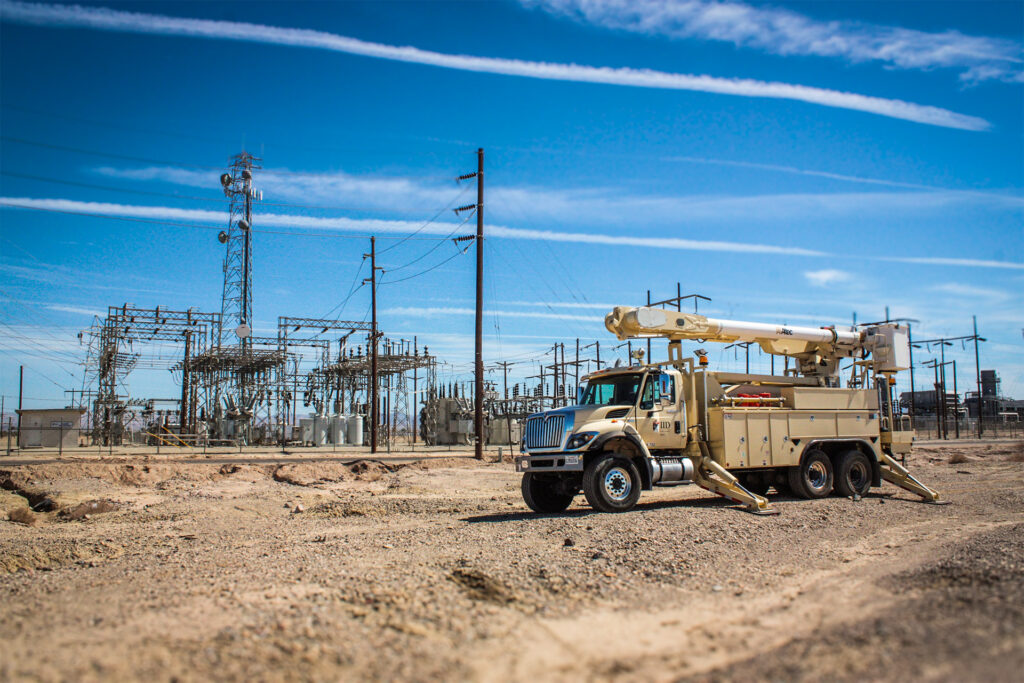
Eastern Coachella Valley residents have pressed city officials for answers about the potential impacts on water, land, air quality and power costs and capacity to serve proposed data centers.
The proposed tariff would require those customers to fund the infrastructure, power supply and system upgrades needed to serve them without shifting costs or risks to existing customers. It also contemplates study funding requirements, technical review, minimum demand and energy obligations, long-term service commitments, collateral requirements, customer reimbursement agreements, electric service agreements and special facilities agreements.
In plain English, IID is telling large-load developers: do not expect the public grid, or the existing rate base, to quietly absorb your business model.
That does not amount to a ban. IID has been careful to describe its approach as transparent and nondiscriminatory. The district’s responsibility is to evaluate whether large electric loads can be served safely and reliably, not to decide where projects should be built.
But the practical effect could be profound. A tariff that requires full cost recovery, collateral, long-term commitments and infrastructure funding changes the financial equation for speculative data center proposals. It forces developers to prove they are not just bringing investment, but also bringing the money, guarantees and operational commitments needed to avoid leaving the public with stranded costs.
That is especially important in the Imperial and Coachella valleys, where IID serves more than 166,000 customer meters and where summer reliability is not theoretical. Extreme heat already places heavy demands on the grid. Any new industrial load that runs continuously, especially at the scale of AI data centers, must be understood not as a single development project but as a regional utility-planning event.
IID has said it has received multiple large load proposals or inquiries at varying stages of evaluation. That helps explain why the district’s action matters. The Stronghold proposal may be the project that captured Coachella’s attention, but the market is clearly probing the broader desert region.
For data center developers, the attraction is obvious. The desert offers large parcels, industrially zoned land in some areas, proximity to renewable energy narratives and transmission infrastructure that appear attractive from a distance. But from the perspective of residents and public agencies, those same qualities can make the region vulnerable to a rush of projects before communities fully understand what they are being asked to host.
IID’s tariff proposal is a way of slowing that rush through economics rather than slogans.
The Desert Is Becoming A Test Case
The local backlash is unfolding as data centers face growing resistance across California and the country.
In Monterey Park, voters recently approved a measure permanently banning data centers citywide, making it one of the most forceful public rebukes of the industry to date. Elsewhere in Southern California, cities have adopted temporary moratoriums or are considering tighter rules. In Imperial County, a massive proposed data center has drawn opposition from residents, the City of Imperial and elected officials who argue that environmental review and public participation have been inadequate.
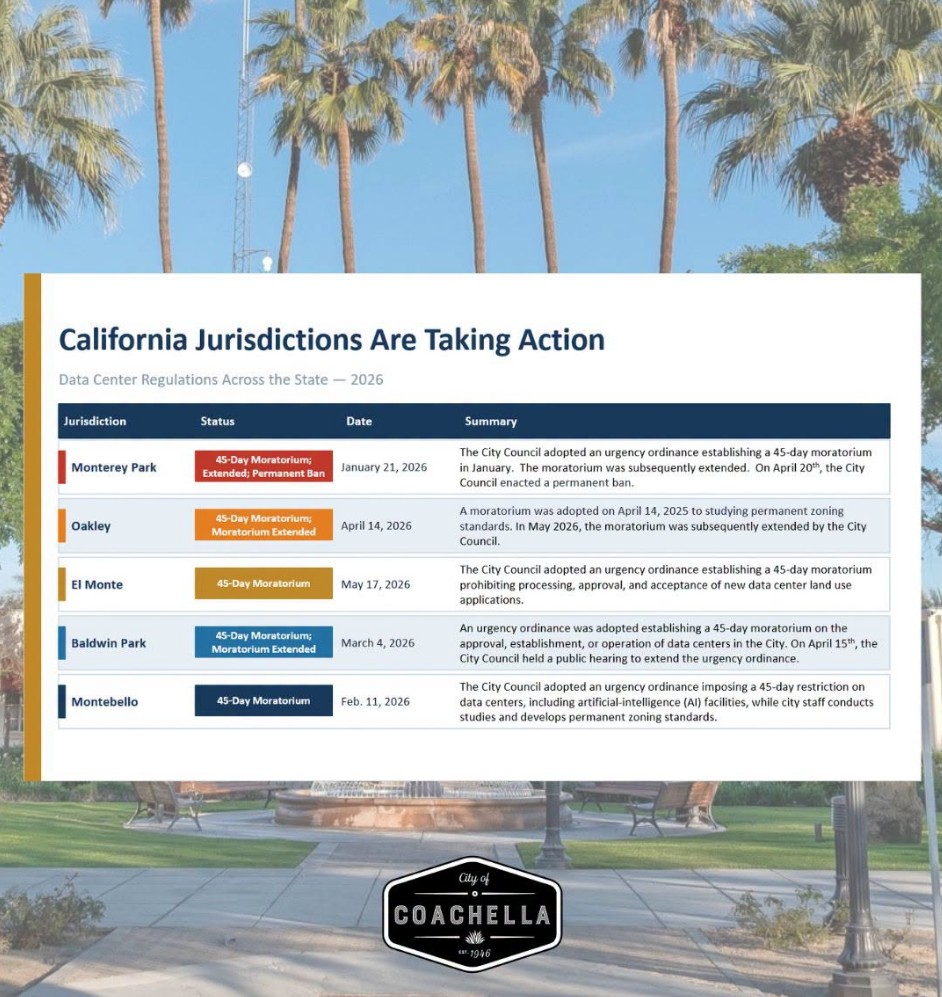
A city of Coachella social media post identifies other cities that have enacted moratoriums on data centers.
The pattern is clear. Communities that once might have viewed data centers as quiet, clean industrial users are now reassessing that assumption in the AI era.
Older data centers were often discussed as back-office infrastructure. The new generation is different. Artificial intelligence workloads have intensified the demand for computing power and with it the need for electricity, cooling, land and utility infrastructure. The facilities may employ fewer permanent workers than many residents expect, while placing enormous demands on public systems.
That is why the old economic development pitch is starting to fail.
For decades, cities in inland and desert California have been told that major projects should be welcomed because they expand the tax base, create construction jobs and signal investment. That argument still has power, particularly in communities seeking revenue and employment. But data centers complicate the calculation because their public costs are not always evident at the land-use hearing.
Who pays for substation upgrades? Who pays if load forecasts do not materialize? Who bears reliability risks during peak summer demand? What happens if a project requires backup generation? How much water is needed for cooling, and from what source? How close is too close to homes, schools or agricultural land? How many permanent jobs justify hundreds of acres of land and hundreds of megawatts of demand?
These are not anti-technology questions. They are governance questions.
The desert is now asking them earlier, more aggressively and in public.

Bob Marra is the CEO/Publisher of GPS Business Insider and GPS Market Intel. He has been studying, writing and giving presentations about business, economic and public affairs news and issues and the local economy in the Greater Palm Springs/Coachella Valley region for more than 20 years.