The first quarter is when the Greater Palm Springs economy is supposed to show its strength.
Seasonal residents are in town. Hotels and resorts are busy. Signature events fill calendars. Restaurants, shopping districts and auto dealerships benefit from some of the heaviest visitor traffic of the year.
Yet Retail and Food Services businesses across the region’s nine cities generated $1.892 billion in taxable sales during the first three months of 2026, down $15.3 million, or 0.8 percent, from the same period a year earlier.
The decline was modest. The message beneath it was not.
By comparison, Riverside County’s countywide Retail and Food Services total increased 3.2 percent during the same period. U.S. Retail and Food Services sales rose 3.7 percent. California’s experimental measure of store-based retail sales, which excludes nonstore retailers and restaurants, remained positive but slowed from 1.9 percent year-over-year growth in January to 1.0 percent in February and 0.9 percent in March.
The measures are not identical, but they point in the same direction: Greater Palm Springs entered 2026 with less momentum than the county, state and nation around it.
Nearly $1.9 billion in first-quarter sales is still formidable. But growth is no longer broad or evenly shared.
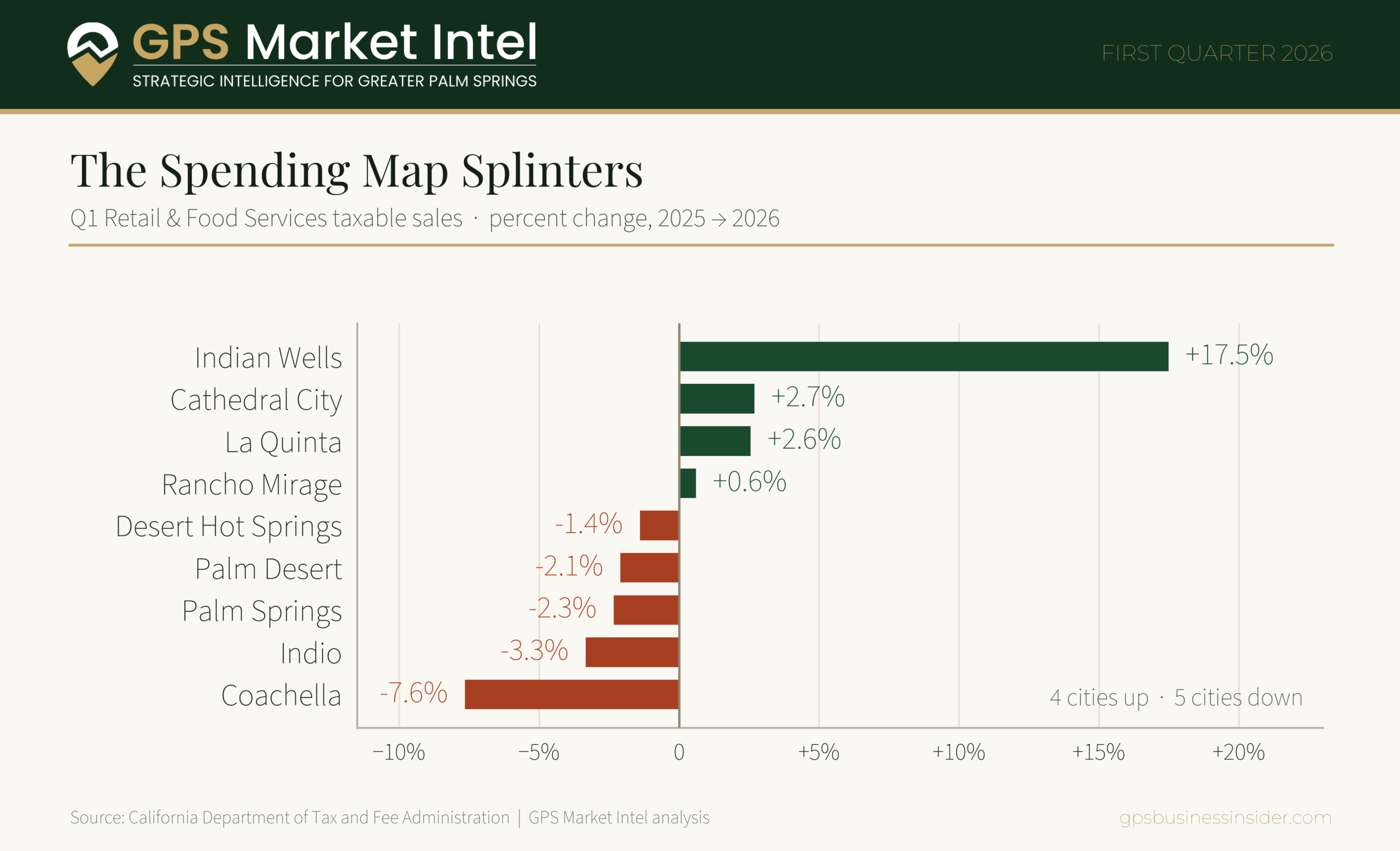
Four cities increased sales. Five declined. Auto dealers and clothing stores were bright spots in several markets. Indian Wells restaurants posted an extraordinary gain. But taxable sales at food and beverage stores fell sharply in many cities, home-related retail remained soft, and declines in Palm Desert, Palm Springs and Indio outweighed gains elsewhere.
Four cities gained, but the largest markets pulled the region lower
Indian Wells was the first quarter’s standout.
Retail and Food Services sales increased 17.5 percent to $45.1 million, adding $6.7 million from a year earlier. Food services and drinking places did most of the work, climbing 27.5 percent to $40.4 million.
For a resort city with a comparatively small retail base, strong restaurant, hotel and event activity can move the numbers dramatically. Dining accounted for nearly nine of every 10 taxable Retail and Food Services dollars reported in Indian Wells during the quarter.
Cathedral City increased 2.7 percent to nearly $238 million. Motor vehicle and parts dealers led the way, adding $10.5 million in sales, a 7.2 percent increase. That gain more than offset declines in food and beverage stores, gasoline stations and several smaller categories.
La Quinta posted one of the region’s most balanced performances. Sales rose 2.6 percent to $254.9 million, supported by gains in restaurants, general merchandise, apparel, food and beverage stores, home furnishings, building materials and other retail businesses.
Rancho Mirage edged up 0.6 percent to $127.5 million. Some category comparisons are limited because sales are withheld to protect taxpayer confidentiality and folded into broader groups, but the city’s overall total returned to slight growth after a much weaker 2025.
The five declining cities included the region’s three largest retail markets.
Coachella recorded the steepest percentage drop, falling 7.6 percent to $76 million. Indio declined 3.3 percent to $304.8 million. Palm Springs fell 2.3 percent to $342.2 million. Palm Desert slipped 2.1 percent to $456.9 million, and Desert Hot Springs declined 1.4 percent to $46.8 million.
The dollar losses in Indio, Palm Desert and Palm Springs were especially important. Together, the three cities generated about 58 percent of all nine-city Retail and Food Services sales during the quarter. Their combined decline exceeded $28 million, enough to pull the regional total lower despite gains in the other four cities.
Consumers did not stop spending. They became more selective.
Motor vehicle sales were a major source of strength.
In addition to Cathedral City’s 7.2 percent increase, motor vehicle and parts sales rose 8 percent in Coachella, 6.2 percent in Palm Desert, 4.9 percent in Indio and 4.5 percent in Palm Springs.
The gains mattered because dealerships generate unusually large taxable transactions. In Cathedral City, stronger vehicle sales effectively carried the entire Retail and Food Services sector. In Indio, auto dealers added $4.7 million even as the city’s overall retail total declined.
Apparel was another bright spot.
Clothing and clothing-accessory sales jumped 29 percent in Indio, increased 9.3 percent in Palm Springs and rose 6.9 percent in Cathedral City. La Quinta gained 3.7 percent and Palm Desert, which generated more than $77 million in apparel sales during the quarter, increased 2.6 percent.
The pattern broadly matched California and national trends, where clothing remained one of the stronger discretionary categories. It also suggests that destination shopping and fashion-oriented retail retained drawing power even as other forms of spending weakened.
General merchandise was mostly positive as well. Sales increased 7.7 percent in Coachella, 3.8 percent in Palm Springs, 2.8 percent in Indio, 2.6 percent in La Quinta and nearly 1 percent in Palm Desert.
The county benchmark showed the same split. Across Riverside County’s incorporated cities, vehicle sales increased 11.3 percent, apparel 11.9 percent, general merchandise 5.2 percent and dining 1.9 percent. Home furnishings fell 22.4 percent, food and beverage stores 17.2 percent, gasoline stations 6.9 percent and building materials 3 percent.
The first-quarter slowdown was not a universal loss of demand. The winners were concentrated in particular categories and locations.
Restaurants delivered both the biggest success and some of the clearest warning signs
No category better illustrated the divided market than dining.
Indian Wells restaurants and drinking places added $8.7 million in taxable sales, a 27.5 percent increase. La Quinta dining sales rose 4.4 percent, Indio increased 3.9 percent, and Coachella gained 1.7 percent.
But several of the region’s best-known dining markets moved in the opposite direction.
Restaurant and drinking-place sales declined 13.2 percent in Rancho Mirage, 2.3 percent in Palm Springs, and 1.1 percent in both Palm Desert and Cathedral City. Desert Hot Springs was nearly flat.
Palm Springs still generated the region’s largest dining total at $114.5 million, followed closely by Palm Desert at nearly $109 million. The concern is that both declined during the quarter that captures much of the region’s peak visitor season, while national restaurant sales were growing.
Event timing, hotel occupancy, openings, closures, pricing and changes at a few high-volume establishments can all affect quarterly results. Still, the split suggests that a strong tourism season no longer guarantees that every restaurant district will rise with it.
The sharpest declines require caution
The most dramatic negative category was food and beverage stores.
Taxable sales fell nearly 50 percent in Indio, 34.6 percent in Palm Springs, 20.7 percent in Coachella, 18.6 percent in Cathedral City and 15.3 percent in Palm Desert.
Those declines removed millions of dollars from several city totals. Indio alone lost $13.7 million in the category. Palm Springs lost $8.8 million and Palm Desert lost $4.7 million.
Yet the numbers should not be read as proof that residents suddenly bought far less food.
Many basic grocery products are not subject to California sales tax. The category measures taxable transactions, not total store revenue. The California Department of Tax and Fee Administration has also identified classification changes affecting parts of the retail sector, and large shifts can reflect reclassifications, openings, closures or reporting changes.
The broad downward pattern is still important, but the scale is too large to attribute automatically to consumer behavior alone.
Home-related retail offered a clearer economic signal.
Home furnishings and appliance sales declined 17.3 percent in Rancho Mirage, 14.4 percent in Palm Springs, 8.8 percent in Palm Desert, 5.8 percent in Desert Hot Springs and 4.5 percent in Indio.
Building material and garden-supply sales fell 12.2 percent in Indio, 6.5 percent in Cathedral City and about 3 percent in Palm Desert and Palm Springs. La Quinta was an exception, posting modest gains in both categories.
The weakness is consistent with a market still feeling the effects of higher borrowing costs, slower housing turnover and the fading of the pandemic-era home-improvement surge.
The first quarter extends a three-year cooling trend
Greater Palm Springs Retail and Food Services sales reached nearly $6.985 billion in 2025, down only 0.2 percent from 2024. That was a much smaller decline than in either of the two previous years, but it also meant the market had not returned to growth.
Cathedral City increased 4.4 percent. Indian Wells surged 32.8 percent to an all-time high. Indio rose 1.2 percent to a record $1.279 billion. La Quinta was essentially flat.
Palm Desert declined 2.4 percent but remained the region’s largest retail market at $1.654 billion. Palm Springs was nearly unchanged, while Coachella, Rancho Mirage and Desert Hot Springs each fell by roughly 5 percent.
The longer history provides perspective.
Regional Retail and Food Services sales totaled $5.010 billion in 2015. They grew steadily before the pandemic, fell 9.7 percent in 2020, then exploded upward by 31.1 percent in 2021 and another 9.9 percent in 2022.
That pushed sales to a record $7.415 billion.
The region has since posted three consecutive annual declines: 3.1 percent in 2023, 2.5 percent in 2024 and 0.2 percent in 2025. Even after those pullbacks, 2025 sales remained 39 percent above 2015 and nearly twice the $3.632 billion recorded in 2009.
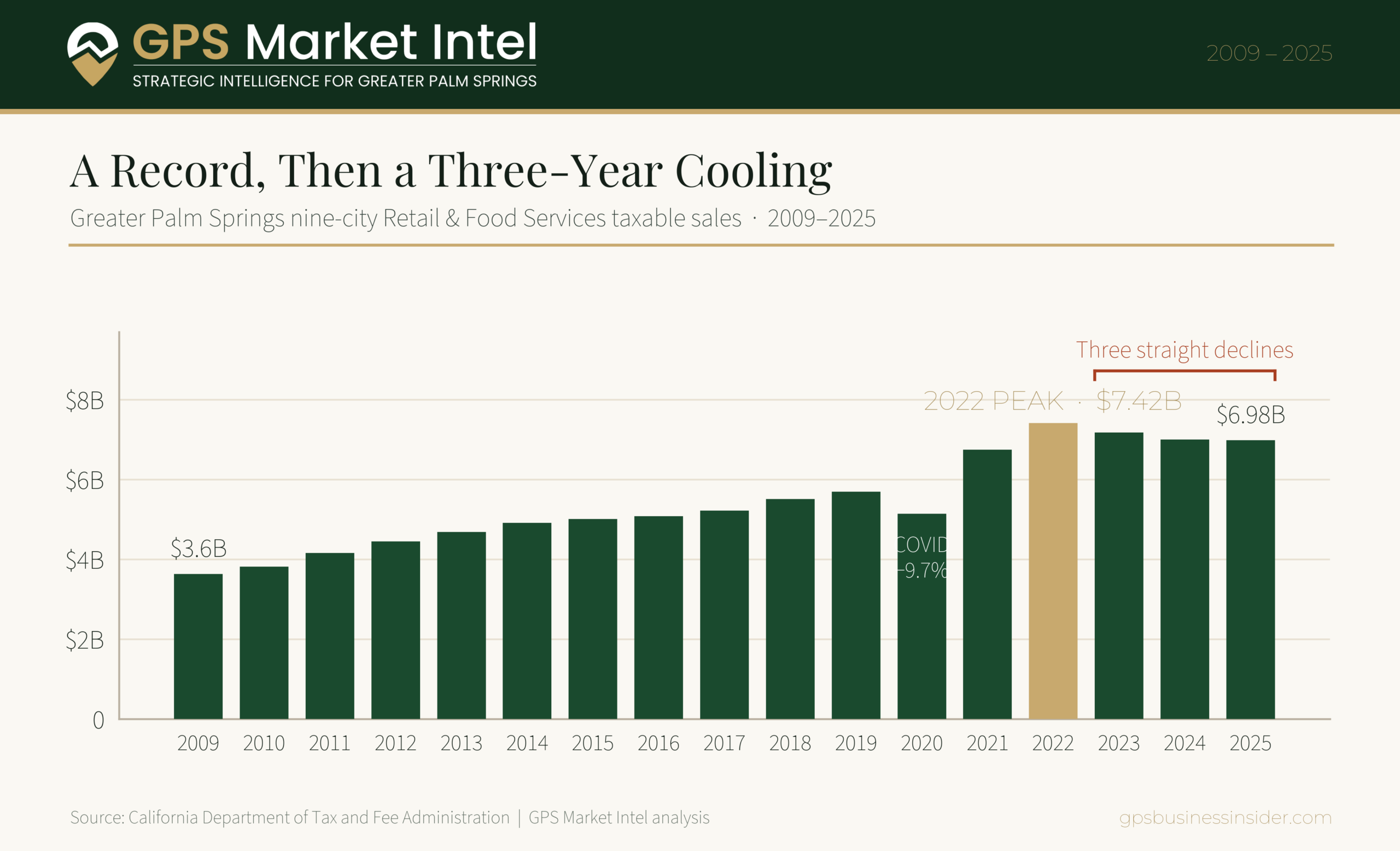
But the first quarter suggests the transition is not over. The question is whether the recent flattening represents a stable new plateau or a mature retail market beginning to lag faster-growing parts of Riverside County.
What the numbers are really saying
Three conclusions stand out.
First, Greater Palm Springs retail is not collapsing. The region continues to generate extraordinary sales volume, and several cities and categories are growing. Indian Wells dining, Cathedral City auto sales, Indio apparel and La Quinta’s broad-based gains are evidence of real strength.
Second, the region is underperforming its larger benchmarks. A 0.8 percent decline contrasts with growth in Riverside County, California and the nation. Because the local figures are reported in current dollars and are not adjusted for inflation, even a small nominal decline implies greater pressure on the actual volume of goods and services being sold.
Third, the market is becoming more fragmented.
The post-pandemic boom lifted nearly every city and many categories at once. The current environment rewards particular business mixes, commercial corridors and customer segments. Auto dealers can carry one city while restaurants carry another. Apparel can rise while home furnishings fall. A city can post a record year and begin the next one in decline.
That is the new retail story in Greater Palm Springs.
The region still has scale. It still has visitor spending. It still has strong commercial centers and growing markets in the East Valley.
What it no longer has is a single tide lifting everyone.
The next phase will be decided city by city, corridor by corridor and category by category. The first quarter of 2026 suggests that the winners are already beginning to separate from the rest.

Bob Marra is the CEO/Publisher of GPS Business Insider. He has been studying, writing and giving presentations about business, economic and public affairs news and issues and the local economy in the Greater Palm Springs/Coachella Valley region for more than 20 years.