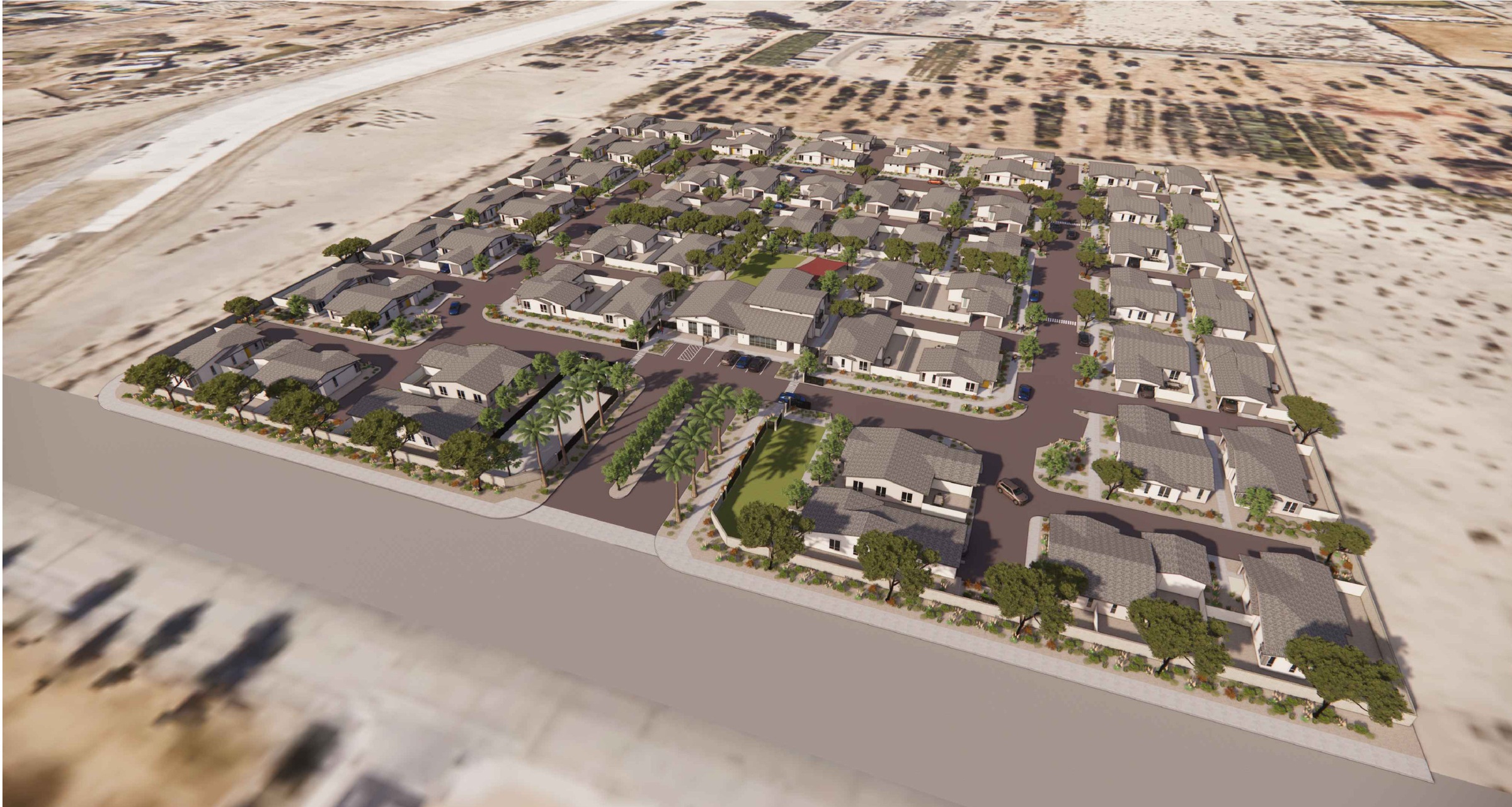
The Indio City Council unanimously approved Roadrunner Flats on June 17, clearing the way for a 10-acre affordable housing development in North Indio that will pair detached rental homes with accessory dwelling units (ADU) in a lower-density format that city leaders said could help meet a different kind of housing need.
The project will bring 30 detached single-family homes, 30 ADUs, a leasing office, a manager’s unit, private streets, amenities, landscaping and stormwater improvements to a vacant site north of Avenue 39 and east of Dreams Lane, west of Jefferson Street.
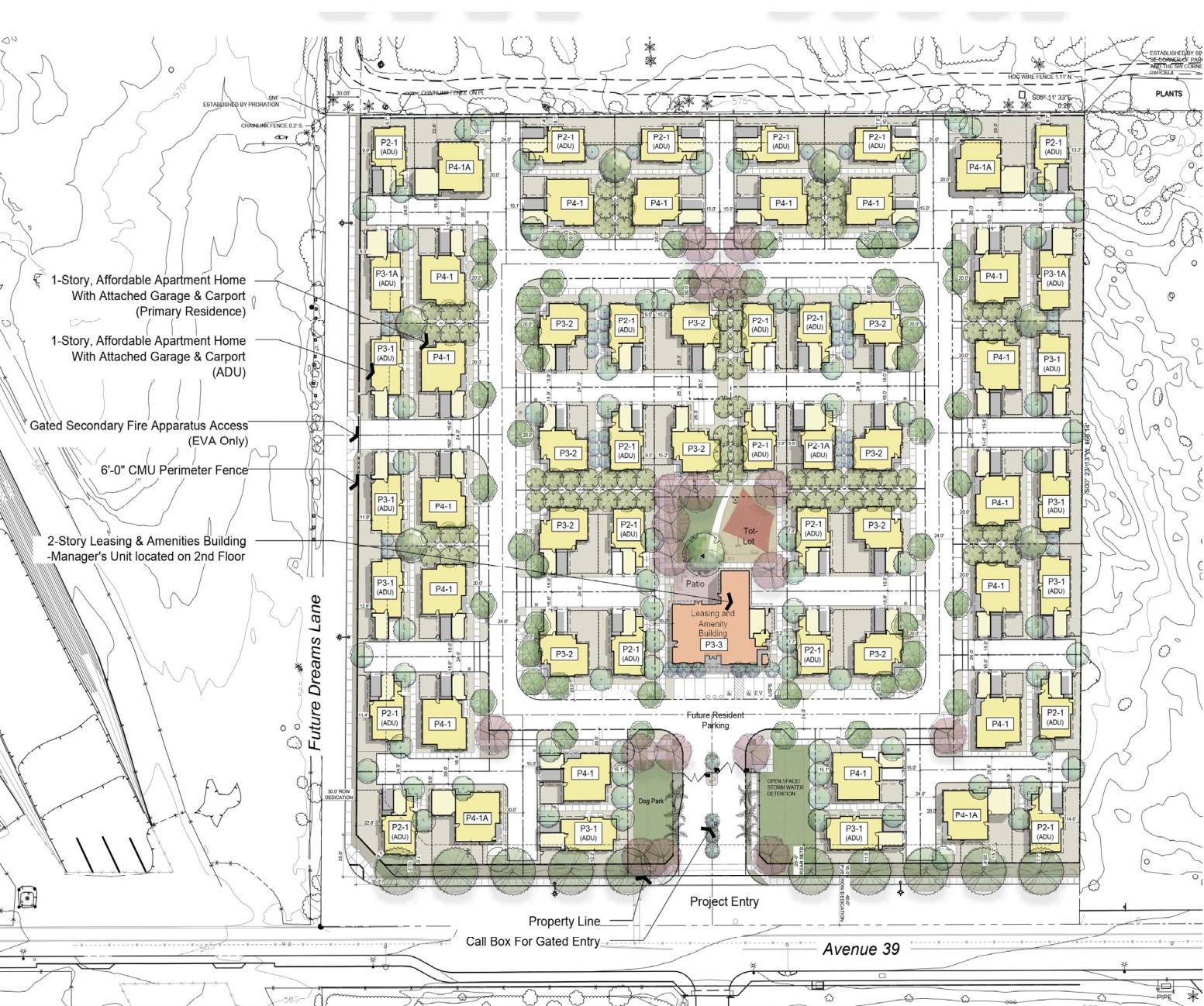
Site plan for the Roadrunner Flats affordable housing project north of Avenue 39 in Indio.
Council members voted in favor after a discussion that was broadly supportive but also focused on practical questions that often determine whether affordable housing succeeds over the long term: property management, parking, maintenance of private streets and common areas, emergency access, nearby agricultural uses and the financial structure needed to keep the project affordable.
“I think this is a really good opportunity,” council member Oscar Ortiz said during the hearing. “We don’t have a lot of affordable projects that provide a rental home. We have a lot of apartments, not a lot of homes.”
The comment captured what makes Roadrunner Flats notable. It is not a conventional affordable apartment complex. It is planned as a gated rental neighborhood, with detached homes and ADUs on the same lots. The format could serve larger households, multigenerational families, and residents who need more space than a typical apartment can offer but still cannot afford market-rate housing in the Coachella Valley.
Ortiz also said the project could create “a unique opportunity to keep multi-generational families together,” particularly if some households can rent both a primary home and an ADU for extended family members.
The applicant, Tung (Steve) Tran of Tustin-based Etapes Corporation, submitted the project to the city in November 2025. The Planning Commission recommended approval on May 27.
The site is currently vacant. It sits near Shadow Hills High School, with vacant or agricultural land to the north and east, the North Indio Regional Flood Control Channel to the west, and school uses to the south.
City staff described the project as affordable housing intended for households earning between 30 percent and 70 percent of the area median income. Before final map approval, the property owner must record an affordable housing covenant or regulatory agreement requiring the approved affordable housing units to remain affordable to low- and moderate-income households for at least 55 years.
That condition gives the project’s affordability component long-term legal force. It also makes the city’s approval more than a standard subdivision entitlement.
The primary homes are planned as three-bedroom and four-bedroom single-story residences ranging from about 1,230 to 1,477 square feet. The ADUs are planned as two-bedroom and three-bedroom units ranging from about 1,006 to 1,192 square feet. The development also includes a three-bedroom manager’s unit above the leasing and amenities building.
Amenities proposed for the community include a clubhouse and lounge, indoor and outdoor fitness areas, a playground and tot lot, barbecue area, open space and a dog run.
The discussion at the council meeting made clear that members were not only weighing whether the project should be approved, but also how it should be managed once occupied.
Council members raised concerns about parking, whether the homes and ADUs would be rented separately, how the property would be managed and whether the city would have enough leverage if problems emerged. Project representative John Okura said the development team expected to use a third-party property management company, and that such an arrangement provides accountability because “if they don’t do a good job, you fire them and you replace them.”
He also said affordable housing developments financed through tax credits are subject to multiple levels of oversight.
“There are multiple levels of oversight and compliance to these transactions,” Okura told the council.
Some council concerns focused on long-term maintenance. Because the project includes private streets, gates, common areas and amenities, the city attorney suggested revising the conditions of approval to require a recordable and enforceable maintenance obligation before final map recordation. The purpose was to ensure that the city would not later be asked to take over private streets or facilities if ownership changed or the project encountered financial problems.
Council members supported that change, and the motion to approve included additional tweaks and conditions discussed at the hearing.
Required improvements include work along Avenue 39 and Dreams Lane, such as pavement, curbs and gutters, sidewalks, streetlights, storm drain facilities and landscaped parkways. Avenue 39 is to be improved as a boulevard under city standards, while Dreams Lane is to be improved as a collector street.
For Indio, the approval comes as the city continues to emphasize housing production as part of its growth strategy. The city’s housing element identifies a need to plan for 7,812 housing units during the 2021 to 2029 planning period, including very-low-income, low-income, moderate-income and above-moderate-income units. Staff said Roadrunner Flats would contribute 30 low- and moderate-income units toward that allocation.
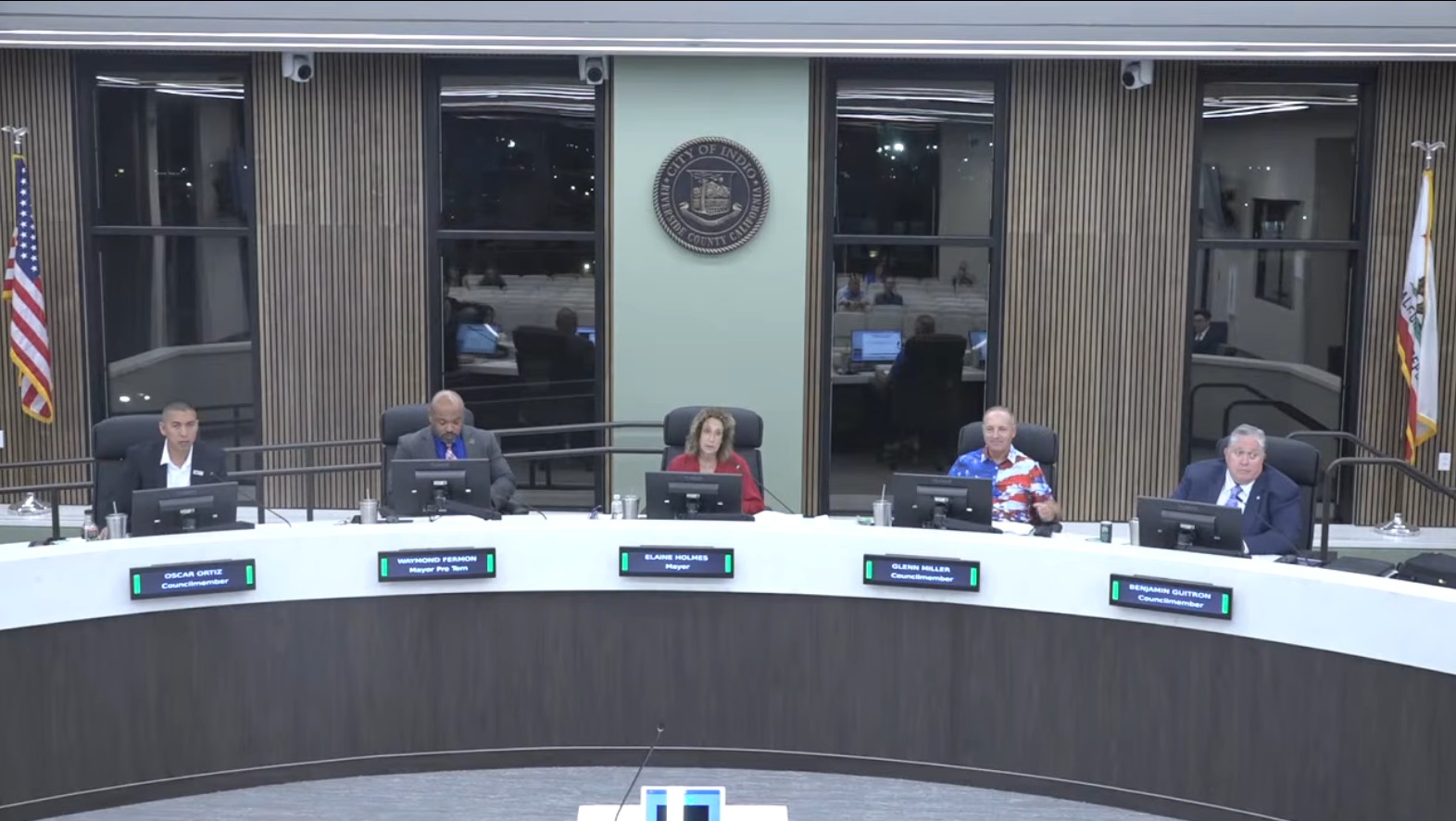
The Indio City Council unanimously approved the Roadrunner Flats project on June 17.
The project also aligns with Indio’s broader pro-housing positioning. In 2025, the city announced it had received a Prohousing Designation from the California Department of Housing and Community Development, becoming the first city in the Coachella Valley and the third jurisdiction in Riverside County to receive the designation. The state program can provide advantages in certain housing, infrastructure and transportation funding programs.
Across Greater Palm Springs, affordable housing remains one of the region’s most persistent economic challenges. Rising housing costs affect workforce retention, family stability and employers' ability to attract and retain workers. Lift to Rise, the regional housing coalition, has set a goal of helping drive 10,000 new affordable homes by 2028, and its recent impact reporting says more than 7,200 affordable units have been planned or placed under construction across the region.
Roadrunner Flats is smaller than many of the region’s major affordable apartment developments, but its format may make it more meaningful than its unit count suggests. It offers a model of affordable housing that resembles a residential subdivision more than a traditional apartment complex, while still maintaining long-term affordability restrictions.
Toward the end of the discussion, Mayor Elaine Holmes called it “a really cool project” and said it could be “wonderful for our families,” while also stressing that the city must ensure affordable communities are not merely built, but remain livable.
That may be the central test for Roadrunner Flats. The city has approved the homes. The next question is whether the development team can deliver the financing, management and long-term stewardship needed to make the project work for residents, neighbors and the city.

Bob Marra is the CEO/Publisher of GPS Business Insider. He has been studying, writing and giving presentations about business, economic and public affairs news and issues and the local economy in the Greater Palm Springs/Coachella Valley region for more than 20 years.