The city’s first technology and creative economy conference, which was a huge success last year, returns this month with a larger footprint, a new name, national speakers, hands-on programming and an explicit goal: making emerging technology practical for local residents, students, educators, creators and small businesses.
Palm Springs is positioning its next major conversation about the technology and creative economy sectors not as a distant technology conference for engineers, but as a community event for those trying to understand what emerging technologies, including AI, will mean for daily life and the local economy.
That is the central promise behind PS/NExT Summit 2026, a newly expanded version of last year’s Palm Springs AI & Creativity Expo. The summit, now formally branded as PS/NExT (New Experiences in Technology), is scheduled for June 22 and 23 at the Palm Springs Convention Center.
Presented by the City of Palm Springs Office of Economic Development and the Palm Springs Chamber of Commerce, in partnership with the Palm Springs Convention Center, the summit is intended to build on the momentum of the inaugural 2025 event, which attracted more than 500 attendees and received great survey feedback, a sign that organizers saw enough demand to expand the concept into a broader regional platform.
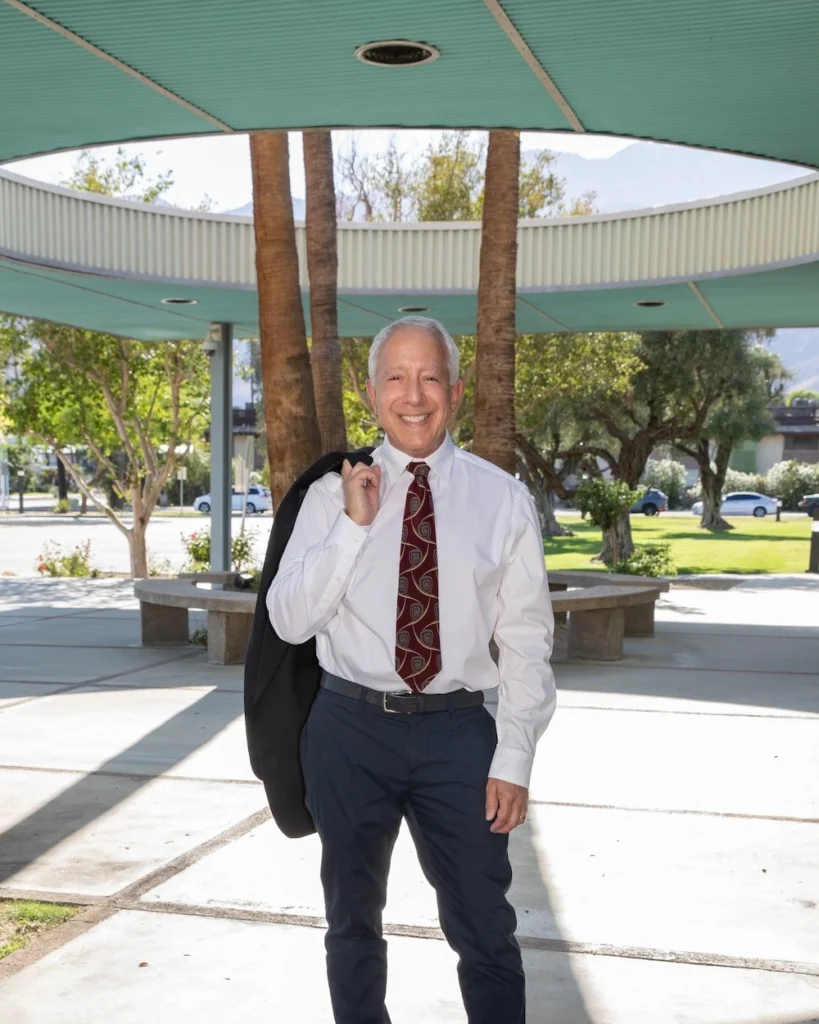
Palm Springs City Council Member, Jeffrey Bernstein, who chairs the Palm Springs Technology Steering Committee, has led the way in developing the conference for the past two years.
The 2026 version is expected to feature 1.5 days of programming, six tracks and more than 30 speakers, with content built around residents, small businesses, educators and students, builders, creators and civic leaders. The program is being framed as part technology conference, part workforce development effort, part creative summit and part civic experiment in how a destination city can adapt to a fast-changing economy.
“PS/NExT is about ensuring our community participates in the future instead of watching it happen from the sidelines,” said Palm Springs City Councilmember Jeffrey Bernstein, who chairs the Palm Springs Technology Steering Committee. “This summit connects creativity, technology, education and entrepreneurship in ways that help residents, students, and businesses build practical skills and opportunity. Importantly, our local students and educators will receive free access to this event.”
A Larger Stage For A Fast-Moving Topic
The event arrives at a moment when AI has quickly moved from a specialized technology topic into the center of business operations, education, media production, design, healthcare, customer service, software development and public policy. For Palm Springs, the question is not only how residents can understand the technology, but how the city and broader Coachella Valley can capture more of the economic activity around it.
The summit’s speaker lineup reflects that broader ambition.
Rob Minkoff, co-director of Disney’s Academy Award-winning film “The Lion King,” is returning as a headliner. According to PS/NExT materials, Minkoff has been exploring how AI tools can support animators rather than replace them, a distinction that speaks directly to one of the central debates surrounding the technology.
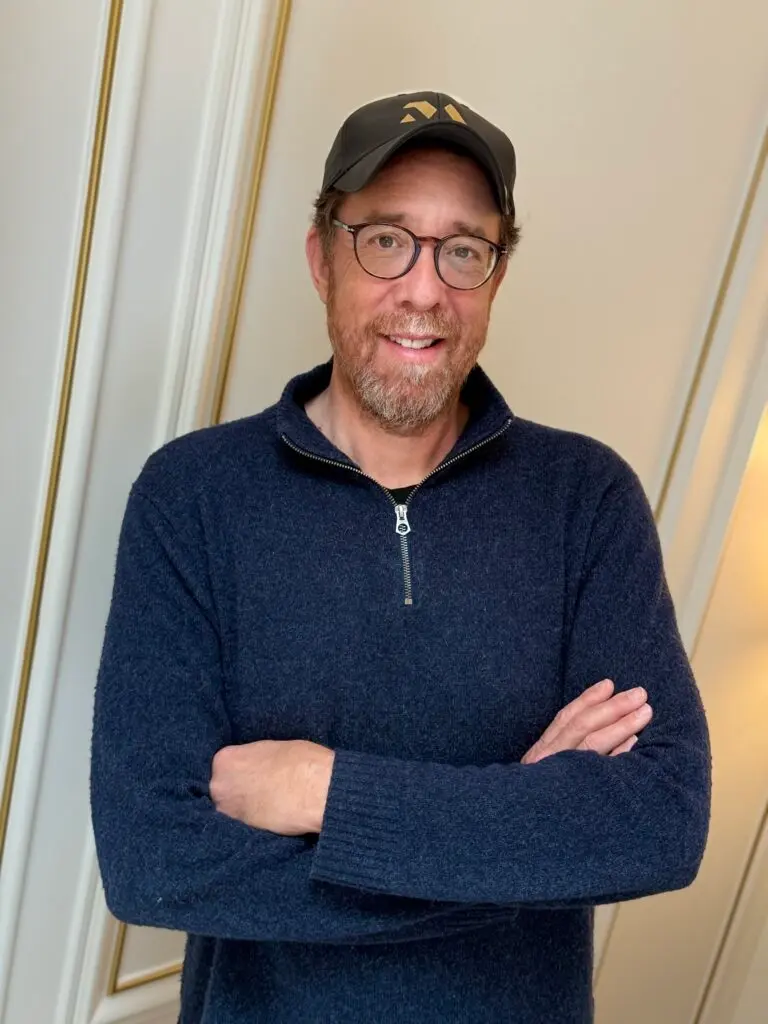
Rob Minkoff, will return as a keynote speaker.
“I’m excited to return to Palm Springs for the PS/NExT Summit,” Minkoff said. “Technology and creativity have always been inextricably linked, and it feels like we’re standing at the edge of an unprecedented new era for artists and storytellers. Palm Springs is the perfect place for that conversation, a city where the arts are deeply embedded in its DNA. And if this Summit can also make a meaningful impact on education and young people, that makes it all the more important.”
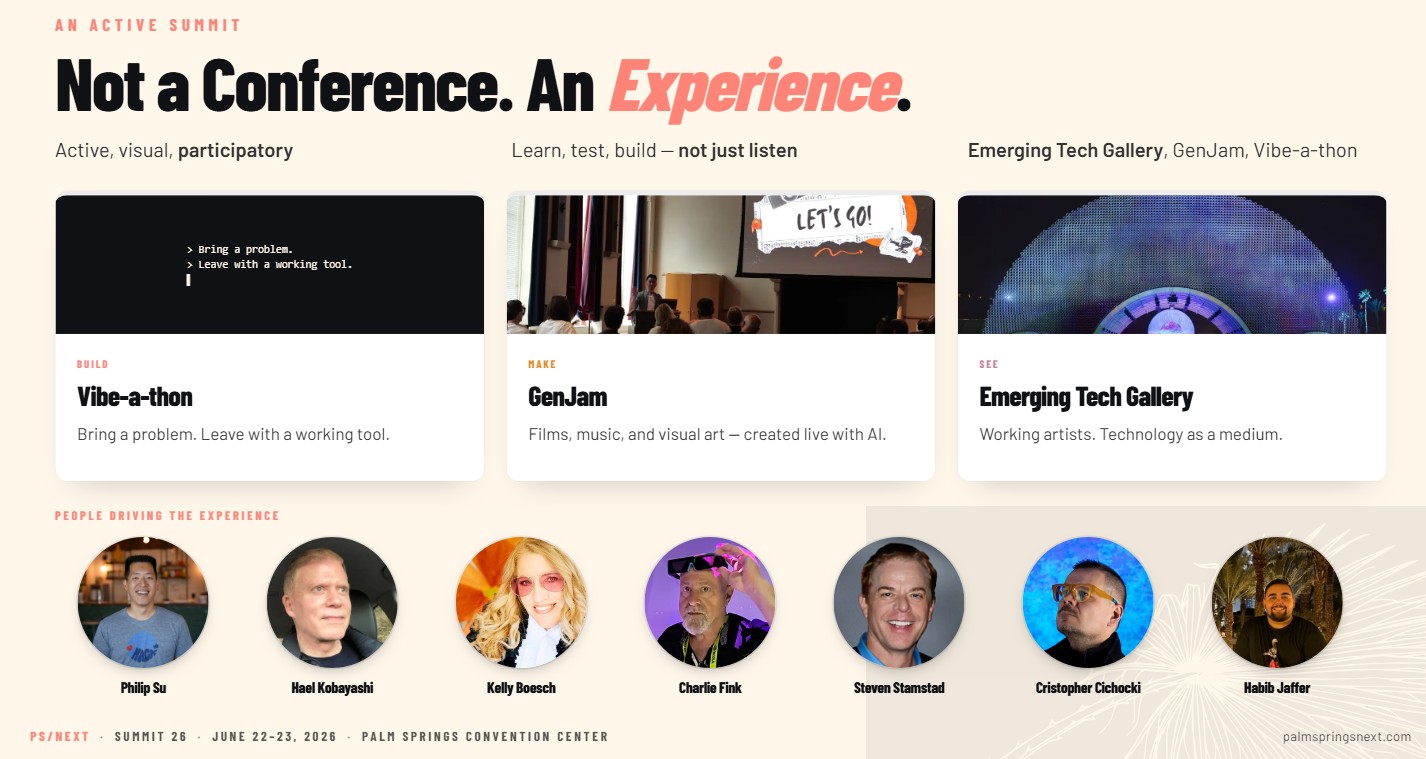
Other featured participants include Baratunde Thurston, the Emmy-nominated storyteller, author and Palm Springs resident; Philip Su, a former engineer at Microsoft, Meta and OpenAI; AI artist Kelly Boesch; and artists Cristopher Cichocki and Glen Wexler.
Thurston is scheduled as the opening keynote. PS/NExT describes his work as focused on the relationship between nature, humans and technology, including his podcast “Life with Machines,” which won a People’s Voice Webby for Best Creative Use of AI and Technology.
Boesch, a Palm Desert-based AI artist, is being presented as one of the event’s local creative anchors. The summit’s website describes her as a TED speaker with more than 4 million followers across social channels and more than 100 million music streams. Her work gives the conference a direct Greater Palm Springs connection to one of the fastest-growing areas of generative AI: visual art, immersive media and AI-assisted creative production.
Practical AI For Local Businesses
For the local business community, the summit’s most tangible component may be the Vibe-a-thon, a live innovation challenge designed to surface real problems from businesses and organizations in Greater Palm Springs, and then rapidly prototype software tools to help solve them.
The idea is simple but potentially powerful: local owners and operators bring a problem they do not have the budget, staff or technical expertise to solve, and developers work with AI tools to build a functioning prototype during the summit.
The summit’s website describes the challenge in plain business terms: “Bring a problem. Leave with a working tool.”
For a region heavily shaped by hospitality, tourism, healthcare, retail, professional services, restaurants, real estate, construction, nonprofits and small owner-operated businesses, that kind of programming could make AI less abstract. Rather than asking whether AI will transform the economy in general, the summit is asking how it might help a hotel operator manage workflow, a retailer personalize customer outreach, a nonprofit improve reporting, or a service business automate repetitive administrative tasks.
“Our conference is about New Experiences in Technology that are important to understand and may have an impact and benefit to our region,” noted Bernstein. “We are not Hollywood or Silicon Valley, but we have the ability to lead and come up with an approach that works for us. We acknowledge that the pace of technological change is increasing (and can be overwhelming at times), so leaning in to better understand together with national and local experts, and the broader community is key. New technology (including AI) can be helpful, and where it can be potentially harmful is a key focus of this event. Ultimately, we are attempting to strengthen our community and economy by helping residents, businesses, our workforce, and our educational institutions better understand and responsibly leverage new technology to the benefit of our region.”
That focus matters because many small businesses are not resisting technology so much as trying to figure out what is useful, what is safe, what is affordable and what can be implemented without a dedicated technology department. For them, the promise of AI is not a theoretical productivity revolution. It is whether a practical tool can reduce hours spent on scheduling, marketing, bookkeeping, customer follow-up, training, proposals, inventory, compliance or content creation.
A Workforce And Education Play
PS/NExT also carries a workforce development message. Greater Palm Springs students will be eligible for free admission, and organizers say local students and educators will have sponsored access opportunities.
The education track is designed to bring students, teachers, administrators and employers into the same conversation about how AI is changing learning, work readiness and the skills that may matter most over the next decade.
That is an especially relevant issue for a region that has long sought to diversify its economy while still relying heavily on visitor spending, public agencies, healthcare, construction, real estate, education and service-sector employment. If AI becomes a baseline workplace tool across industries, local access to training and confidence-building could become part of the region’s competitive position.
Wayne Olson, Palm Springs’ Chief Economic Development Officer, described the summit as both a community event and an economic development strategy.
“PS/NExT positions Palm Springs at the center of the national conversation of emerging technology and its impact on our communities and local economies,” Olson said. “This summit is about creating opportunity, preparing our workforce for the future, and building toward an economy that attracts investment and new ideas to our city.”
Creativity As Economic Identity
Palm Springs is not trying to present itself as another Silicon Valley. Its pitch is different: technology filtered through design, film, art, architecture, culture and destination appeal.
That is why the summit’s timing is notable. PS/NExT sits between XOXO Palm Springs, a citywide arts and culture festival running June 11 through 22, and Palm Springs International ShortFest, scheduled June 23 through 29. Together, those events create a June sequence that links arts, technology and film in a way that fits the city’s brand.
XOXO Palm Springs is being promoted as a citywide celebration of arts, culture, architecture, film, music, visual arts and immersive experiences. ShortFest, one of the largest short film festivals in North America, will bring filmmakers, industry participants and audiences to the city immediately after PS/NExT.
For Palm Springs, the connection is strategic. AI is already disrupting film, design, music, photography, advertising, architecture visualization, and digital storytelling. By placing an AI and creativity summit between two major cultural events, the city can make the case that its creative economy is not only about legacy institutions and destination tourism, but also about the next generation of creative tools.
One of the summit’s signature creative programs is GenJam, an AI-powered film, music and visual art sprint organized with Machine Cinema, a global AI creativity community. Participants will form teams, use AI production tools and create work tied to a Palm Springs theme. The format includes a shorter sprint and a longer GenJam experience designed for more complex storytelling, sound design and character work.
That hands-on approach may help the event stand apart from conferences built mostly around panels and keynote speeches. The summit’s programming appears to be built around a more active premise: attendees should leave having tried something, built something, learned something or made a new connection.
Access As A Core Message
Ticket pricing also reflects the community positioning. The standard summit pass is listed at $250, while Coachella Valley residents can purchase a $95 resident pass. Coachella Valley student passes are listed as free, and premium passes are listed at $500. Organizers also offer options to sponsor student and nonprofit access.
Last year’s event was a sellout, and organizers say the registration is robust
Sponsors listed for the 2026 summit include the City of Palm Springs Office of Economic Development, the Palm Springs Chamber of Commerce, Amazon, College of the Desert, Eisenhower Health, the Foundation for Palm Springs Unified School District, Greater Palm Springs Economic Development, the Grace Helen Spearman Charitable Foundation, Palm Springs Disposal Services, Wintec Energy, Desert Water Agency and Engineering Resources of Southern California.
The sponsor list underscores the breadth of the event’s intended audience. It is not just a tech-sector gathering. It includes civic institutions, education partners, healthcare, utilities, economic development organizations and local business interests.
The summit will take place June 22 and 23 at the Palm Springs Convention Center. Registration and event information are available at https://www.palmspringsnext.com/.
Bob Marra is the CEO/Publisher of GPS Business Insider. He has been studying, writing and giving presentations about business, economic and public affairs news and issues and the local economy in the Greater Palm Springs/Coachella Valley region for more than 20 years.