Palm Springs International Airport (PSP) hit a pocket of turbulence in May, not in the terminal or on the airfield, but in the demand picture that has helped make the airport one of the region’s most visible economic indicators.
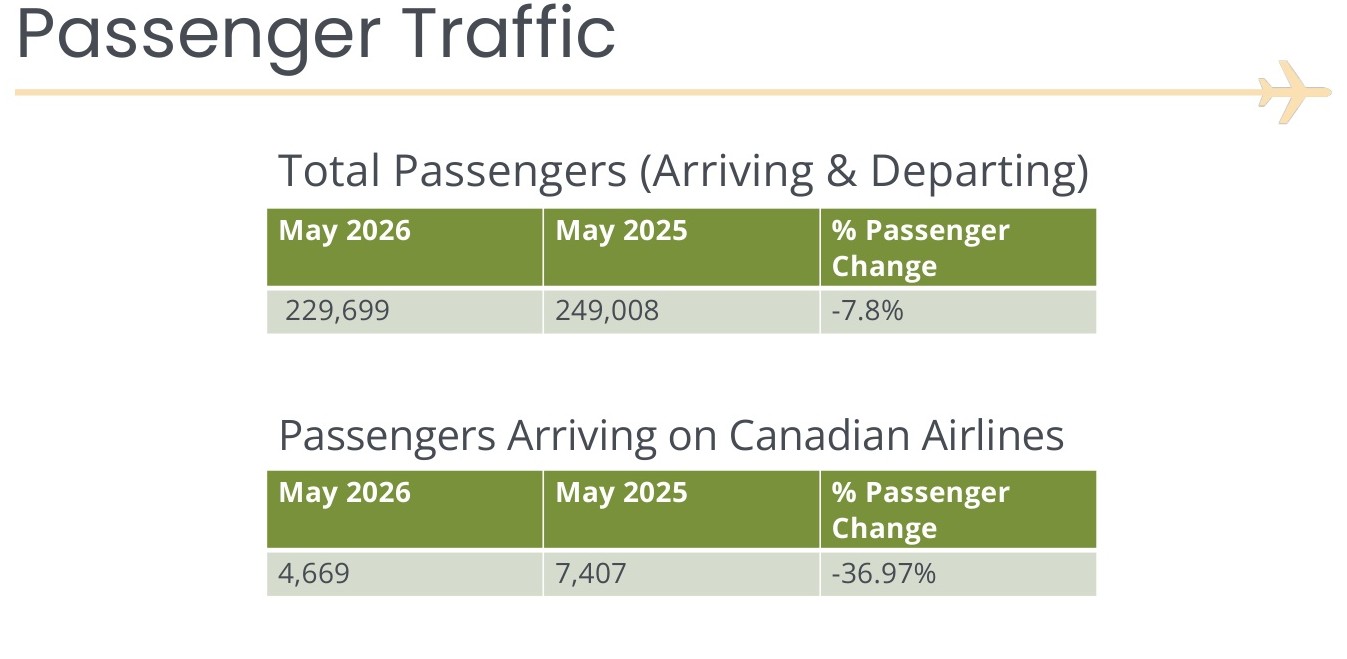
PSP handled 229,699 arriving and departing passengers in May, down 7.8 percent from 249,008 in May 2025, according to data presented to the Palm Springs Airport Commission. The decline amounted to 19,309 fewer passengers than in the same month last year, when PSP was still riding one of the strongest traffic periods in its history.
A Year-To-Date Gap Emerges
Through the first five months of the year, PSP handled 1,824,284 total passengers, down from 1,890,747 during the same period in 2025. That put the airport 66,463 passengers behind last year’s pace, a year-to-date decline of about 3.5 percent. Enplanements fell from 956,097 to 921,989, while deplanements fell from 934,650 to 902,295.
The May decline does not erase PSP’s longer-term growth story. The airport has become a central part of the Greater Palm Springs economy, connecting the region to major domestic hubs, Canadian cities and the leisure travelers who support hotels, short term rental homes, restaurants, attractions, golf courses, rental car activity, retail spending and convention business.
But the drop raises a timely question for the valley’s tourism economy: Was May simply a softer shoulder-season month after a record-setting 2025 or an early signal that travelers are becoming more price-sensitive as airfare, fuel costs, and Canadian travel patterns put pressure on discretionary trips?
Airport Officials Point To Multiple Causes
Jake Ingrassia, PSP’s marketing and communications specialist, told commissioners that the decline was not the result of a single issue.
“It’s not any one single thing, but many smaller things adding up,” Ingrassia said during the airport’s marketing update.
Among the factors he cited were softening Canadian demand, higher travel costs, airline fuel costs being reflected in ticket prices, operational disruptions tied to runway construction at San Francisco International Airport, carriers that operated in May 2025 but not in May 2026, and an overall reduction in airline capacity of about 4 percent compared with the prior year.
Canadian Arrivals Remain A Pressure Point
The numbers show why airport officials are watching Canada closely.
Canadian airline arrivals at PSP totaled 4,669 passengers in May, down from 7,407 in May 2025. That was a decline of 2,738 passengers, or nearly 37 percent. The Canadian decline accounted for some of the total drop, but not most of it. Even excluding that loss, PSP still would have seen a weaker May than last year.
That makes the airfare and capacity question especially important.
Capacity Cuts Do Not Explain Everything
The airport’s own schedule data showed 328,000 total scheduled seats in May 2026, compared with 342,000 in May 2025. That was consistent with Ingrassia’s point that airlines had trimmed capacity by about 4 percent. But passenger traffic fell nearly twice as much, suggesting that softer demand or weaker load factors also played a role.
For a tourism region, that distinction matters. A capacity cut means airlines offered fewer seats. A larger decline in passenger numbers can suggest that some available seats were harder to fill, particularly in a shoulder month when demand depends less on major events and more on discretionary leisure travel.
A Broader Tourism-Airport Split
The comparison with other tourism-oriented airports cuts both ways.
Las Vegas’ Harry Reid International Airport, the largest leisure and convention gateway in the western United States, also showed signs of a spring slowdown. Harry Reid International has not yet posted its May 2026 passenger data, but its latest official monthly report showed April passenger traffic down 7.1 percent from April 2025. Year-to-date traffic through April was down 5.6 percent.
That gives PSP some company among large desert tourism markets. Las Vegas is not a perfect comparison. It is far larger, has a broader international base and depends heavily on conventions, gaming and entertainment. Still, its April decline supports the idea that at least some major tourism airports were seeing softer spring demand.
PSP Falls Between Las Vegas And Faster-Growing Leisure Markets
The year-to-date comparison makes the picture more nuanced. PSP’s 3.5 percent decline through May was less severe than the 5.6 percent year-to-date decline reported at Las Vegas through April, but PSP was still moving in the opposite direction from several smaller tourism-focused airports where May data was available.
Jackson Hole Airport, a smaller but highly tourism-dependent gateway, reported strong May growth. Its total May passenger count, combining enplanements and deplanements, increased to 82,138 from 70,073 a year earlier, a gain of more than 17 percent. For the year through May, Jackson Hole handled 404,875 total passengers, up from 393,042 during the same period in 2025, a gain of about 3 percent.
Bozeman Yellowstone International Airport, another mountain and outdoor tourism gateway, also posted a strong May. Its total revenue passengers increased to 220,996 from 194,218 in May 2025, a gain of nearly 14 percent. Through May, Bozeman handled 1,047,296 total passengers, up from 956,819 during the same period last year, a year-to-date gain of about 9.5 percent.
San Diego International Airport, a larger coastal tourism and business gateway, had not yet posted a May passenger report in its public files, but its April passenger count was up 10.6 percent from the prior year. Its published schedule outlook also showed May seat capacity expected to be up 9.5 percent year over year. Through April, San Diego reported 8,253,432 calendar-year-to-date passengers, up from 7,457,611 in the same period last year, a gain of 10.7 percent.
The result is a mixed national picture. Some leisure and convention gateways were under pressure. Others were still expanding sharply.
That suggests PSP’s May decline should not be dismissed as simply a fuel-cost story, even though fuel costs are a real pressure on airline pricing. The more precise reading is that PSP faced a combination of market-specific factors: reduced capacity, fewer Canadian passengers, carrier changes, operational disruptions on an important route, and a comparison against an unusually strong May 2025.
It also suggests that PSP’s year-to-date performance occupies a middle ground. The airport is not seeing the sharper year-to-date decline reported in Las Vegas, but it is also not matching the growth seen at several smaller or coastal tourism gateways.
Why Canada Still Matters
For Greater Palm Springs, Canada is more than an airline route map issue. Canadian visitors have long been part of the region’s winter and spring economy, filling hotel rooms, short-term rentals, restaurants, golf courses and retail centers during the high season.
In May, however, PSP’s Canadian arrivals were still well below last year. Ingrassia told commissioners that the decline had begun to level off compared with earlier peak-season months, but the airport remained cautious.
Summer Schedules Point To A Rebound
Looking ahead, the schedule data offered a more encouraging picture.
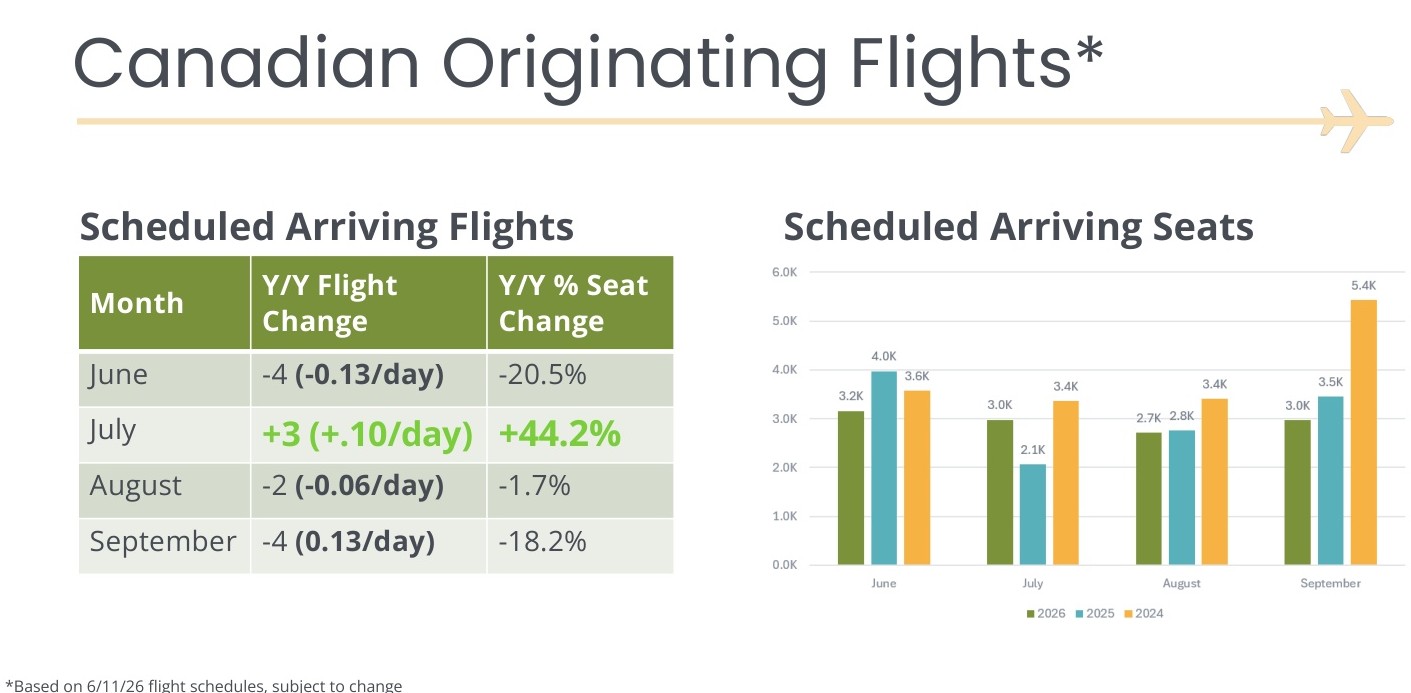
For June through September, PSP projects more than 3 percent growth in summer seat capacity, equivalent to roughly 22,000 additional seats. The strongest month is expected to be July, with scheduled capacity up more than 8 percent from last year.
The Airport Commission report showed June scheduled seats up 1.7 percent, July up 8.3 percent, August up 3.5 percent and September essentially flat, down 0.3 percent. In raw numbers, that equals about 3,100 additional seats in June, 13,900 in July, 5,900 in August and about 500 fewer seats in September.
Canadian service is expected to improve in capacity terms as well, though unevenly by month. PSP’s third-quarter Canadian seat capacity is projected to rise 4.4 percent, driven by a sharp July increase. Vancouver service is expected to be a particular bright spot.
Still, Ingrassia cautioned that scheduled seats are not the same as booked passengers.
“We always need to couch this with the fact that these are seat projections and not actual bookings,” he said, noting that booking data is proprietary and not shared publicly by airlines. “We still need to fill these planes.”
That may be the most important line in the airport’s update.
Airlines appear to still see Palm Springs as a viable summer market. Additional service to San Francisco and Phoenix, along with year-round Los Angeles service on United, gives PSP more ways to attract travelers during a season once viewed as an off-period for aviation in the desert.