The Planning Commission approved a nearly 1 million-square-foot logistics project near Interstate 10, but the debate comes after Amazon’s first giant Desert Hot Springs warehouse opened as a much smaller and less fiscally powerful project than originally expected.
Desert Hot Springs has approved another major logistics project near Interstate 10, advancing a nearly 1-million-square-foot warehouse next to the Amazon facility that opened earlier this year, and again placing the city at the center of a larger question about the future of major logistics facility development in Greater Palm Springs.
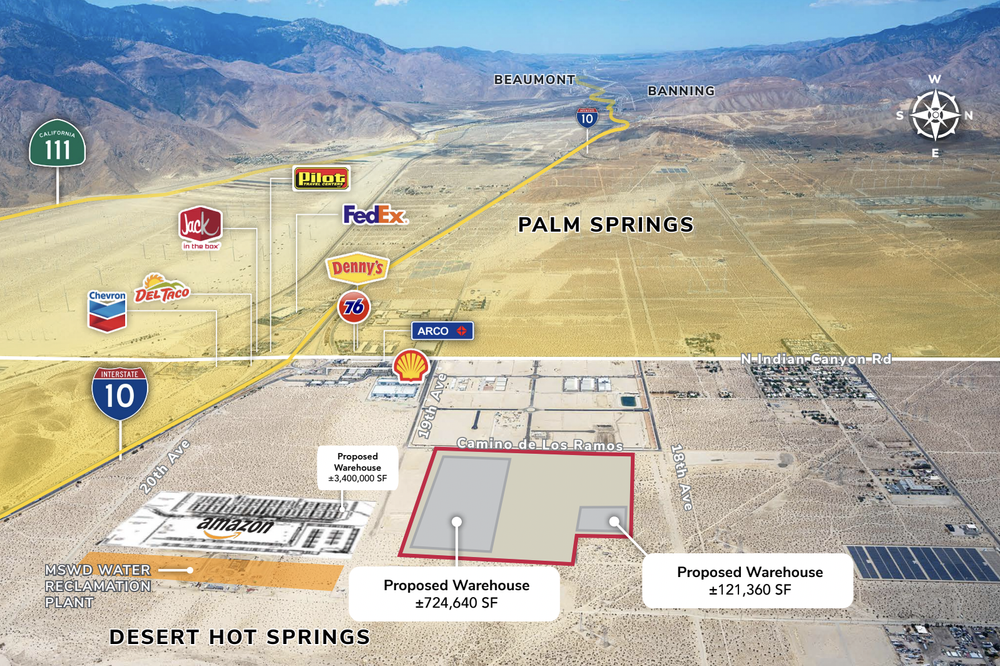
The Planning Commission voted unanimously Tuesday, June 9, to approve what is being referred to as the Snider Logistic Center, a two-story industrial building planned on roughly 64.6 acres along Calle de los Romos between 18th and 19th avenues. The project includes about 946,497 square feet of warehouse space and 55,612 square feet of mezzanine space, along with loading docks, employee and truck parking, EV-capable parking stalls, landscaping, utility connections and improvements to Calle de los Romos.
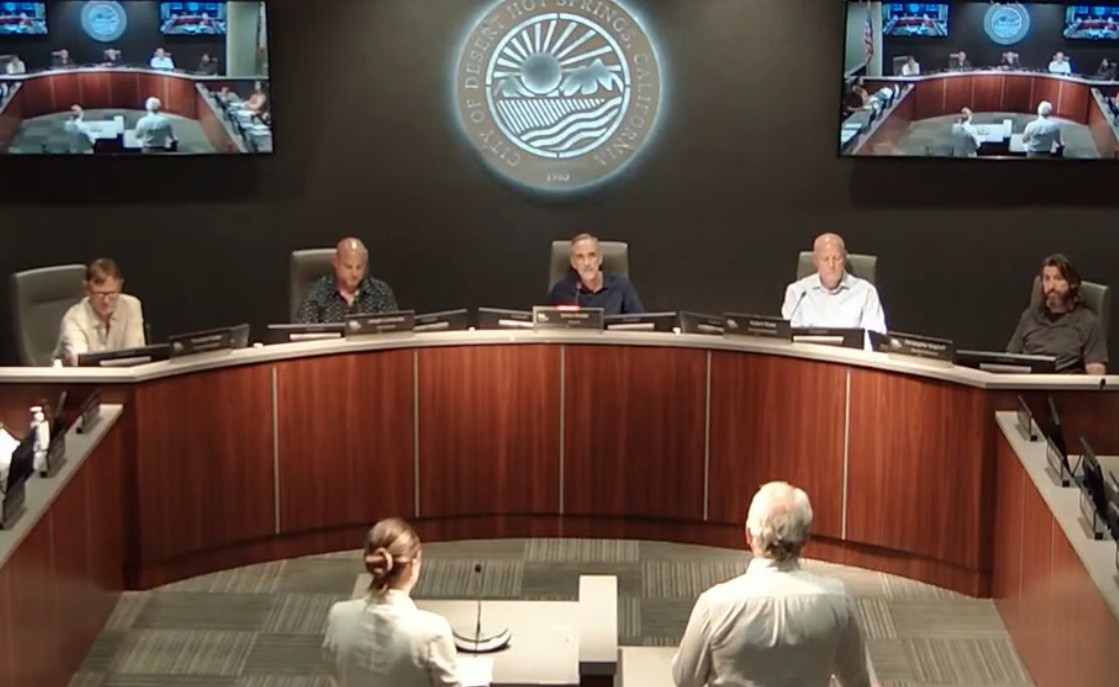
Mar Snider (left) and David Snider of the Snider Company testified to the merits of their warehouse development project to the Desert Hot Springs Planning Commission on June 9.
On paper, the approval looks like another step in the city’s long campaign to turn vacant land and freeway access into jobs, investment and a broader tax base. But it arrives with a complicated recent history.
Desert Hot Springs has already experienced the upside and disappointment that can come with a giant warehouse. Amazon’s new facility, located near the Snider site, opened this year with what they said would be more than 1,500 workers and expectations of eventually surpassing 2,000 employees. That was celebrated by city leaders as a major employment win in a community where many residents leave town each day for jobs elsewhere in the region.
But the Amazon project also became a cautionary tale. What opened was not the massive fulfillment-center-scale project the public first heard about when the entitlement process began. The original proposal was described as one of the largest warehouse projects in the country, with a capacity of roughly 3.4 million square feet and a height of 105 feet. The facility that ultimately opened is about 635,000 square feet, still enormous by any local standard, but roughly one-fifth the size of what was initially discussed.
More importantly for Desert Hot Springs, the operation changed in character. Instead of the larger fulfillment-center concept that once carried expectations of massive fiscal impact via point-of-sale taxation of the products, which was estimated to yield more than $20 million per year in sales tax for the city in its early years, then increasing, the facility opened as an Amazon inbound cross-dock, part of the company’s middle-mile logistics network. That means goods move through the building on their way to other fulfillment centers, but the city does not receive the sales-tax benefit that would have accompanied what the city originally proposed and lauded as a game-changer for revenue.
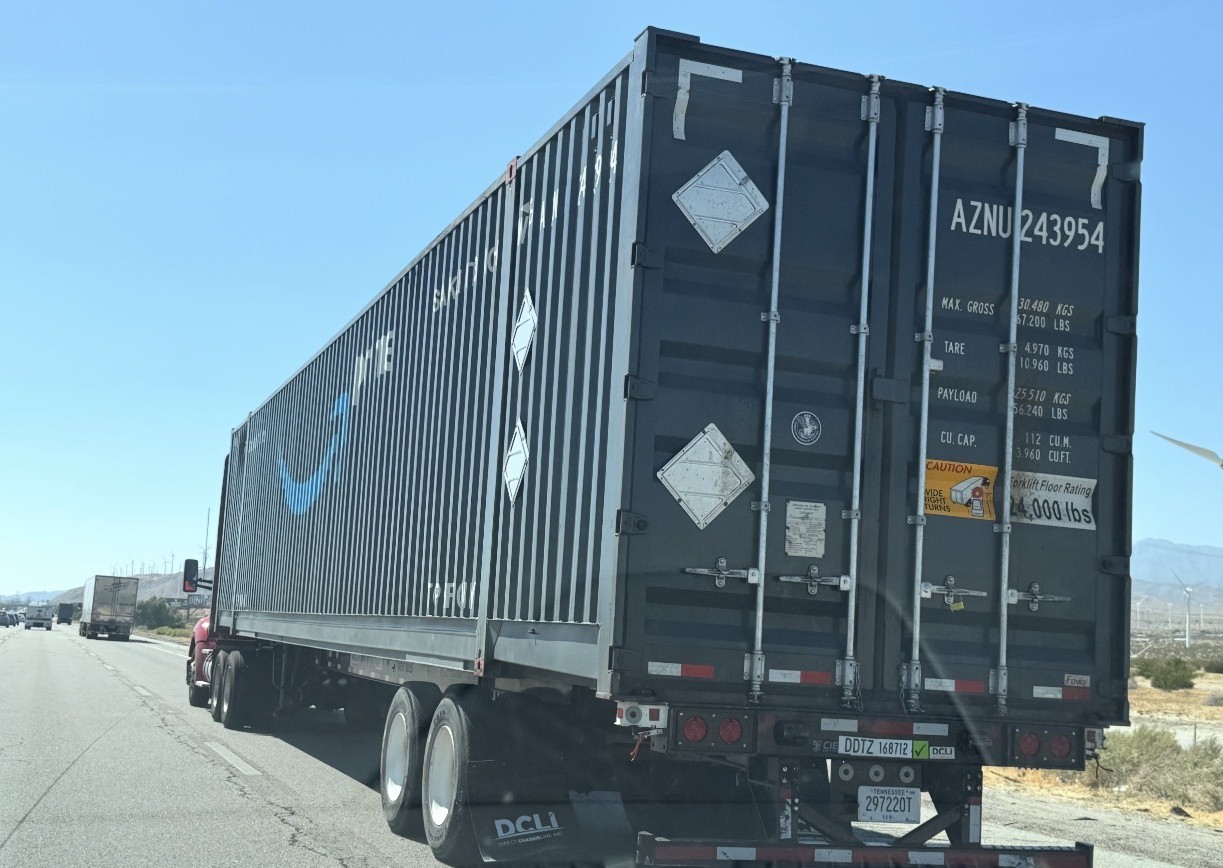
Like every one we observed, this Amazon truck heads west after leaving the warehouse in Desert Hot Springs.
In other words, the city got all the negative impacts, especially the estimated 700 one-way truck trips to the facility, which is doubled when they leave, but none of the envisioned sales tax revenue. None of the $20 million. Amazon publicly stated that the decision to change the entire project entitlement was based on “market conditions.” What a farce it was to even say that. Meanwhile, the products are obviously not intended for distribution within Greater Palm Springs. Instead, the trucks bring cargo all the way from the ports of Los Angeles and Long Beach, reorganize it and ship it back to the west and/or north. GPS Business Insider has observed the truck traffic leaving the facility and saw it in action. All of this because people in Western Riverside County have been fighting vehemently for the past several years against additional warehouse development. Not that big of a problem for the likes of Amazon to just send the goods a bit farther east to Desert Hot Springs as the hub, especially when the city will go for it even when the deal is changed almost entirely.
That history hung over the Snider Logistic Center approval, even when it was not always stated directly. Desert Hot Springs wants and needs private-sector jobs. It also wants a larger fiscal base to support city services, infrastructure and long-term growth. But the Amazon experience showed that a large warehouse entitlement can produce an outcome that is significantly different from the early public expectations attached to it.
The Snider project is being presented as a major economic development opportunity. The applicant has said it expects to create about 1,000 permanent jobs and generate millions of dollars in development fees and taxes. The eventual user has not yet been identified, though developer David Snider suggested during the hearing that a Fortune 500 company or another major international company could occupy the building. It’s exactly the same premise that Snider gave for a similar warehouse entitlement in the northern area of Palm Springs roughly a year ago. Ground has not been broken for that entitled project.
“When we first purchased the site in 2022, we believed it to be uniquely positioned for exactly this purpose,” Snider told planning commissioners. “Our project represents a very meaningful investment in the future of Desert Hot Springs.”
Snider also sought to distinguish his project from other large industrial proposals that have drawn skepticism in the region. He said the Snider Company has been doing business in the area since 2015, has developed, constructed and continued to own multiple projects, including industrial buildings in Desert Hot Springs, and views the I-10 industrial corridor as the kind of location the city has intentionally identified for this type of use.
“The industrial corridor along I-10 didn’t happen by accident,” Snider told the commission. “It happened because the city has identified this area as an appropriate area for this type of industrial development, and this is exactly where a project like this belongs.”
From the developer’s standpoint, the project is also a major construction investment. Snider said the total cost of a building of this size would be “well over $200 million,” in the range of $225 million, and that an economic analysis prepared for the project estimated at least 1,500 construction jobs during the building phase. He also said the project is expected to generate between $10 million and $13 million in fees to the city from building permits, development impact fees and other required payments, though not all of those dollars would flow directly to the city.
Snider said the company has an agreement with SAFER, a labor-affiliated environmental organization, that would ensure the project is built with union labor. He also told commissioners the company had reached an agreement with the local chapter of the Sierra Club, saying a letter on the issue had been exchanged between attorneys and that an agreement was in place.
The hearing reflected how much public scrutiny has changed around big industrial buildings in Greater Palm Springs. To many residents, the questions are no longer limited to whether a warehouse is allowed under the zoning code. They now include what the building will actually be used for, how many truck trips it will generate, how much power and water it will require, whether the promised jobs will last and whether the final economic impact will match anything near the expectations stated during the approval process.
Some residents at the meeting were under the impression that the Snider warehouse could be a data center, a concern shaped by the recent public backlash in Coachella over a proposed technology campus that included a hyperscale data center. That controversy, driven by concerns over energy demand, water use and air quality, has made large industrial and infrastructure-dependent projects more politically sensitive across the region.
The Desert Hot Springs planning staff and Planning Commission responded by adding a condition prohibiting the Snider project from being used as a data center. Commissioners also added language prohibiting the use of the property as a holding facility for U.S. Immigration and Customs Enforcement.
Snider said the company had never considered either use or had itself asked the planning director to add a condition prohibiting both. “It has never been thought of on our part,” he said. “We’ve never considered it and are happy to make it a condition of approval.”
The condition was more than a procedural detail. It was a signal that public trust around large buildings now depends on specificity. A warehouse, a fulfillment center, a cross-dock and a data center may look similar to residents when viewed from the outside as big boxes on desert land. But their economic and environmental profiles can be dramatically different.
That is precisely the lesson of Amazon’s Desert Hot Springs project. The facility did open. The jobs created so far are real, but not yet confirmed to be 1,500. The building is active with trucks coming and going roughly every 1.5 minutes. But the city’s biggest early expectations were attached to a different version of the project, one of far more square footage and the anticipation of a much larger potential fiscal benefit.
For the Snider Logistic Center, the city is again betting that logistics can become a durable part of its economic base. The site is near Interstate 10, adjacent to other emerging industrial activity, and located in a part of the city where large-scale logistics uses can be accommodated more easily than in built-out residential or resort areas.
Mar Snider, president of operations at the Snider Company, told commissioners the building was designed to function as more than a basic warehouse. She said the company spent significant time studying truck movements, employee parking, circulation and site operations, with the goal of keeping trailer storage, docking, staging, queuing and maneuvering within the project boundaries.
That point is central to the applicant’s case. Mar Snider said the project is expected to generate about 2,100 daily trips, while the city’s General Plan had modeled and accepted 9,500 daily trips for the area. She said the traffic studies prepared for the project confirmed that the existing infrastructure can handle the facility, especially because the site is less than a mile from Interstate 10 in an established industrial corridor.
The project is also conditioned to widen Calle de los Romos, which Mar Snider said would improve circulation and help support future development in the area.
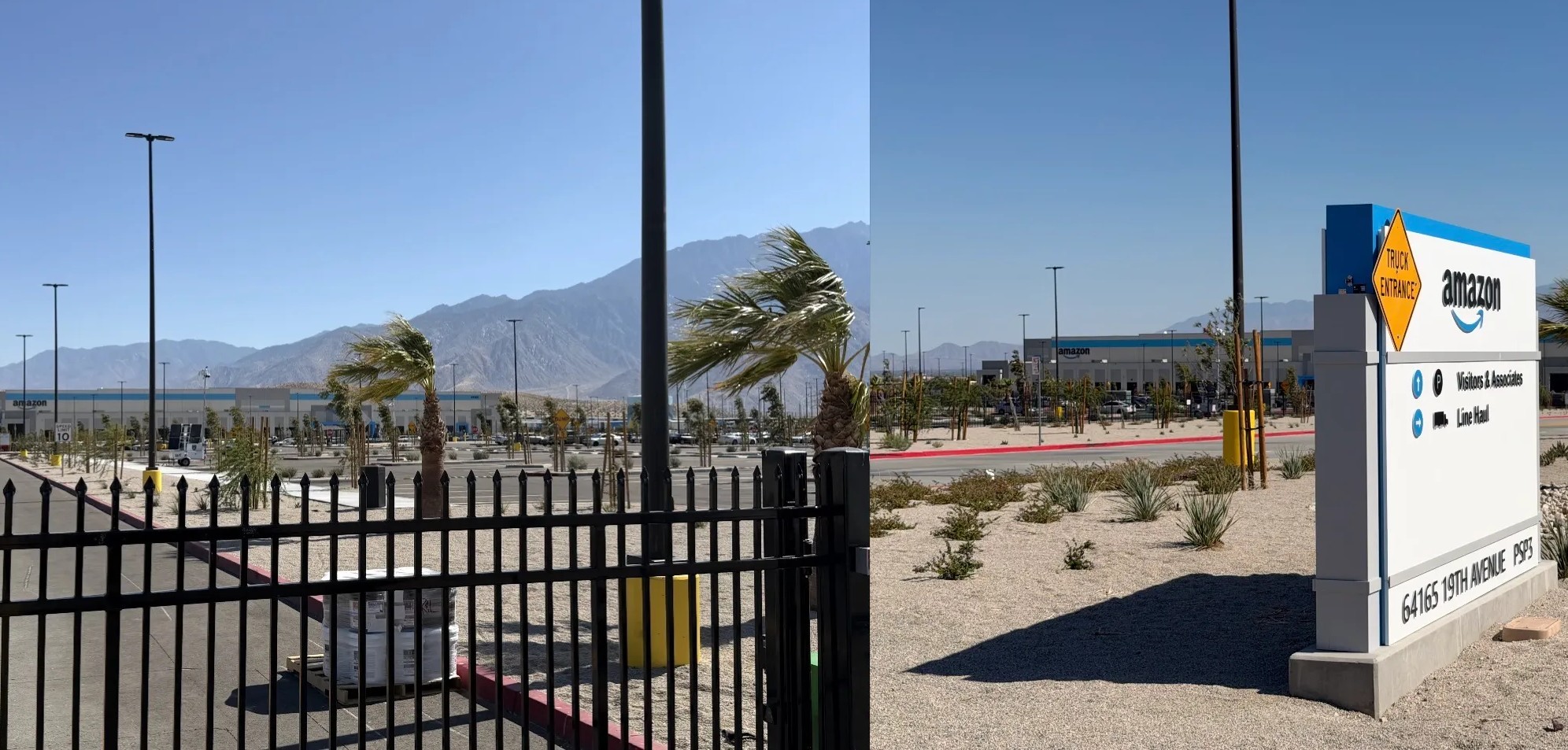
A view of the Desert Hot Springs Amazon warehouse associates parking area at mid-day.
But the strategy also carries risks. Warehouses bring extreme truck traffic, resulting in wear and tear on smaller local roads, noise, air-quality concerns, and public skepticism, especially if residents believe the benefits are overstated or that the use may change after approval. The accelerated use of automation, robotics and artificial intelligence in warehousing also raises longer-term questions about how many jobs these buildings will support over time and what kinds of jobs they will be. A look at the employee parking section at the Amazon facility in Desert Hot Springs indicates far fewer than 1,500 employees.
Those questions are especially important in Desert Hot Springs because the city is not merely approving isolated buildings. It is shaping a new industrial corridor.
The applicant also argued that the project’s design should be viewed as part of that broader corridor-building effort. Mar Snider said the company wanted to create a “best-in-class building” that would be an aesthetically pleasing addition to the Desert Hot Springs Industrial Corridor, with articulated facades, extensive glazing, higher-quality materials and a desert-inspired color palette. She said the site layout was designed to screen operational areas from public view, create a more attractive streetscape, and use drought-tolerant perimeter landscaping to soften the building’s scale as the landscaping matures.
That is the central issue now facing Desert Hot Springs. For years, the city has pursued investment that could help it catch up economically with other parts of the valley. Amazon’s arrival gave the city a visible symbol of progress, but also a reminder that corporate logistics decisions can shift, and that the public benefits of a project may depend heavily on what ultimately gets built and how it operates.
That uncertainty matters because the eventual user will determine much of the project’s real impact, from truck activity and employment levels to operational intensity and community benefit. Desert Hot Springs has learned through Amazon that the name, size and use of a warehouse can dramatically change the economic story.
The city is still making the bet. But this time, residents and commissioners appear more alert to the fine print.

Bob Marra is the CEO/Publisher of GPS Business Insider and GPS Market Intel. He has been studying, writing and giving presentations about business, economic and public affairs news and issues and the local economy in the Greater Palm Springs/Coachella Valley region for more than 20 years.