California’s official launch last week of the new Salton Sea Conservancy adds what some see as fresh momentum to mitigate one of the state’s most persistent environmental challenges. For communities in the Coachella Valley and Imperial Valley, that is meaningful progress. But the moment also requires a clear understanding of what is new, what is not, and why the long-established Salton Sea Authority remains central to the Sea’s future.
The Conservancy is new. The Salton Sea Authority is not.
That distinction matters because public discussion of the Conservancy’s debut can easily create the impression that California has only now put a serious institutional framework in place around the Salton Sea. In reality, the region already has an entity, in the Salton Sea Authority, that has spent decades focused on the issue, advocating for solutions, coordinating among agencies and keeping the Sea on the policy agenda through often drastically shifting political and financial cycles.
The new Conservancy deserves recognition. Created under state law and preparing for its first board meeting, it will help sustain restoration work over the long term, support habitat and dust-suppression efforts, improve public access and provide a more durable stewardship framework around completed and ongoing projects. Those are important responsibilities, and if the Conservancy performs them well, it can become a valuable asset to the region.
But it should not be seen as a replacement for the Salton Sea Authority. The stronger case is that both bodies can serve important, complementary roles.
That is especially true because a better future for the Salton Sea will require much more than project maintenance and state-level coordination. It will require a long-term plan that is technically sound, financially realistic and backed by multiple layers of government, including Washington. That is where the Salton Sea Authority’s partnership with the U.S. Army Corps of Engineers becomes one of the most consequential pieces of the region’s strategy.
To add more perspective, the Salton Sea Conservancy’s creation is institutionally significant, but its budget helps clarify what it is, and what it is not. The conservancy entered the state system with a 2026-27 budget of about $3.2 million, a modest figure compared with some of California’s older conservancies, including the State Coastal Conservancy at roughly $82.9 million, the San Gabriel and Lower Los Angeles Rivers and Mountains Conservancy at about $23.3 million, and the Sacramento-San Joaquin Delta Conservancy at about $17.7 million. Even several smaller California conservancies (there are 11 in total) have budgets in a similar range. That does not diminish the importance of the Salton Sea Conservancy. It does, however, underscore that the new agency is not a standalone financial solution to the Sea’s enormous long-term needs.
The Authority has long presented itself as the only federally recognized local sponsor of Salton Sea restoration efforts, and it has repeatedly argued that its value lies in coordination, continuity and alignment across jurisdictions. Most significantly, it is serving as a joint local sponsor, alongside the California Department of Water Resources, on the Army Corps of Engineers feasibility study tied to long-term restoration planning.
That is not a minor procedural matter. It is one of the most important structural developments ever in the Salton Sea effort.
The feasibility study is designed to help establish what is actually reasonable, feasible and achievable over the next 20 to 50 years. Just as important, it formally ties the Sea’s future to the Army Corps and, by extension, the federal government. That federal connection matters because the scale of restoration and environmental management needed at the Salton Sea far exceeds what symbolic gestures or smaller programmatic budgets can accomplish.
If the Salton Sea is ever going to see the level of investment required to make meaningful long-term progress, the federal government will have to be involved in a major way. The Army Corps partnership is therefore more than a planning exercise. It is a gateway to the federal participation and funding necessary to move beyond fragmented improvements toward a comprehensive strategy.
Patrick O’Dowd, the Salton Sea Authority’s executive director/general manager, made clear that the Authority does not view itself as a secondary player in that process.
“I often say that the Salton Sea Authority has three priorities, health, habitat and opportunities,” O’Dowd said. “I call opportunities jobs, housing, schools, retail, and more.”

Expanded geothermal energy production and the acceleraton of the extraction of lithium and other minerals must be a part of the solution for a sustained Salton Sea solution.
Without that broader economic vision, he said, “the rest of this vision is not going to work.”
That outlook reflects an important reality. The Salton Sea is not only an environmental problem. It is also a public health issue, a regional quality-of-life issue and an economic development issue. Any durable strategy must account for all of those dimensions at once.
O’Dowd also pushed back on the idea that recent changes in membership have weakened the Authority’s relevance.
“It was a little disappointing when IID, for reasons that are personal to them, decided to no longer associate with the Authority as a member,” he said. “But I just don’t think the rest of the member agencies have missed a beat.”
He added that the Authority will now have to work with Imperial Irrigation District “in a bit of a different manner.”
More importantly, O’Dowd emphasized that the Authority’s position in the Army Corps process gives it a continuing and protected role in the future of Salton Sea planning.
“The Authority is a joint local sponsor with the state on the Army Corps project,” he said of the feasibility study. “Regardless of what the Conservancy does, no one can take that away from us because we secured it. We are at the table. We are a signatory to the agreement.”
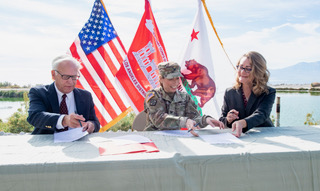
Patrick O’Dowd formalizes the SSA partnership in the Army Corps of Engineers Feasibility Study with representatives of the Corps and the California Department of Water Resources.
That statement gets to the heart of why the Authority remains so important. The Conservancy may emerge as an effective long-term steward of on-the-ground projects. But the Authority is already embedded in the framework that could shape the Sea’s broader future, including the long-range planning process most likely to attract the level of federal commitment the region needs.
That does not diminish the Conservancy. It clarifies its role.
California has made real progress in recent years, including work on the Species Conservation Habitat Project and other efforts aimed at reducing dust, restoring habitat and improving conditions around the Sea. State officials have highlighted more than $500 million in combined state and federal investments since 2019, and those milestones deserve recognition. The Conservancy can help ensure such projects are maintained, managed and expanded in a more coherent and durable way over time.
O’Dowd himself framed the relationship in cooperative terms.
“The Salton Sea Authority played a leading role in the creation of the Salton Sea Conservancy, and we are pleased to see it come to life,” he said. “For decades, communities around the Sea have lived with environmental and public-health challenges that no single agency could ever solve alone. The Conservancy provides the long-term stewardship framework needed to ensure that restoration projects are maintained, expanded, and supported for the benefit of local residents, Tribal nations, regional partners, and the broader stakeholder community.”
He added: “The Authority stands ready to align regional capacity and support the Conservancy in ensuring that the progress now underway becomes durable, coordinated, and lasting.”
That is the most constructive way to view the moment. The Salton Sea does not need a contest over institutional relevance. It needs clearly defined roles, steady coordination and a path that connects local advocacy, state implementation and federal participation.
For a region that has spent decades hearing promises about the Salton Sea, that distinction is not academic. It goes directly to whether the current moment can produce lasting results.
The best outcome from here is not that one organization eclipses the other. It is that the new Conservancy and the established Authority each perform the role they are best positioned to play.
There’s so much more to the story of the Salton Sea – past, present and future – and we will continue to consistently write about it.

Bob Marra is the CEO/Publisher of GPS Business Insider. He has been studying, writing and giving presentations about business, economic and public affairs news and issues and the local economy in the Greater Palm Springs/Coachella Valley region for more than 20 years.