Five speakers will take the stage Aug. 25 for a free program that connects psychology, endurance, grief, communication and a Coachella Valley composting venture.
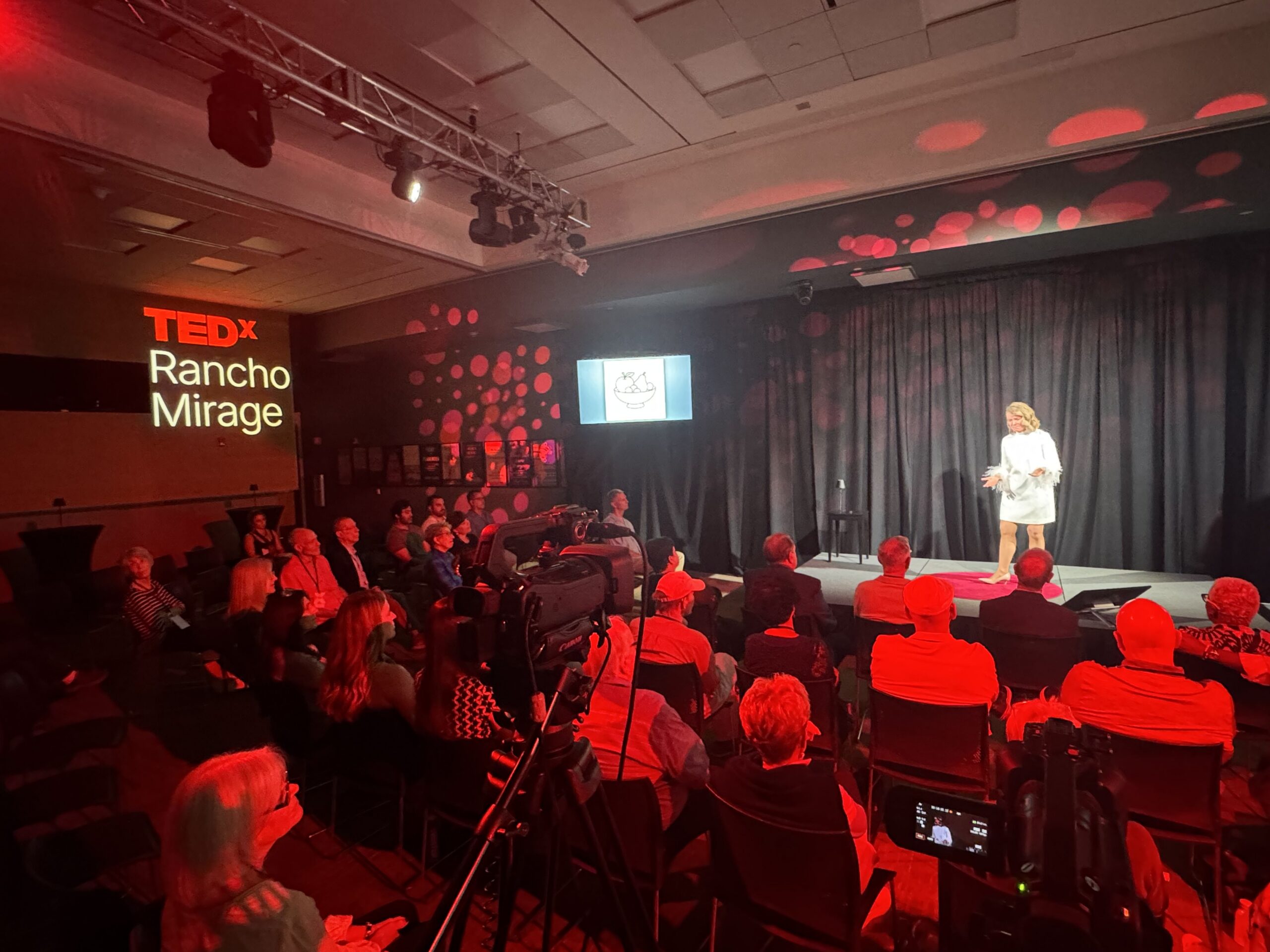
Last summer, the TEDx experiment in Rancho Mirage fit neatly inside a 100-seat room.
The audience was invitation-only, the five speakers were from the Coachella Valley, and the program arrived with the guarded ambitions of a first-year event. Their talks ranged from artificial intelligence and entrepreneurship to hospitality, theater and the emotional needs of young boys.
Twelve months later, the experiment has widened.
Organizers of the second annual TEDxRanchoMirage received 499 speaker submissions during an open application period in April. Most came from the Coachella Valley, but proposals also arrived from New York, Washington, Canada, London, France and Manila.
On Tuesday, Aug. 25, five of those applicants will take the stage at the Rancho Mirage Library & Observatory. This time, the public is invited. Doors open at 6 p.m., and the program begins at 7 p.m. Admission is free, and no advance registration or ticket is required.
The theme is “Under the Same Sky,” a deliberately expansive phrase intended to connect ideas across professions, cultures and personal experiences. The selected talks will explore human perception, grief, psychological identity, the limits people place on themselves and an environmental entrepreneur’s effort to turn California waste mandates into a functioning local business.
“We are energized to bring TEDxRanchoMirage back for its second year,” organizer Eric Cunningham said. “And the world-famous Rancho Mirage Library & Observatory is the perfect place to host it. Everyone already knows it’s synonymous with brainy, high-quality programming. Under this year’s theme, ‘Under the Same Sky,’ we’re opening the doors wider than ever to share ideas that connect us all.”
From a local debut to a global applicant pool
The leap from five locally based speakers in 2025 to 499 proposals a year later is an early measure of how quickly the Rancho Mirage event has gained attention.
Organizers said the applicant pool included a former chief technology officer of the Central Intelligence Agency, executives associated with Amazon and Deloitte, a physician-engineer from the Mayo Clinic, an Emmy Award-winning journalist and a Hollywood stuntwoman.
The final slate, however, was not assembled as a celebrity showcase. It crosses disciplines while keeping one of its clearest business and public-policy connections firmly rooted in the Coachella Valley.
The event is independently organized under a license from TED. TED supplies the framework and standards, but local organizers select the speakers, shape the program and coach the participants.
The distinction is important. TEDxRanchoMirage is not a touring version of the main TED conference. It is a locally produced platform operating within the broader TEDx program, which allows communities to develop TED-style events around ideas they believe deserve a larger audience.
Speakers do not pay to appear. Organizers say consideration, coaching and participation are provided without charge. The five people selected for 2026 have spent months refining their talks for the relatively compressed TEDx format.
Five approaches to a broad theme

Prema Walker offers the program’s most direct connection to the Coachella Valley economy.
Walker is founder and chief executive of Prema’s Permaculture & Composting, a local venture built around collecting organic material, converting it into compost and returning it to the communities that generated it.
She grew up in India watching her grandfather farm land without attaining lasting financial security. After settling in the Coachella Valley in 2020, she saw similar pressures confronting local growers and began developing a model intended to connect environmental work with economic opportunity.
Her business also illustrates how regulation can create a market.
California Senate Bill 1383 established a statewide target of reducing the amount of organic waste sent to landfills by 75 percent from 2014 levels by 2025. It also called for recovering 20 percent of edible food that otherwise would be discarded.
The law requires local jurisdictions to provide organic-waste collection, oversee compliance and use products made from recycled organic material, including compost and mulch. Those requirements have created demand for collection systems, processing capacity, education and new composting businesses.
Walker’s company has diverted more than 700,000 pounds of organic material from landfills since 2021, according to event organizers. Her work has secured roughly $275,000 in competitive funding while supporting jobs, food production and community green spaces.
At UFO Palm Springs, short for Urban Farm of Palm Springs, Walker has used a backyard operation as a small-scale demonstration site, composting more than 82,000 pounds of material.
She also filed a Measure J community-initiated project application with Palm Springs proposing a larger urban farm and micro-composting facility. The application described a $1 million concept that would combine organic-waste processing, food production, workforce training and community education.
Her TEDx talk is expected to frame that work as social entrepreneurship, showing how a state mandate can become the foundation of a local enterprise rather than simply another compliance obligation.
Ivan Borzenko’s talk begins with a very different kind of limit.
Borzenko was told as a child that he might never walk and could spend his life in a wheelchair. He later undertook a 320-mile triathlon as part of a Guinness World Record effort and, in 2026, served with an emergency medical team on Mount Everest.
Rather than presenting the physical accomplishments as ends in themselves, his talk will examine the boundaries people and institutions construct around human potential. His premise is that perceived limits can shape decisions long before actual ability is tested.
Dr. Romi Ran, an Oxford-trained clinical psychologist, will approach the theme through thought, identity and the origins of suffering.
After more than a decade working within conventional psychological frameworks, Ran became interested in how perception and identity shape human experience. Her perspective has also been influenced by intensive contemplative practice, including extended solitary and darkroom retreats.
Her talk will challenge audiences to consider what remains when familiar social identities and mental narratives are stripped away, and what it might mean to experience life more directly.
Dr. Carl Christman brings another examination of perception, although his approach begins with entertainment.
A professor, mentalist and author of How to Read Minds & Influence People, Christman uses language, psychology and body language to create the appearance of mind reading. His talk will move beyond performance to explore how people interpret behavior, make assumptions and communicate information they may not realize they are revealing.
Dr. Lynda Reid will focus on grief and the expectation that people should eventually “move on” from loss.
Reid is an author and Professional Certified Coach with a doctorate in education centered on multicultural leadership. After the death of her husband, she combined personal experience with neuroscience and leadership research to develop a different way of describing grief.
Her talk will argue that adaptation does not necessarily require leaving a loved one behind. Instead, loss can be carried forward as an enduring expression of love while a person continues building a life around it.
A free event, but not a guaranteed seat
The most visible change from the inaugural 2025 program is public access.
The first event operated under a 100-person attendance limit. The 2026 program is being expanded to admit more of the community, although organizers have not announced an exact seating capacity.
There are no tickets and no advance reservations. Rancho Mirage residents and people who contribute at least $100 annually to the Rancho Mirage Library and Observatory Foundation are eligible for priority seating at Premier programs if they arrive early. Organizers are encouraging everyone else to do the same because popular library programs frequently reach capacity.
Remaining seats will be filled on a first-come, first-served basis.
The setting is part of the event’s identity. The city-owned library and observatory has built a regional following through author appearances, science programs, films, lectures and the Rancho Mirage Writers Festival. Hosting TEDx there places the event within an existing civic institution devoted to public learning rather than in a hotel ballroom or private conference center.
That may also help distinguish TEDxRanchoMirage as it seeks a lasting place in the region’s intellectual and entrepreneurial life.
TEDxRanchoMirage occupies a different space, but it is responding to a similar regional question: How many consequential ideas and experiences already exist in the desert without a platform large enough to connect them?
The 499 applications suggest that finding people who want to speak will not be the problem.