A welcome dose of certainty for the desert
For Greater Palm Springs, the PGA TOUR’s confirmation that The American Express will return Jan. 21-24, 2027, is more than a calendar item. It is a sigh of relief.
At a moment when the tour is openly reconsidering how many events it wants, where they should sit on the calendar and how aggressively it should avoid television conflicts with the NFL, certainty has suddenly become valuable in its own right. That is especially true in Greater Palm Springs, where The American Express is not merely a golf tournament but one of the region’s most durable economic, charitable and branding assets.
The reassurance, first reported by Larry Bohannon of The Desert Sun, lands with extra force because the warning lights elsewhere are now flashing. The PGA TOUR has confirmed plans to end its tournament presence in Maui and is exploring a shift of the Sony Open in Hawaii into a PGA TOUR Champions format. In practical terms, that means two long-established Hawaii stops that once helped define the start of the season are no longer regular PGA TOUR events.
For the desert, that is not background noise. It is evidence that the tour is serious about a major reordering of its schedule for 2027 and beyond.
That is why the American Express confirmation matters so much at this point. In a period of rumor, restructuring and strategic ambiguity, the valley has something concrete. The event that began in 1960 and became inseparable from the Bob Hope era is still on the board, still in January and still positioned as part of the PGA TOUR’s West Coast presence even as the broader framework around it remains unsettled.
The tournament’s future beyond 2027 is not guaranteed. But for now, the region has what it needed most: time, clarity and a seat at the table while the tour decides what its next era will look like.
A 2026 tournament that made its case
That matters because The American Express has spent the past several years strengthening its case.
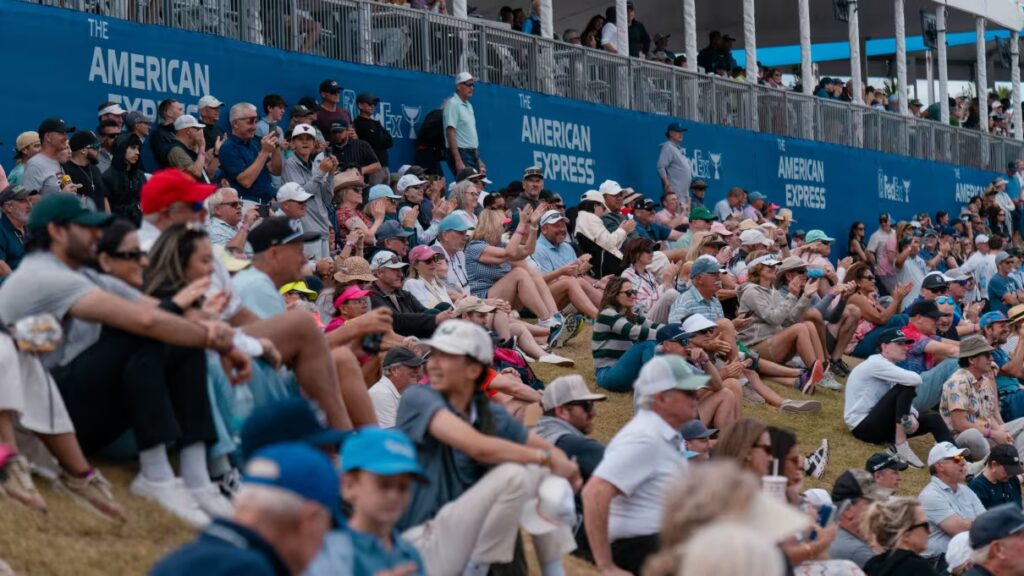
In 2026, the tournament delivered what local organizers could reasonably describe as one of its strongest editions in years, and perhaps one of the most important in proving its continuing value to the PGA TOUR. Scottie Scheffler, the No. 1 player in the world, won the event in his first start of the season. The field was exceptional by almost any measure. The tournament earned 379.25 points in the Official World Golf Ranking system, making it the strongest field on the PGA TOUR outside the four majors, The Players Championship and the Genesis Scottish Open over the past two seasons.
That is not a small distinction for an event that has periodically had to defend its place in a changing professional golf economy. For Greater Palm Springs, it amounts to proof that the tournament is not living on nostalgia alone.
Record attendance, stronger ratings, sharper business case
The business metrics were just as notable.
Tournament officials said the 2026 edition set attendance records, with ticket sales up 30 percent from the prior year. Concessions and merchandise also reached record highs. On television, Golf Channel posted its most-watched American Express since 2015, with overall viewership up 124 percent from the previous year. Four-day coverage averaged 515,000 viewers. Saturday’s third-round telecast, boosted by 18-year-old Blades Brown’s headline-grabbing 60, averaged 883,000 viewers and peaked at more than one million. The final round averaged 617,000 viewers, up 127 percent year over year.
Those numbers matter because the PGA TOUR’s current leadership has made clear that it is evaluating events through a modern media-and-market lens. In that context, The American Express was not merely adequate in 2026. It was persuasive.
The event also continues to offer something few other tournaments can match: a large-scale, three-course desert pro-am that blends elite golf, sponsor hospitality and the kind of executive networking that has become increasingly central to how modern sports properties justify their existence.
In La Quinta, that formula still appears to work.
More than a tournament week for the local economy
For the Greater Palm Springs economy, the importance extends beyond tournament week.
Local reporting has placed the event’s economic impact at roughly $20 million, with one estimate at about $24 million. That spending ripples across hotels, restaurants, transportation, retail and a range of hospitality-related services during one of the desert’s most important visitor months. It helps fill rooms and tables at a time when the region’s winter weather is among its greatest competitive advantages.
But the deeper significance goes beyond one weekend.
Golf remains one of the foundational industries in Greater Palm Springs, tied not only to tourism but also to real estate identity, destination marketing, resort economics and the broader service-sector ecosystem. The American Express serves as both a high-visibility event and a reinforcement mechanism for the broader golf economy. It keeps the region in front of a national audience that already associates the desert with fairways, winter sunshine and leisure travel.
The branding effect the region cannot easily replace
That branding value is difficult to overstate.
Televised golf has long served as a form of destination marketing that communities cannot easily buy outright. For four days, viewers are shown mountain backdrops, resort landscapes and course imagery that effectively operate as an extended travel advertisement for Greater Palm Springs. It is typically referred to as earned media, and for a market built in part on lifestyle, tourism and seasonal visitation, the exposure carries real value.
Even as the region has expanded its identity through music festivals, food, wellness and arts programming, golf remains one of its most globally legible calling cards. The American Express is one of the events that keeps that signal strong.
A charitable pipeline with deep local roots
Then there is the charitable side, which may be the tournament’s most locally resonant argument for survival.
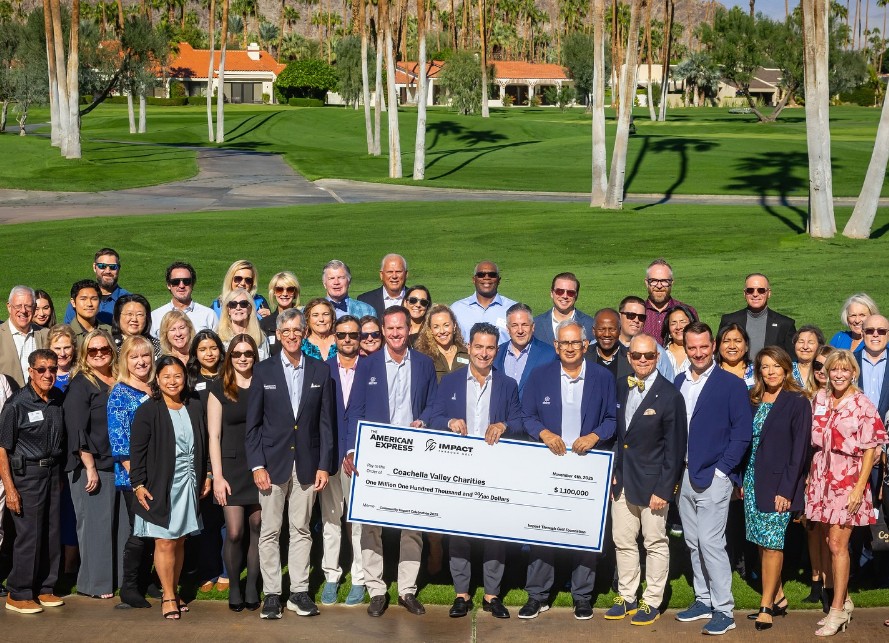
The Impact From Golf Foundation affiliated with The AMEX funded $1.05 million to local charities in 2025.
The event has generated more than $67 million for local charities since its inception, according to tournament and affiliated foundation reporting. Last November, Impact Through Golf awarded $1.1 million to 15 nonprofit organizations in the Coachella Valley. Those dollars support a range of causes, including youth and family services, health and wellness, education, hunger relief, homelessness-related needs and community improvement efforts.
That kind of giving has become part of the event’s civic identity. It is not simply a byproduct of the tournament. It is one of the core reasons local stakeholders care so deeply about its future.
In an era when leagues and tours are increasingly asking what measurable value each stop provides, the Coachella Valley’s answer is unusually strong. The American Express brings high-end visitors, business relationships, national television exposure and a long-running stream of charitable support. It is both a sports event and a regional asset.
Still safe for 2027, but not free of questions
That does not mean the uncertainty is gone.
What remains unclear is where the tournament will fit inside the PGA TOUR’s evolving competitive structure. Tour leadership has discussed a leaner model built around a smaller number of high-value events, possibly with a premier tier and a secondary track beneath it. It is still unknown where The American Express will land within that architecture, whether any such system will arrive fully in 2027 and what the long-term implications might be for purse size, field composition and format.
There is also the continuing NFL issue. The 2027 tournament dates still overlap with divisional playoff weekend, underscoring that the tour’s desire to reduce football competition has not yet translated into a clean solution for every event.
What the desert should take from this moment
Still, the message from the latest developments is unmistakable.
The PGA TOUR is willing to make hard decisions. Hawaii learned that the old assumptions no longer hold. That makes the confirmation of The American Express all the more meaningful. The desert event did not just survive a round of uncertainty. It survived at a time when the tour is actively reshaping the front end of its calendar.
For Greater Palm Springs, that is welcome news. It protects a proven economic generator, preserves a major charitable pipeline and secures another year of worldwide exposure for a region that has spent decades building its identity around golf, hospitality and winter appeal.
The harder question comes next: how to make sure this is not merely a reprieve for 2027, but part of a case strong enough to carry the tournament well beyond it.

Bob Marra is the CEO/Publisher of GPS Business Insider. He has been studying, writing and giving presentations about business, economic and public affairs news and issues and the local economy in the Greater Palm Springs/Coachella Valley region for more than 20 years.