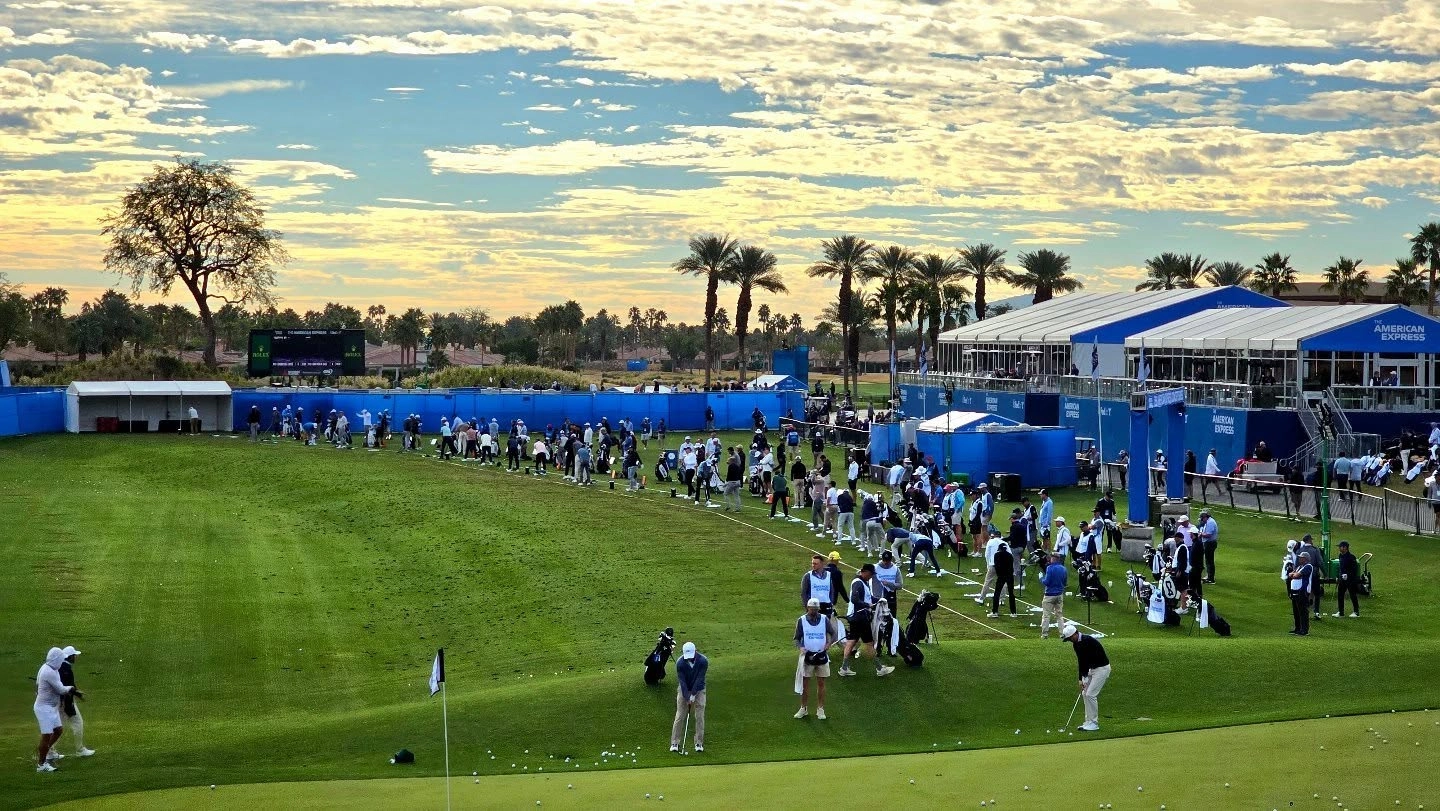
For Greater Palm Springs, the PGA Tour’s confirmation a couple of months ago that The American Express will return to La Quinta in January 2027 was the news many local golf fans, sponsors, charities and hospitality businesses were waiting to hear.
The tournament is secure for one more year. The familiar January week is still on the calendar. The desert will again have its PGA Tour showcase at PGA WEST and La Quinta Country Club, bringing national television exposure, hotel demand, restaurant traffic, sponsor activity and charitable giving to a region that has built part of its identity around golf.
But the relief comes with a warning.
On June 23, the PGA Tour announced plans to launch a new two-series structure that could reshape long-running tournaments across the country beginning in 2028. For The American Express, that means the 2027 event may not just be another edition of a desert tradition. It may be a critical transition year before the tournament faces major challenges to its field, purse, format, course rotation and place on the calendar.
Certainty for 2027, uncertainty after that
The 2027 tournament will be played Jan. 21-24, preserving the event’s traditional early-season position. That matters locally because January is prime time in Greater Palm Springs. The weather is a selling point; the hotels are active; seasonal residents are in town; and the tournament gives the region a national platform at exactly the right moment.
For local businesses, the confirmation gives planners, sponsors, vendors and hospitality partners time to prepare. For charities, it protects another year of support from the region’s most important philanthropic sports event. For fans, it means the valley will again host the kind of PGA Tour week that has been part of the local calendar since the event began in 1960.
But the broader PGA Tour landscape has changed quite significantly.
The tour has already shown it is willing to make hard decisions, including ending its regular tournament presence in Maui and exploring a shift of the Sony Open in Hawaii into a PGA Tour Champions event. Those decisions sent a clear message to every established tournament: history alone does not guarantee a place on the new PGA Tour.
The American Express now has one confirmed year to strengthen its case.
A tournament that matters far beyond golf
The American Express is not just a professional golf event. In Greater Palm Springs, it is an economic asset, a charitable engine and a branding platform.
It’s been several years since the analysis, but the tournament has claimed an annual economic impact of roughly $20 million, with some estimates closer to $24 million. That money flows through hotels, restaurants, transportation companies, retailers, vendors and service businesses during one of the most important tourism periods of the year.

The Impact Through Golf Foundation, the current charitable arm of The American Express distributed roughly $1 million in grants to local charities last November.
The charitable impact is just as important. The event and its affiliated foundation have generated more than $67 million for local charities since 1960, and recent annual giving has remained around $1 million. Those dollars support youth programs, family services, health-related causes, education, hunger relief and other community needs.
For local sponsors and long-time supporters, that is the heart of the argument. The tournament is not simply a week of golf. It is a long-running community institution that brings business activity, national visibility and charitable support together in a way few other events can match.
A strong 2026 helped the tournament’s case
The good news for the desert is that The American Express entered this moment with momentum.
The 2026 tournament was one of its strongest editions in years. Scottie Scheffler, the No. 1 player in the world, won the event in his first start of the season. The field was exceptionally strong, earning 379.25 points in the Official World Golf Ranking system. That made it the strongest PGA Tour field outside the four majors, The Players Championship and the Genesis Scottish Open over the previous two seasons.
The fan and business numbers were also strong. Tournament officials reported record attendance, a 30 percent increase in ticket sales, and record concessions and merchandise sales. Golf Channel coverage was the most-watched American Express since 2015, with overall viewership up 124 percent from the prior year.
Those numbers matter because the PGA Tour’s future structure is being built around stronger fields, clearer competition, better television value and more consistent fan interest. In 2026, The American Express showed it could deliver.
What could change in 2028
The PGA TOUR’s new model is expected to split events into two tracks: the PGA Tour Championship Series and the PGA Tour Challenger Series.
The Championship Series would feature the game’s top players, smaller fields of about 120, purses of at least $20 million, and no sponsor exemptions. The Challenger Series would feature fields of about 144 players and purses of at least $4 million, serving as the main pathway for players seeking promotion to the Championship Series.
For The American Express, the distinction is enormous.
If the tournament lands in the Championship Series, it could become more elite, with stronger player access and a much larger purse. But that could also require a smaller field and major changes to the pro-am format. It would also require moving to later in the year, as the first event in the series, starting in 2028, will be held in February to avoid competing for viewers with the NFL.
If it lands in the Challenger Series, it could remain a meaningful PGA TOUR event, but it would not include the game’s biggest names. Championship Series players would not be eligible to play in Challenger Series events under the announced structure. That would be a major change for a tournament that just saw Scheffler win and has spent years strengthening its field.
The current three-course format would likely also be affected. The American Express has long used the Pete Dye Stadium Course at PGA WEST, the Jack Nicklaus Tournament Course at PGA WEST and La Quinta Country Club, with a three-day pro-am and a 54-hole cut. The new PGA Tour structure calls for 72-hole events with 36-hole cuts. If applied strictly, that could make the current three-course rotation difficult to preserve.
A smaller field would also likely significantly change the pro-am, one of the tournament’s most distinctive features and a strong sponsor asset.
The local fan experience should be part of the strategy
The American Express has a strong business case, but it also has a fan experience challenge and opportunity.
For decades, the tournament was known not only for golf but for fun. The Bob Hope Classic era made the event famous by blending professional golf, celebrities, entertainment and a uniquely desert sense of personality. The modern tournament has become stronger competitively, but its future may depend on combining that stronger golf product with a more compelling local and visitor experience.
That matters whether the event lands in the Championship Series or the Challenger Series.
If it becomes a top-tier event, the valley should make sure the tournament still feels accessible, energetic and distinctly local. If it becomes part of the Challenger Series, the need for entertainment, sponsor activation and fan engagement becomes even more important.
The desert has the assets to do this well: weather, scenery, golf history, resort hospitality, a strong volunteer base, affluent seasonal residents, corporate guests and a built-in audience of local fans who have supported the tournament for decades.
The goal should be clear. The American Express should not become smaller in spirit, even if the PGA Tour changes its structure.
One year to enjoy, and one year to make the case
The 2027 tournament should be celebrated. It protects another year of economic impact, charitable giving, national exposure and local tradition.
But it should also be treated as an important audition.
The PGA Tour is redesigning its competitive system, and The American Express must now prove where it belongs within it. Its strongest argument will come from the people and institutions that have always made it matter: local sponsors, business leaders, volunteers, charities, golf fans, hospitality partners and the broader Greater Palm Springs community.
Over the many years, the tournament has survived sponsor changes, format changes, course changes and shifts in the golf economy. Now it faces a larger test. It must show the PGA Tour that The American Express is not just a legacy event, but a modern sports, business, tourism and charitable platform worthy of a strong place in the game’s next era.

Bob Marra is the CEO/Publisher of GPS Business Insider. He has been studying, writing and giving presentations about business, economic and public affairs news and issues and the local economy in the Greater Palm Springs/Coachella Valley region for more than 20 years.