By late spring, the Greater Palm Springs labor market looked better than it did a year earlier.
The regional unemployment rate across the valley’s nine cities fell to 5.0% in May, down from 5.4% in May 2025, according to not-seasonally-adjusted labor force data from the California Employment Development Department. Every Greater Palm Springs city posted a lower unemployment rate than a year ago.
That is the encouraging part of the report.
The more complicated part is that the region did not get there through broad employment growth. The local labor force shrank. Total employment declined. And the valley’s unemployment rate remained higher than Riverside County’s, California’s, and the nation’s.
In other words, the headline improved, but the labor market still did not look especially strong.
Across Greater Palm Springs, the labor force declined from 180,600 in May 2025 to 177,000 in May 2026. Total employment fell from 171,300 to 168,600. The number of unemployed residents dropped from 9,600 to 8,500.
That combination lowered the unemployment rate, but it also shows why the report should be read carefully. A lower unemployment rate is usually best when it comes from more people working. In May, the valley had fewer unemployed people, but also fewer people in the labor force and fewer employed.
For business leaders and policymakers, that distinction matters.
A lower rate in every city
The strongest takeaway in the May report is the breadth of improvement.
All nine Greater Palm Springs cities posted lower unemployment rates than a year earlier. The largest year-over-year improvements came in Cathedral City, Coachella and Indio, each down by half a percentage point.
Cathedral City posted the lowest unemployment rate in the region at 3.6%, down from 4.1% a year earlier. The city had 900 unemployed residents in May, down from 1,100 in May 2025.
Coachella remained the city with the highest unemployment rate in the valley, but it declined from 8.0% to 7.5%. The number of unemployed residents fell from 1,900 to 1,700.
Indio, the region’s largest city by labor force, improved from 5.0% to 4.5%. Its unemployed count fell from 2,300 to 2,000, the largest numerical decline among the nine cities.
Rancho Mirage remained the second-highest in the region at 6.9%, down from 7.3%. Desert Hot Springs improved from 5.0% to 4.6%.
Palm Desert declined from 4.7% to 4.5%. Palm Springs improved from 4.6% to 4.4%. La Quinta edged down from 4.5% to 4.4%. Indian Wells moved from 4.7% to 4.4%.
The city-by-city picture
The May unemployment rates by city:
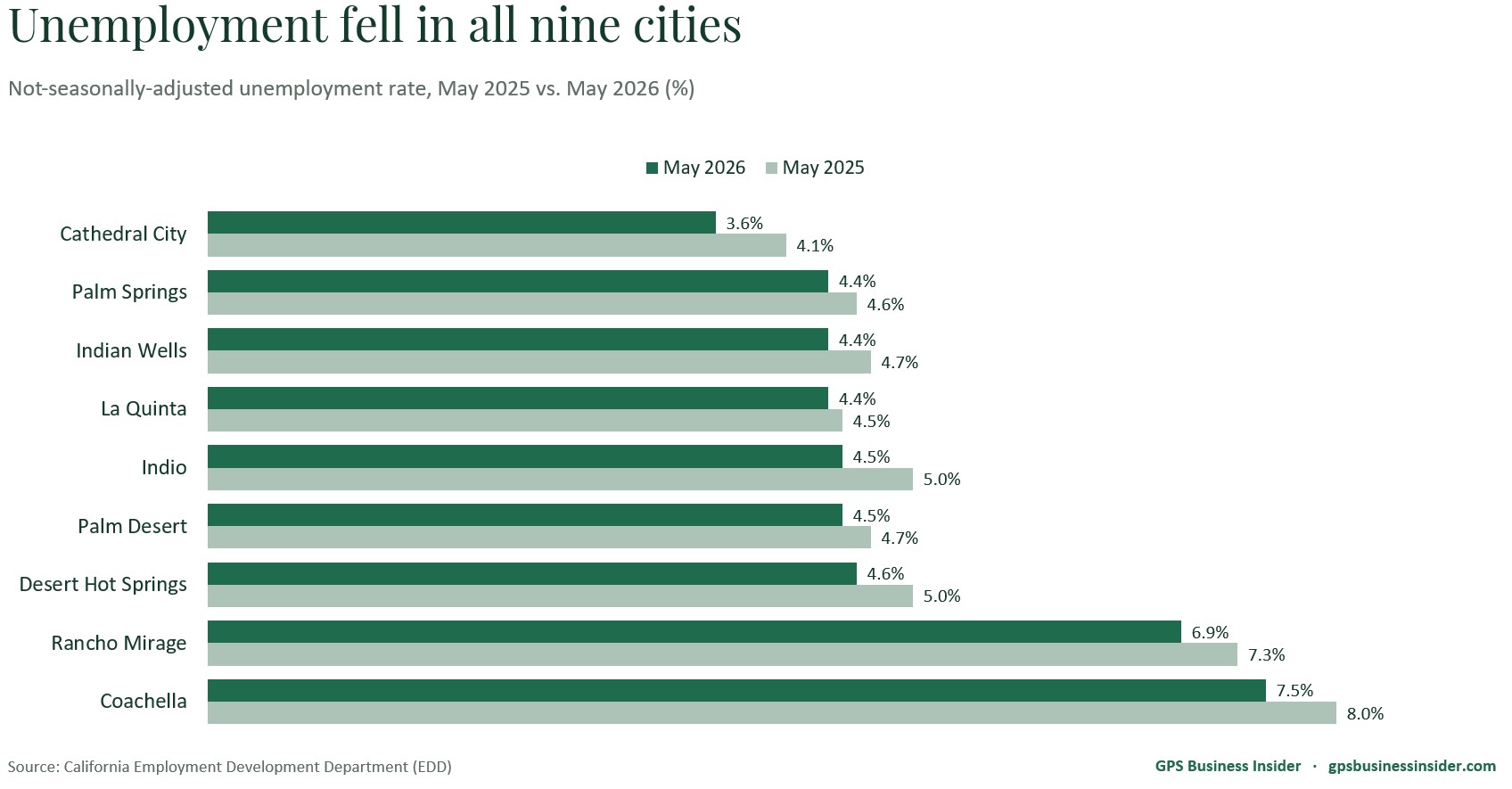
The city spread is important. The region’s lowest rate, Cathedral City’s 3.6%, was less than half of Coachella’s 7.5%. That gap reflects a familiar Greater Palm Springs pattern: the regional economy can improve overall while still producing very different conditions across individual cities.
The East Valley remains a major part of that story. Indio and Coachella together represented about 38% of the valley-wide labor force in May, but about 44% of the region’s unemployed residents.
That does not mean those cities are moving in the wrong direction. Both improved. But it does show where the region’s employment stress remains most concentrated.
Better than last year, still above benchmarks
Greater Palm Springs improved more than Riverside County and California on a year-over-year basis, but it still remained above both.
Riverside County’s not-seasonally-adjusted unemployment rate was 4.7% in May, down from 5.0% a year earlier. California’s not-seasonally-adjusted rate also was 4.7%, down from 5.0%.
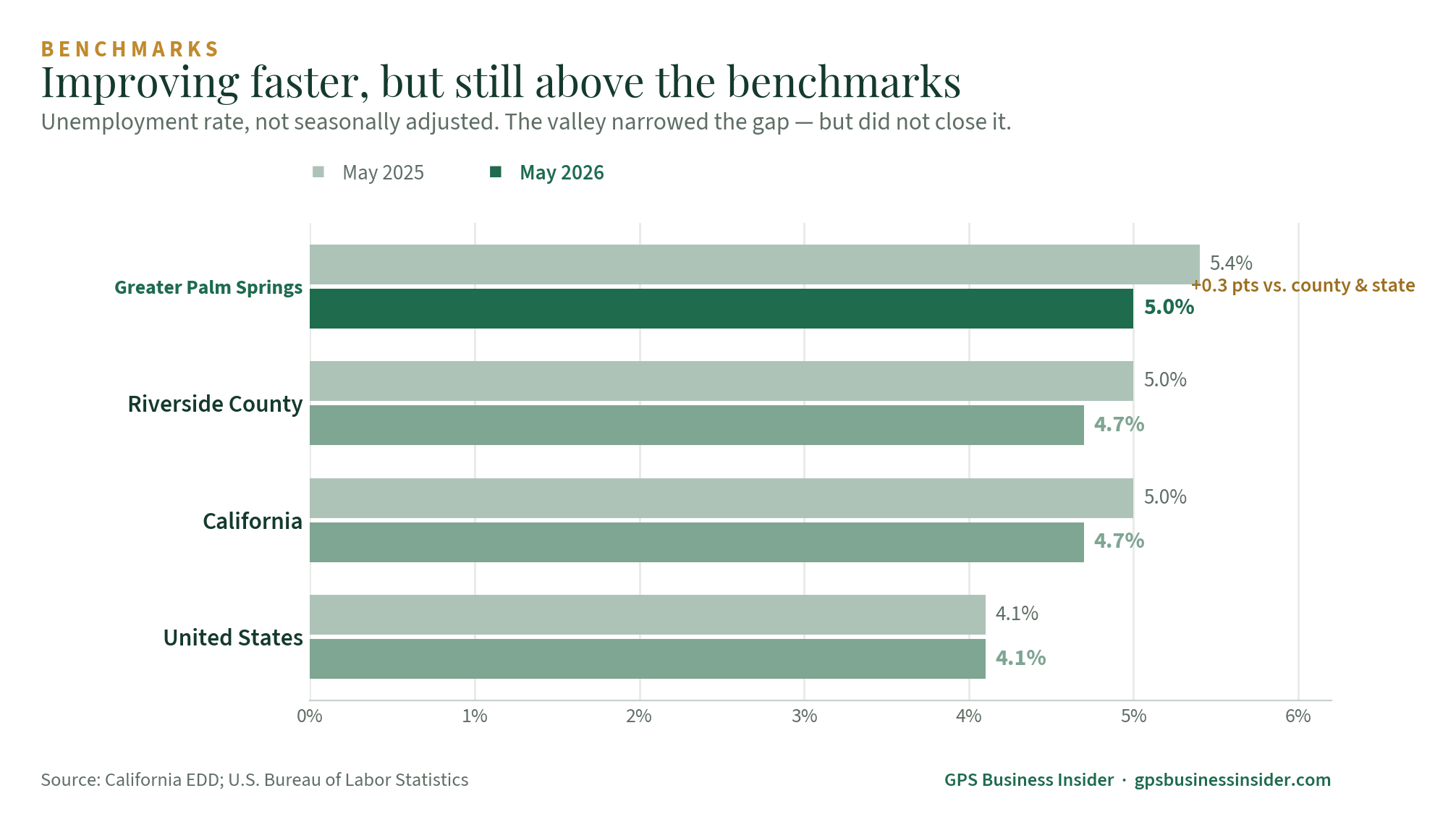
Greater Palm Springs was at 5.0%, down from 5.4%.
That means the valley narrowed its gap with the county and state, but did not close it. The region remained three-tenths of a percentage point higher than both Riverside County and California.
The national comparison is more favorable than in some earlier local reports, but still shows the valley running higher than the U.S. rate. The national unemployment rate in May was 4.1% on a not-seasonally-adjusted basis, little changed from a year earlier.
Only Cathedral City was below the national rate in May.
California adds jobs, but slowly
The statewide picture also points to a labor market that is stable but hardly booming.
California gained 3,100 nonfarm payroll jobs in May, while the state’s seasonally adjusted unemployment rate held steady at 5.3%. The state has now held that rate for three consecutive months.
California’s job gains were concentrated in a few sectors. Private education and health services added 6,200 jobs, continuing the long-running strength of health care and social assistance. Leisure and hospitality added 5,900 jobs, although state officials noted the gain was smaller than usual for May.
Professional and business services posted the largest monthly loss, down 6,900 jobs. Other services fell by 5,000, and trade, transportation and utilities declined by 2,400.
That matters locally because Greater Palm Springs depends heavily on visitor-facing employment, professional services, health care, local government, construction, restaurants and retail. When statewide hiring is concentrated in a few sectors and leisure and hospitality gains are softer than usual, it reinforces the need to look beyond the topline unemployment rate.
National report shows a slower hiring environment
The national backdrop grew more cautious with a June 2 Bureau of Labor Statistics (BLS) report.
The U.S. economy added 57,000 jobs in June, a slower pace than in May, while the national unemployment rate slipped from 4.3% to 4.2%. On the surface, that still looks like a durable labor market. But the details were more mixed.
The labor force declined sharply in June, and the labor force participation rate fell to 61.5%. That makes the lower unemployment rate less straightforward, because fewer people participating in the labor force can also push the rate down.
The BLS also revised previously reported job gains for April and May, lowering them by a combined 74,000 jobs. May’s national gain was revised down from 172,000 to 129,000.
June’s sector data was especially relevant for a tourism-driven region. Leisure and hospitality employment declined by 61,000 nationally, while professional and business services added 36,000 jobs, social assistance added 25,000 and health care added 22,000.
For Greater Palm Springs, the national report does not directly match the local May city data. But it provides the broader context: the labor market is still functioning, though not accelerating.
What the May report really says
The May data give Greater Palm Springs something positive to report. Unemployment is lower than it was a year earlier. Every city improved. The regional gap with Riverside County and California narrowed slightly.
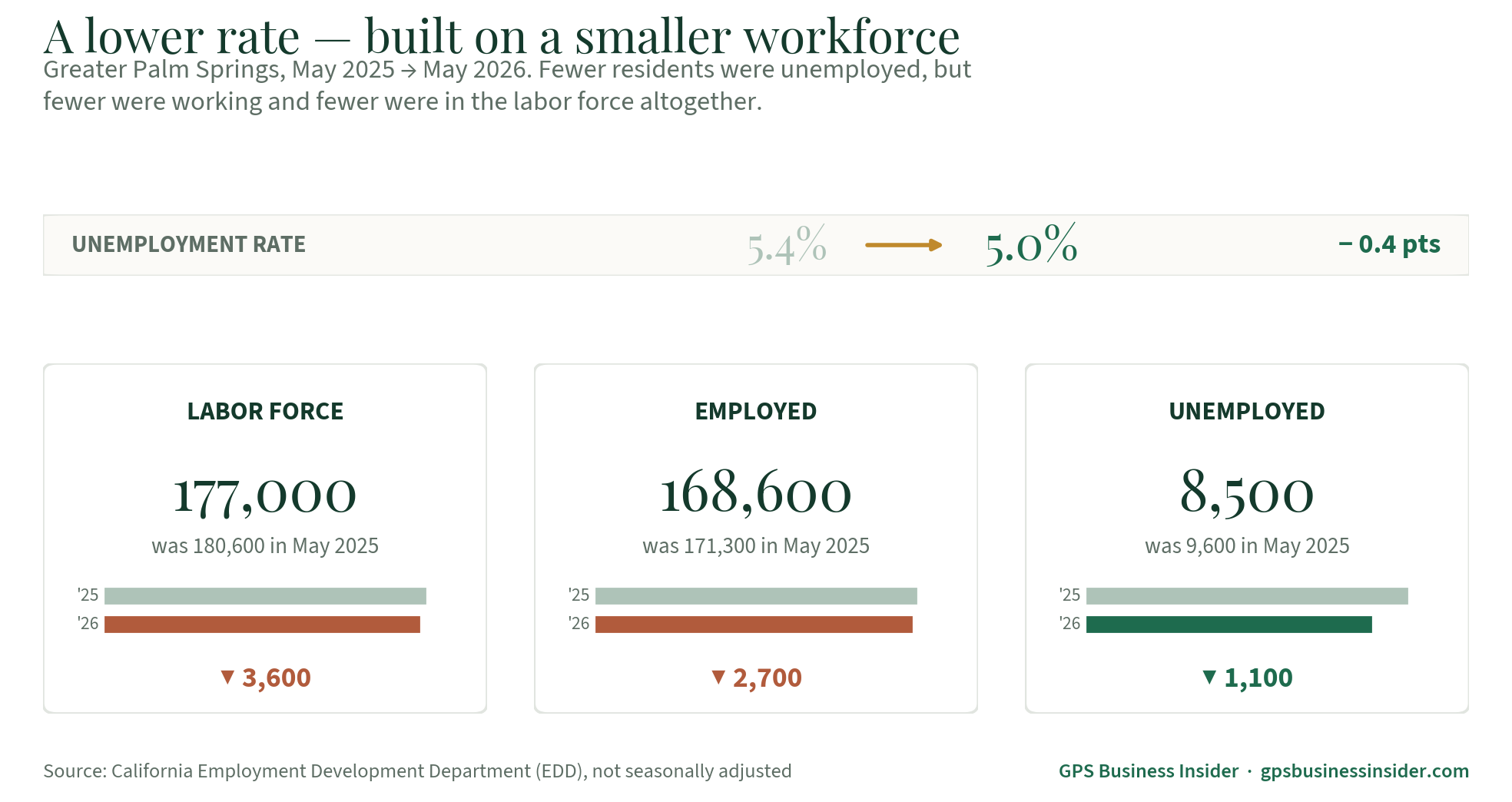
But the report also points to a more restrained local economy than the headline alone suggests. The valley had fewer unemployed residents, but also fewer employed residents and a smaller labor force. That is not the same as a broad hiring expansion.
The best interpretation is that Greater Palm Springs entered the summer with less visible unemployment pressure than a year earlier, but without clear evidence of stronger employment momentum.
That is the key distinction for the region heading into the second half of 2026.

Bob Marra is the CEO/Publisher of GPS Business Insider. He has been studying, writing and giving presentations about business, economic and public affairs news and issues and the local economy in the Greater Palm Springs/Coachella Valley region for more than 20 years.