The 1.73-acre offering near Highway 111 renews a yearslong effort to put vacant public land to use. Developers have until Nov. 2 to submit concepts.
Palm Desert is asking developers to propose housing on six publicly owned parcels, giving builders latitude to determine what they can build on 1.73 acres without setting a target number of homes or prices.
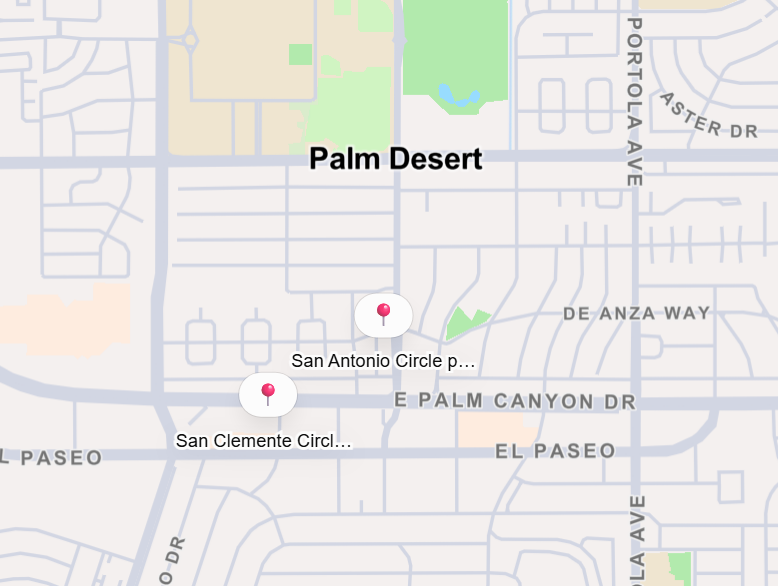
The San Antonio Circle and San Clemente Circle areas in Palm Desert, where the city is seeking development proposals for six publicly owned parcels totaling approximately 1.73 acres of potential residential development.
The request for proposals, issued Oct. 1, covers vacant property around San Antonio Circle, San Clemente Circle and Alessandro Drive, near the Highway 111 commercial corridor. Concepts may include detached homes, townhouses, duplexes, triplexes, courtyard housing, condominiums and smaller apartment buildings. Proposals are due Nov. 2.
The city encourages affordable, workforce or attainable housing, but it has not imposed an affordability quota in this initial solicitation. Instead, developers are being asked to show what they believe is financially feasible and compatible with the surrounding neighborhood.
A Yearslong Effort to Develop Public Land
The new offering follows several attempts to move the property toward development. In December 2022, the City Council and redevelopment successor agency considered declaring seven related parcels surplus. Six parties subsequently expressed interest after notices were issued in February 2023, according to a city development summary.
No development agreement resulted from that process. In September 2024, the city sought renewed proposals from interested parties. The current solicitation covers six parcels rather than seven, and no builder has been selected.
Four parcels are owned by the Successor Agency to the Redevelopment Agency of the City of Palm Desert and total approximately 51,835 square feet. Two city-owned parcels add 23,522 square feet. Together, the offering encompasses about 75,357 square feet, although the lots do not form a single continuous site.
A seventh parcel is excluded and will remain in city ownership. Developers cannot assume they may use that property for access, parking, utility connections or construction staging, a constraint that could shape the design of nearby lots.
Housing Options, With Neighborhood Constraints
The sites lie within Palm Desert’s Downtown Edge Transition Overlay, where the General Plan calls for new housing while preserving a reasonable transition to established neighborhoods. The solicitation emphasizes compatibility rather than maximizing density.
Developers must propose preliminary unit counts and identify whether the homes would be sold or rented. They must also address height, setbacks, privacy, landscaping, shade, pedestrian access and desert-appropriate design. Practical matters such as parking, drainage, emergency access, trash collection and utilities could prove just as consequential for parcels of this size.
Bidders may seek all six lots, one ownership group or individual parcels. The city could award different sites to different teams. That flexibility broadens the field, but it creates tradeoffs: detached or attached ownership homes may need fewer shared facilities, while apartments could spread site-development costs across more units. Parking and neighborhood-design requirements will help determine what is practical.
Affordability Remains an Open Question
Although the request does not prescribe affordable units, future property transfers may still be subject to California’s Surplus Land Act, which gives affordable housing a defined role in the disposition of qualifying public land. Palm Desert says it will determine the legal requirements for each proposed transaction. The absence of an affordability quota in the RFP should not be confused with an exemption from those rules.
The solicitation comes as Palm Desert works toward its state-assigned housing targets. Its 2025 housing progress report listed permits for 60 moderate-income homes against a 2021-29 allocation of 461. It also reported 561 very-low-income units against a target of 675 and 304 low-income units against 460. Those figures track permits, not completed homes.
Whether the public parcels help address the region’s workforce housing gap will depend on the proposals. Small market-rate homes could expand ownership or rental choices, while income-restricted projects would serve a different segment of residents. As GPS Business Insider has reported, softer advertised rents have not erased the mismatch between local wages and housing costs. Unit sizes, construction costs and eventual prices on these parcels are not yet known.
Design and Track Record Lead the Selection
The first submission is not a land auction. Developers are specifically instructed to omit purchase prices, financing commitments and proof of funds. Such information could be considered during later negotiations.
Under the evaluation framework, qualifications and comparable experience account for 30 percent of the score, followed by design and neighborhood compatibility at 25 percent. Implementation strategy and schedule represent 20 percent, housing and community benefits 15 percent, and submission quality 10 percent. The city may invite up to three top-ranked teams for interviews.
Applicants must nevertheless demonstrate that their concepts can realistically move through approvals and construction. The city cautions that appraisals do not replace independent review of title, environmental conditions, utilities and access. Property could be offered on an as-is basis. The process is unfolding in a market where apartment sales can command substantial prices even as operating and financing costs challenge new construction, a tension examined in recent regional real estate coverage.
Proposals Due Nov. 2
The developer question deadline was Oct. 12, and the city expects to post clarifications by Oct. 19. Electronic proposals are due by 2 p.m. Pacific time Monday, Nov. 2, through the Palm Desert procurement portal.
Submitting a concept will not grant development rights. Any sale, ground lease or other transfer would require further negotiations, applicable reviews and governing-body approvals. Palm Desert retains the option to reject all proposals or keep some of the parcels.