
At the Greater Coachella Valley Chamber of Commerce’s State of Education conference, Val Martinez Garcia framed College of the Desert as a central force in economic mobility, talent development and the region’s next chapter
At a time when Greater Palm Springs is working to grow its economy, retain talent and prepare workers for rapidly changing industries, College of the Desert Superintendent/President Val Martinez Garcia delivered a message that was both personal and strategic.

COD Superintendent/President Val Martinez Garcia
The college, he told business, civic and education leaders, is no longer simply a place where students take classes. It is becoming a valley-wide system designed to connect education, workforce training, business needs and economic opportunity.
That theme, which Martinez Garcia described as “connecting the dots,” became the central argument of his presentation at the Greater Coachella Valley Chamber of Commerce’s State of Education conference, held May 1 at Agua Caliente Rancho Mirage.
The sold-out, first-time event brought together educators, employers, public officials and community leaders for a morning focused on the intersection of education and workforce readiness. The program included networking and a Workforce & Education Expo, bringing business leaders and education providers together at a time when the region’s workforce needs are becoming more urgent.
Martinez Garcia used the occasion to make a broader case: College of the Desert is not just responding to those needs. It is positioning itself as one of the most important institutions shaping the Coachella Valley’s future.
“What we’re doing here today really matters,” he said. “When education from every level comes together at the same table, something powerful happens. We stop talking about separate systems, and we start building a shared future.”
A Personal Story Tied To A Regional Mission
Martinez Garcia opened his remarks with a story about his grandparents, who immigrated to the United States in 1915 with little material wealth but a belief that hard work, sacrifice and persistence could create a better future for the generations that followed.
That story, he said, is not separate from the mission of College of the Desert. It is a core component of the mission.
Many COD students, he said, arrive on campus carrying the ambitions of parents, grandparents and families who see higher education as the path to stability, dignity and advancement. They are not simply enrolling in courses. They are carrying “someone else’s dream,” he said, often while balancing jobs, family responsibilities and financial pressure.
That framing gave his presentation its emotional core. For Martinez Garcia, workforce development is not just an economic development term. It is a way of converting aspiration into opportunity for students who may be the first in their families to attend college, complete a credential or enter a career pathway with long-term earning potential.
That is why, he said, the college’s role in the valley has to be understood in larger terms.
“We’re in a defining moment in the Coachella Valley,” Martinez Garcia said. “Our region is growing. Industries are evolving. The demands of the workforce are changing faster than ever before.”
From One Campus To A Valleywide System
One of the strongest messages in Martinez Garcia’s presentation was that College of the Desert is changing its physical and strategic footprint to better align with the geography of the Coachella Valley.
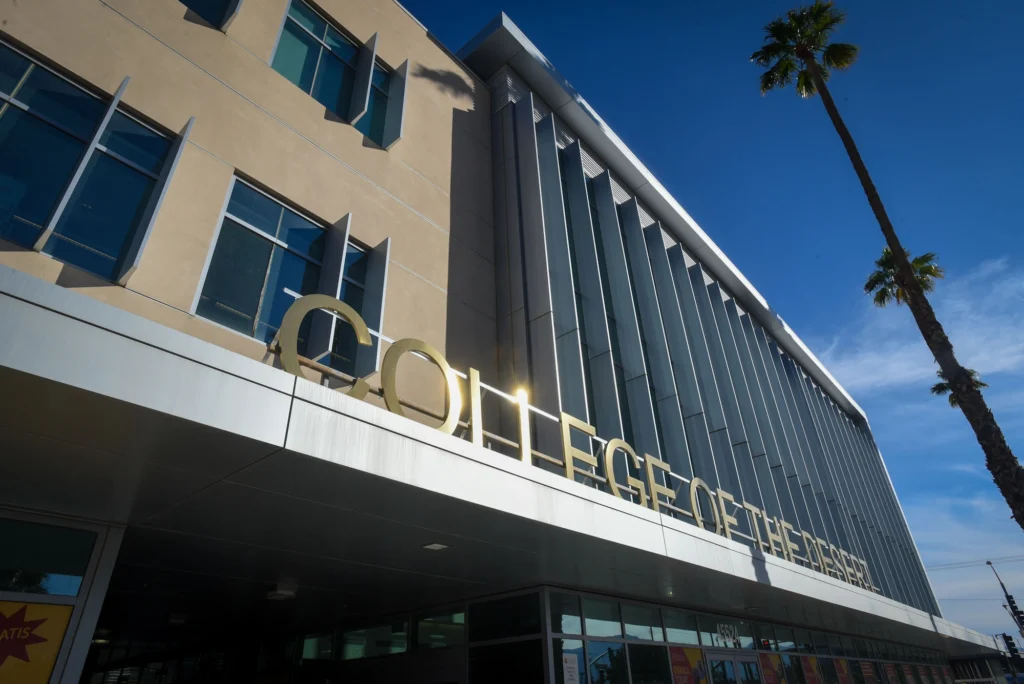
The COD Indio Campus has become an important part of the ongoing redevelopment of Downtown Indio while enhancing educational access for east valley students.
For decades, COD was anchored by its Palm Desert campus. But Martinez Garcia said the institution is becoming a multi-campus district designed to reach students where they live, from the west valley to the east valley.
“We are no longer a single college campus trying to serve a vast region,” he said. “We are becoming a multi-campus college district intentionally designed to meet every student where they are in every corner of the valley.”
He pointed to several major elements of that expansion: the Palm Desert campus, the Indio Campus, the Mecca/Thermal learning center, the future Palm Springs campus, Roadrunner Motors in Cathedral City, and a growing presence in Desert Hot Springs.
The COD Palm Springs Campus, scheduled to open in fall 2027, has been positioned as a major west valley hub for education and workforce training. The campus is expected to include advanced learning environments and programs aligned with regional needs in fields such as digital media, health care and architecture.
Roadrunner Motors, the college’s automotive and mobility training facility, is expected to open for instruction in spring 2027. It represents another piece of the same strategy: putting career education near industry, students and employers.
Martinez Garcia described these projects not as buildings, but as instruments of access.

A construction milestone was recently reached at College of the Desert’s Palm Springs campus, marking transition to interior buildout ahead of planned Fall 2027 opening.
“Every building we open, every campus we expand, every program we launch, is about one thing,” he said. “Bringing opportunity closer to students who need it most.”
That point is particularly important in Greater Palm Springs, where distance, transportation, family obligations and work schedules can determine whether a student can realistically pursue higher education. A campus in Palm Springs or a training facility in Cathedral City does not merely add square footage. It changes the practical equation for students who might otherwise decide college is out of reach.
The Workforce Question Facing The Valley
For business leaders, Martinez Garcia’s presentation landed on a familiar challenge: employers are searching for talent, while local students are searching for opportunity.
His argument was that those two realities should not exist in isolation.
“We know that employers are searching for talent, talent that is right here in our community, if we can just connect the dots,” he said.
That phrase became the bridge between the college’s educational mission and the business community’s workforce needs. Martinez Garcia said the future cannot be built through separate systems, with K-12 education in one lane, community college in another, universities beyond that and industry waiting at the end to see whether the pipeline works.
“For far too long, education has operated in silos,” he said.
The alternative, he said, is a more intentional system in which students can move earlier and more smoothly from high school to college, from college to career training, and from training to meaningful employment.
Dual enrollment is one piece of that strategy. Through dual enrollment, high school students can earn college credits before graduation, reducing both the time and cost required to complete a degree or credential. Martinez Garcia thanked local school district leaders in attendance for their partnerships with COD and said the college is also discussing “middle college” pathways that would allow students to begin their college futures even earlier.
The value of those efforts, he said, is not merely academic acceleration. It is a change in what students believe is possible.
“It tells students you do not have to wait your turn,” he said. “Your future begins right now.”
Access Is Only The First Step
Martinez Garcia made clear that access, while essential, is not enough on its own.
Students also need pathways that align with real jobs, programs that match regional economic needs, and support systems that help them persist to completion.
That is where College of the Desert’s plEDGE for All initiative fits into the broader picture. The program is designed to expand tuition-free education to every Coachella Valley resident in phases, with a goal of serving all residents by 2030.
Martinez Garcia described it as more than a program. He described it as a promise.
“Every student in the Coachella Valley who wants an education from College of the Desert will be able to attend tuition free,” he said, describing the college’s long-term goal. “If you’re going to take that step to go to college, we’re going to take away those barriers in front of you.”
The economic significance of that promise is substantial. Tuition is not the only barrier students face, but removing it can change the way families think about college. It can also help adults return to education, workers reskill for new industries, and employers draw from a deeper pool of trained local talent.
Martinez Garcia said the result is not just individual mobility. It is regional transformation.
“When we remove barriers, like financial barriers, something shifts in our students,” he said. “Students don’t just enroll. They persist, they complete, they move forward.”
Earning While Learning
A second major element of Martinez Garcia’s workforce vision is the idea that students should not have to choose between earning income and pursuing education.
For many Greater Palm Springs students, that choice is not theoretical. It is daily life. Students often balance class schedules with work shifts, caregiving responsibilities and household obligations. Traditional models of higher education can become unrealistic when they require students to pause their income in order to train for a better future.
Martinez Garcia said COD is working to build more earn-while-you-learn models through apprenticeships, internships and industry partnerships.
“This is where education means real-world experience,” he said. “Where students don’t just study concepts, they apply it, where employers don’t just hire talent, they help shape it.”
That model is increasingly important for a regional economy that depends heavily on hospitality, health care, construction, public services, small business, automotive services and other sectors where practical training and industry alignment matter.
For employers, the approach offers a more direct role in shaping the workforce they need. For students, it offers a clearer line between the classroom and a career.
The goal, Martinez Garcia said, is not simply to produce a workforce that is ready. It is to produce one that is resilient.
The Case For Local Bachelor’s Degrees
Martinez Garcia also used the presentation to make a policy argument with major implications for the Coachella Valley: College of the Desert wants to expand its ability to offer bachelor’s degrees aligned with local workforce needs.
He cited potential areas such as casino integrated management, automotive technology and other high-demand fields where local bachelor’s pathways could allow students to remain in the Coachella Valley rather than leaving the region to complete their education.
“We believe our students should not have to leave the Coachella Valley to complete their educational journey,” he said.
That message connects directly to one of the valley’s persistent economic development challenges. The region needs more skilled workers, more advanced training options and more career pathways that allow residents to build lives here. But access to four-year programs remains limited compared with larger metropolitan regions.
Martinez Garcia said the issue is not whether certain programs are needed. Too often, he said, the question becomes whether current approval systems allow them.
“If we are serious about workforce development, if we are serious about economic mobility, then we must be serious about modernizing the policies that govern who gets to offer that opportunity,” he said.
He framed the issue as one of geography, equity and responsiveness. Community colleges, he said, were built to respond to local needs, move quickly and serve regions where access to four-year institutions is limited.
That role, he argued, is not optional for the Coachella Valley. It is “vitally essential.”
A Business Community Role
The setting of the speech mattered.
The State of Education conference was not simply an education-sector gathering. It was hosted by the Greater Coachella Valley Chamber of Commerce, which has been working to strengthen the relationship between business and education. The chamber’s expanding partnership with COD, including its presence at the college’s Indio campus, reflects the same underlying priority that Martinez Garcia emphasized: the workforce pipeline must be built collaboratively.
Martinez Garcia named the chamber, OneFuture Coachella Valley, educators, business leaders and community supporters as part of the network needed to make the system work.
“No single institution can solve workforce development,” he said. “But together, we can build something really extraordinary.”
That was perhaps the most important point for the business audience. COD is not asking employers to watch from the sidelines while education systems try to anticipate workforce needs. It is asking employers to participate in shaping pathways, offering internships, supporting apprenticeships, advising on programs and helping students see where their education can lead.
In that sense, “connecting the dots” is not just the college’s theme. It is a regional assignment.
“One day, not too far from now,” he said, “we’ll look back and realize something extraordinary happened here in this valley. We just didn’t talk about opportunity. We worked together to build it.”

Bob Marra is the CEO/Publisher of GPS Business Insider. He has been studying, writing and giving presentations about business, economic and public affairs news and issues and the local economy in the Greater Palm Springs/Coachella Valley region for more than 20 years.