The Greater Palm Springs housing market delivered the kind of home sales data in June that are easy to misread.
According to Jon Gordon, a local broker with Rosenthal Associates based in Palm Desert, sales increased, inventory fell, and more properties entered escrow. Yet median prices declined, homes continued to sell below their asking prices, and condominium values appeared particularly vulnerable. Gordon’s cites data derived from the California Desert Association of Realtors’ (CDAR) Monthly Market Summary regionwide single-family home and condo sales reports for the month of June.
Taken together, the numbers describe neither a booming market nor one sliding into distress. They show a market finding buyers, but increasingly on the buyers’ terms.
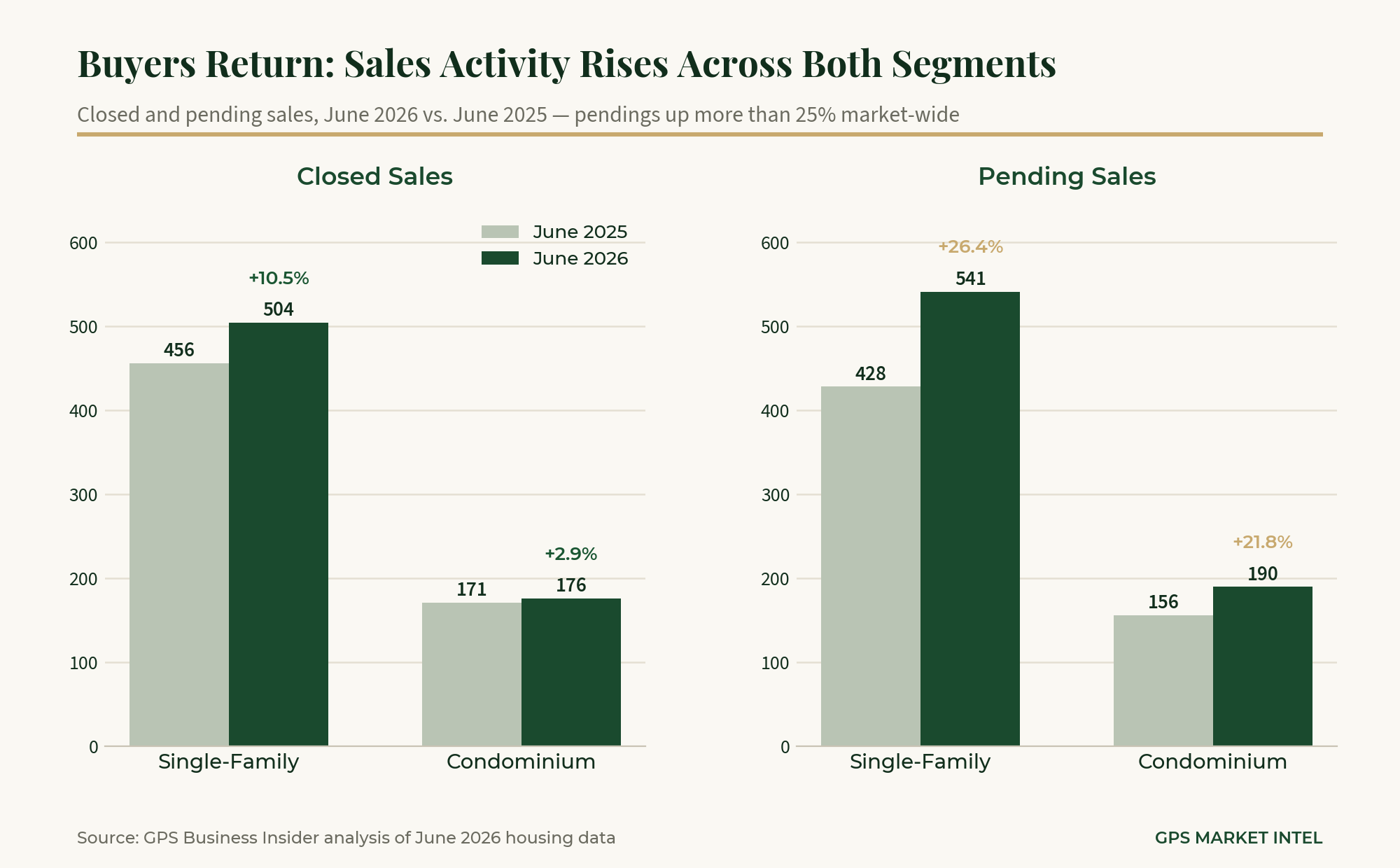
Across single-family homes and condominiums, 680 properties closed in June, about 8.5 percent more than the 627 sales recorded in June 2025. A combined 731 listings went under contract, up more than 25 percent from a year earlier.
At the same time, the median single-family price fell 3.5 percent from last year, while the condominium median dropped 10.8 percent.
The message is becoming clearer as Greater Palm Springs moves deeper into its slower summer season: Demand has not disappeared, but buyers are requiring the market to come to them.
Single-Family Sales Show Renewed Strength
The single-family market produced the strongest evidence that buyers remain engaged.
There were 504 single-family sales in June, up 10.5 percent from 456 a year earlier and 5.9 percent from May. It was a meaningful improvement after the softer performance reported during the previous month.
The more forward-looking number was nearly as encouraging. A total of 541 single-family homes went under contract, 26.4 percent more than the 428 recorded in June 2025.
That increase suggests a considerable number of buyers were willing to move forward even as the peak seasonal population departed, temperatures climbed and the region entered a period when real estate activity typically becomes more deliberate.
But those buyers were not chasing prices.
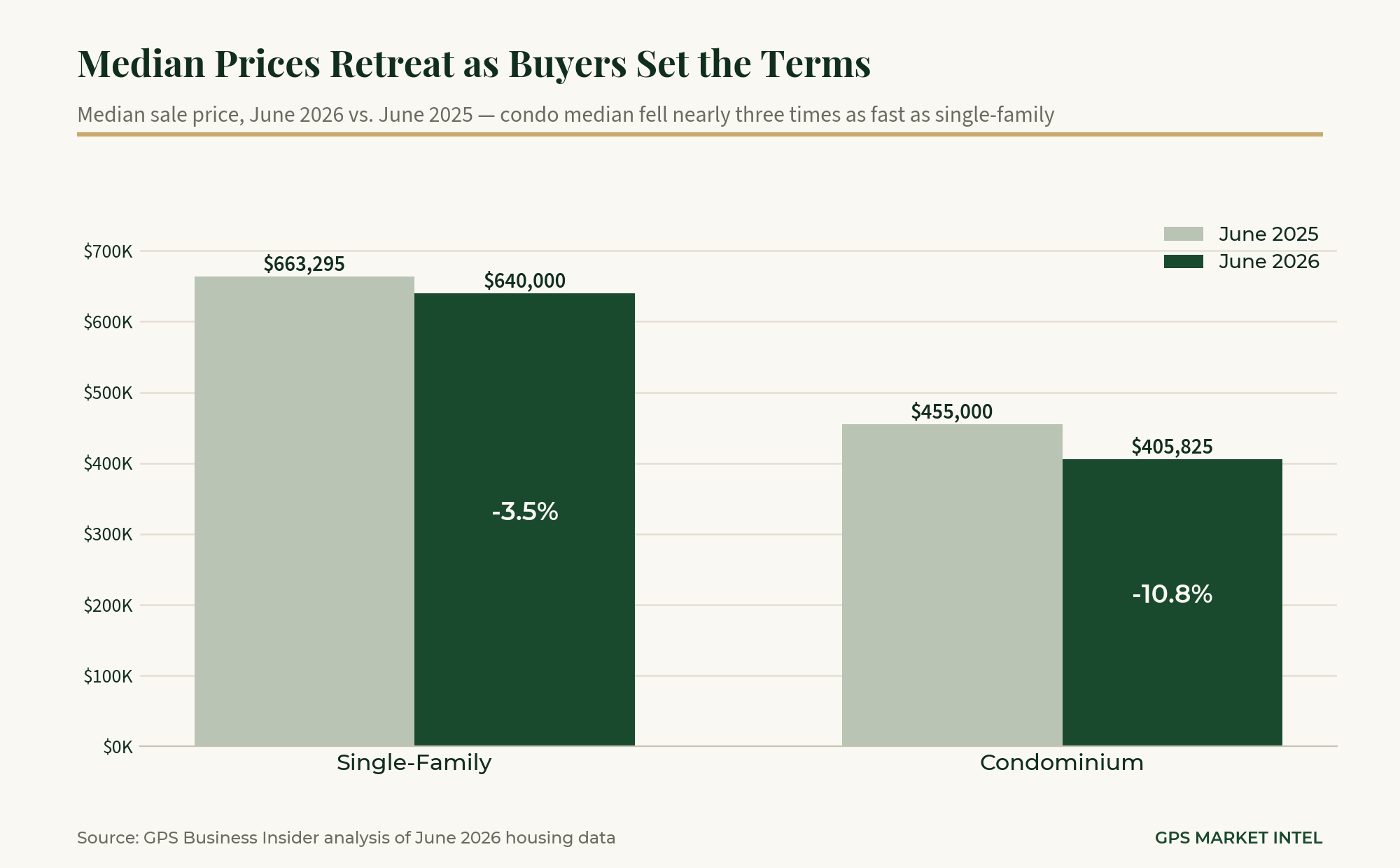
The median single-family sale price declined to $640,000, down 1.5 percent from May and 3.5 percent from $663,295 in June 2025. The three-month median of $650,000 was also below the $695,000 recorded a year earlier.
The decline in the median does not necessarily mean the typical individual home lost 3.5 percent of its value. Median prices can move when the mix of properties sold changes, particularly in a region with everything from entry-level homes to multimillion-dollar estates.
The average sale price per square foot supports that more nuanced interpretation. It was $435 in June, only 0.3 percent below the $437 reported a year earlier.
In other words, the median price fell more substantially than the price buyers paid for each square foot of housing. That suggests at least part of the decline came from more transactions occurring in lower-priced segments of the market.
Even so, sellers clearly had less pricing power.
Single-family homes sold for an average of 94.6 percent of their final list price and 91.9 percent of their original list price. The second figure is particularly important because it captures the cumulative effect of price reductions before a home reaches the closing table.
On average, the distance between the original asking price and the final sale price was slightly more than 8 percent.
That does not mean every seller made such a concession. Properly priced homes can still attract strong interest. But across the market, sellers who began too high often had to make a meaningful adjustment.
Less Inventory Has Not Produced a Seller’s Market
Ordinarily, a large reduction in inventory would be expected to strengthen seller leverage. That has not happened to the degree the supply numbers might suggest.
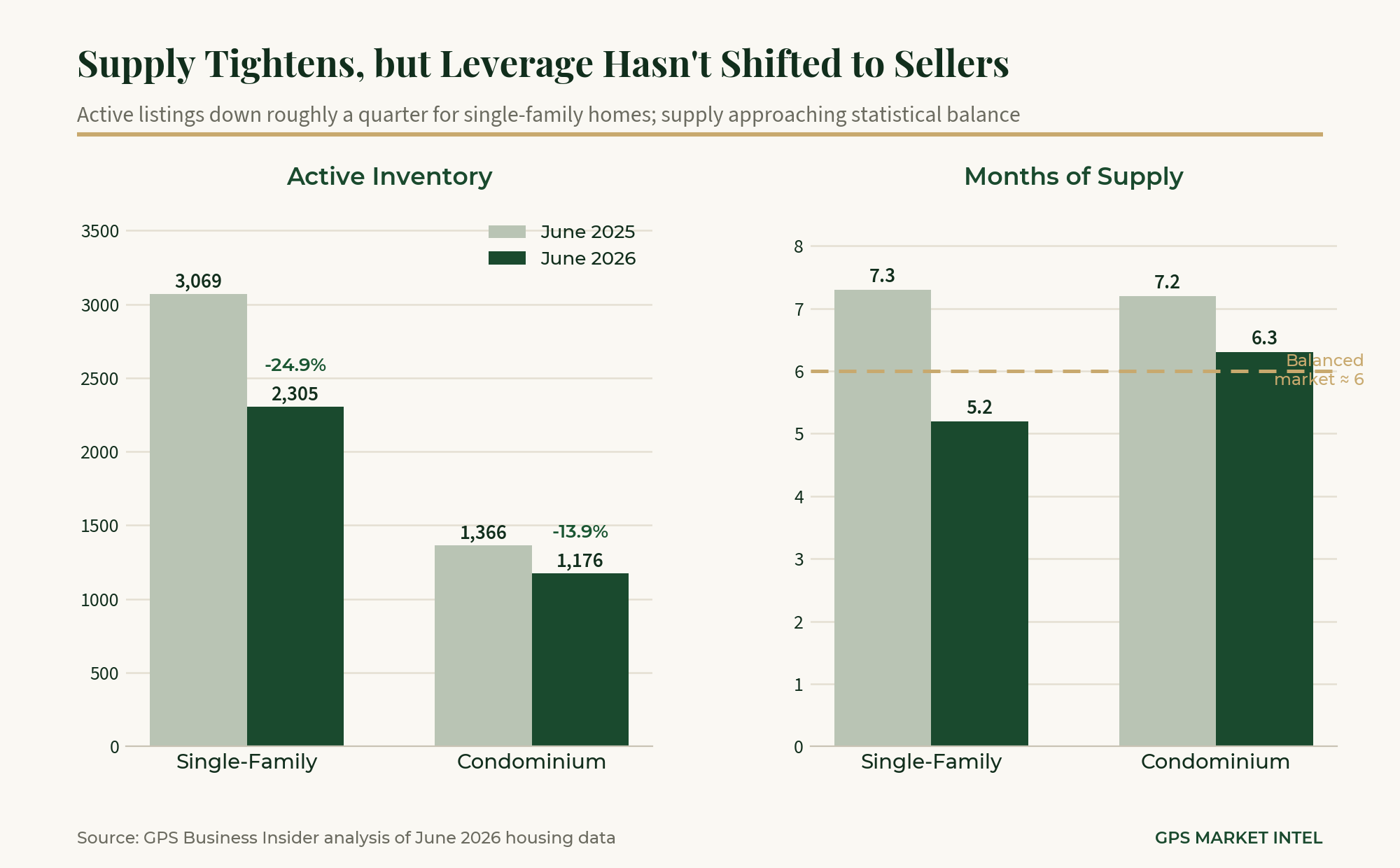
There were 2,305 single-family homes listed for sale in June, down 24.9 percent from 3,069 a year earlier and 13.1 percent from May.
New listings also declined. Only 576 single-family homes entered the market during June, 12.3 percent fewer than in June 2025 and nearly 20 percent fewer than in May.
With fewer homes available, months of supply fell to 5.2, compared with 7.3 months a year ago. That brought the single-family segment close to what is generally considered a balanced market.
Yet balance in the statistical sense has not translated into equal negotiating power.
Homes remained on the market for an average of 72 days, almost unchanged from 71 days a year earlier. While that was an improvement from 83 days in May, it still gave buyers time to compare properties, investigate costs and negotiate terms.
The decline in inventory may therefore say as much about sellers as it does about buyers.
Some homeowners remain reluctant to exchange mortgages obtained at significantly lower interest rates for new loans in the mid-6 percent range. Others may be withdrawing listings or postponing sales as the summer season begins. The June reports do not identify the reasons, but the reduction in new listings indicates that fewer owners are choosing to test the market.
A smaller supply of homes does not automatically generate urgency when affordability remains constrained and buyers believe additional concessions may be available.
Condominiums Face a More Difficult Reset
The condominium market also recorded more sales than it did a year ago, but the improvement was modest and accompanied by a much sharper decline in the median price.
There were 176 condominium sales in June, up 2.9 percent from 171 in June 2025. Sales were down 8.8 percent from May, however, showing that the condo segment lost momentum as the region entered summer.
Pending activity offered a more positive signal. A total of 190 condominiums went under contract, 21.8 percent more than a year earlier.
That indicates buyers are still searching for attached homes, particularly when the location, community amenities and overall monthly cost make sense.
The median condominium sale price fell to $405,825, down 6.7 percent from May and 10.8 percent from $455,000 a year earlier.
That headline decline should be treated carefully. The average condominium sale price per square foot was $338, up 1 percent from June 2025. The three-month median, at $454,250, was also much closer to the $465,000 three-month median recorded a year earlier.
Those figures suggest June’s unusually low monthly median was influenced substantially by the types and price ranges of condominiums that changed hands. More lower-priced transactions can pull down the median even when comparable units are not losing value at the same rate.
Still, condo sellers are operating in a market where buyers have choices and are scrutinizing more than the purchase price.
A condominium’s affordability can change quickly once HOA dues, insurance, reserve funding, assessments, rental restrictions and renovation needs are added to the calculation. Those costs matter throughout Greater Palm Springs, where much of the condominium inventory is located in golf, resort and seasonal residential communities.
Condominiums sold for an average of 95.7 percent of their final list price and 91.4 percent of their original asking price. That original-list-price ratio implies an average gap of nearly 9 percent between where sellers began and where transactions closed.
Inventory declined to 1,176 units, down 13.9 percent from a year earlier. Months of supply fell from 7.2 to 6.3, while the average condominium spent 74 days on the market, essentially unchanged from 73 days in June 2025.
The condo market is therefore becoming less oversupplied, but it has not become aggressive. Buyers still have enough time and inventory to be selective.
The Market Is Clearing Through Price
The most revealing feature of June was the combination of rising activity and declining prices.
Across both residential categories, the number of listings going under contract rose approximately 25 percent from a year earlier. At the same time, the combined inventory of single-family homes and condominiums fell by more than 21 percent.
Those conditions might ordinarily create price appreciation. Instead, the single-family and condominium medians both declined.
That suggests the market is clearing through price discipline rather than buyer urgency.
Homes that are presented well, located favorably and priced for current conditions are finding buyers. Listings anchored to peak pandemic-era expectations are more likely to require reductions or remain available longer.
That was also the central theme of GPS Business Insider’s May housing report, when local Jon Gordon described buyers as still active but increasingly selective.
“Buyers are not gone. They are simply more selective,” Gordon said at the time.
June’s results reinforce that assessment.
The increase in closings shows that buyers are willing to act. The discounts from original asking prices show that many are acting only after sellers adjust.
Mortgage Rates Remain the Market’s Gatekeeper
Mortgage rates remained one of the strongest constraints on the market.
The average 30-year fixed mortgage rate was 6.49 percent in June, slightly higher than in May but below the 6.82 percent average recorded a year earlier.
At a $640,000 single-family median price, a buyer making a 20 percent down payment would finance approximately $512,000. At a 6.49 percent interest rate, principal and interest would be about $3,230 per month before property taxes, insurance, maintenance or association costs.
That is roughly $230 less than the estimated payment on 80 percent of the June 2025 median price at the mortgage rate prevailing then. Lower local prices and a modest improvement in rates have therefore provided some payment relief.
But a payment above $3,200, before other housing expenses, remains beyond the reach of many households earning local wages.
The same issue affects condominiums. Their lower purchase prices can provide a more accessible entry point, but HOA dues and other recurring expenses may offset part of the savings.
The result is a market divided among local households, retirees, cash buyers, second-home owners, investors and people arriving from more expensive coastal communities. Each group evaluates affordability differently, which helps explain why some properties move quickly while similar-looking listings struggle.
Greater Palm Springs Is Repricing Faster Than the State
The local market’s improvement in sales volume mirrors a broader rebound across California, but its price performance does not.
California single-family home sales increased 6 percent from June 2025, while the statewide median price rose slightly to $904,640. Southern California sales increased 10.8 percent and the regional median rose 2.3 percent.
Riverside County recorded a median single-family price of $635,000, unchanged from a year earlier, while sales increased 7.1 percent.
Greater Palm Springs single-family sales grew even faster than the statewide rate and approximately matched Southern California’s increase. But the local median declined 3.5 percent.
The contrast was even greater in condominiums. California’s median condo and townhome price was almost unchanged from a year earlier, while the Greater Palm Springs condominium median fell 10.8 percent.
Nationally, existing-home sales rose 2.8 percent from a year earlier, and the median price increased 1.8 percent. In the West, sales rose 2.8 percent and prices increased 0.9 percent.
Greater Palm Springs therefore participated in the national and statewide improvement in sales, but not in their price appreciation.
That difference reflects the region’s distinct market structure. Greater Palm Springs has a large share of seasonal homes, resort properties, condominiums and discretionary purchases. Buyers who do not need to move immediately can wait for the right property or negotiate until the numbers work.
What June Means for the Summer Market
June provided more encouragement than the headline price declines might suggest.
Sales were up in both major housing categories. Pending contracts increased sharply from a year earlier. Inventory and months of supply fell. Market times improved from May.
Those are not the signals of a market shutting down.
But the numbers offer little support for sellers who believe tighter inventory will automatically restore the pricing conditions of several years ago. Buyers remain payment-conscious, condition-conscious and willing to walk away.
For sellers, the first list price may be the most consequential decision in the transaction. Pricing too high can cost valuable early exposure, extend market time and ultimately result in a larger reduction.
For buyers, June offered more negotiating power than the inventory figures alone would imply. But desirable, accurately priced properties can still attract competition, particularly within limited neighborhoods, price ranges and community types.
The outlook for the remainder of summer will depend partly on whether June’s surge in contracts converts into closed sales and whether the decline in new listings continues.
For now, the defining fact is not whether Greater Palm Springs has become a buyer’s market or a seller’s market.
It is that the market increasingly favors accuracy.

Bob Marra is the CEO/Publisher of GPS Business Insider. He has been studying, writing and giving presentations about business, economic and public affairs news and issues and the local economy in the Greater Palm Springs/Coachella Valley region for more than 20 years.