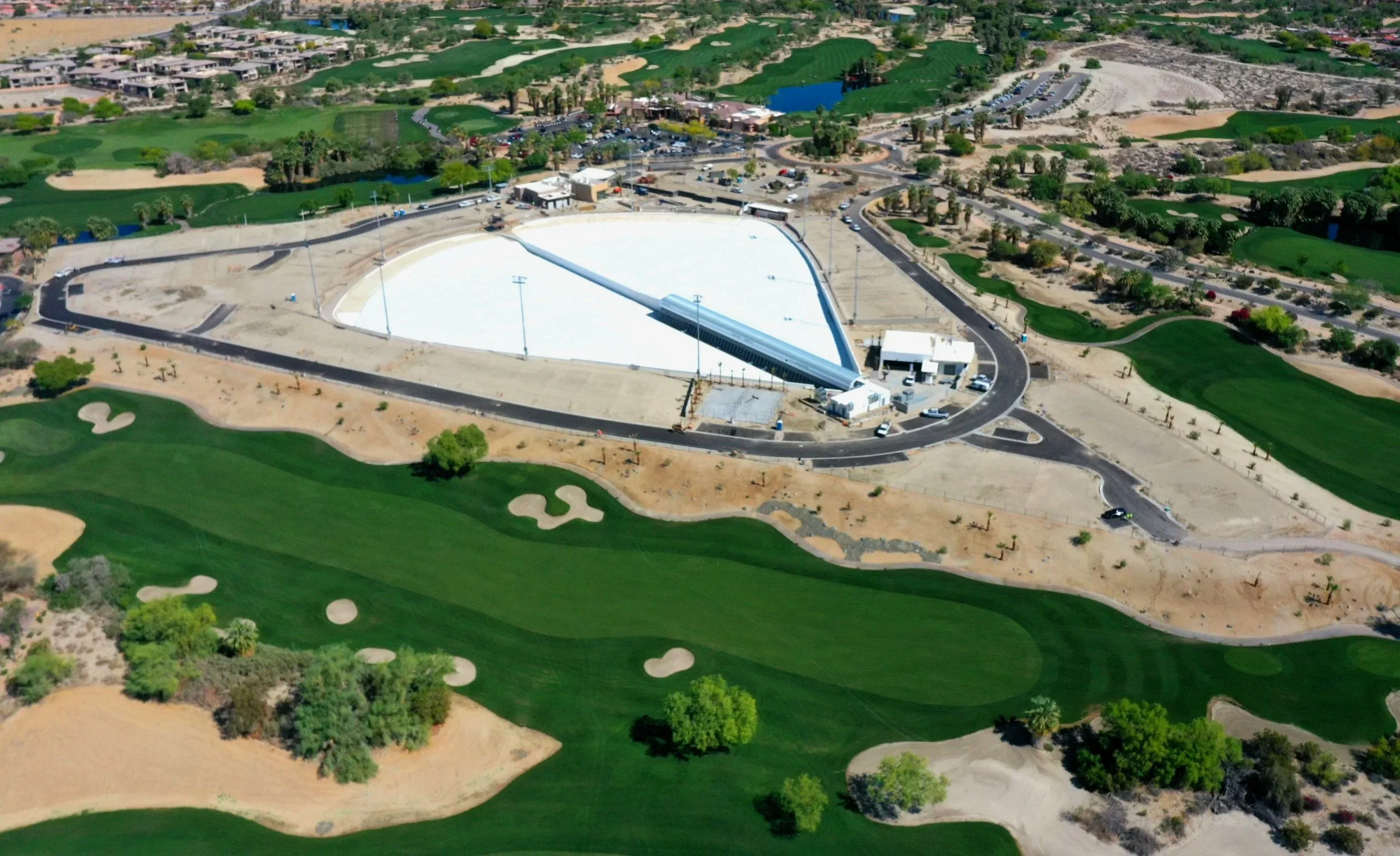
The 5.5-acre Wavegarden surf lagoon at Desert Willow Golf Resort is expected to open this summer, adding a new recreation and tourism draw to Palm Desert. The hotel and villa components remain part of the long-term plan, but the hotel timeline appears less immediate.
DSRT Surf, the long-planned surf lagoon development at Desert Willow Golf Resort, is moving toward a summer opening that will give Palm Desert one of the most unique new recreation and tourism amenities in Southern California: a 5.5-acre wave lagoon capable of producing consistent, ocean-like surf in the middle of the desert.
The first phase is expected to include the Wavegarden-powered surf lagoon, leisure pool, surf center, food and beverage offerings, rental and retail areas, locker rooms, cabanas, event space, pickleball courts and a skate park. An exact opening date has not been announced, but the project has entered the final operational stretch, with the lagoon being filled with water, substantial hiring underway and the refinement of the wave system expected to precede a public opening this summer.
For Palm Desert, the arrival of DSRT Surf is more than a novelty. It is a bid to add a new kind of year-round draw to a robust tourism economy built on golf, tennis, conventions, shopping, restaurants, wellness, festivals and seasonal visitors. For locals, it means a new recreation option that does not require a drive to the coast. For visitors, especially surfers from coastal Southern California and beyond, it offers something the ocean cannot guarantee: scheduled, repeatable waves.
“We’re proud to welcome DSRT Surf to Palm Desert,” Mayor Evan Trubee said in a recent city announcement about the anticipated opening. “It’s the kind of project that reflects who we are as a city, open to new ideas and always looking for ways to create unique experiences for the people who live here and the folks who come to visit.”
The wave lagoon is the near-term story. The longer-term story is whether the full resort vision originally contemplated for the site, including the hotel and real estate components, comes together in the foreseeable future.
The city’s 2019 Specific Plan for DSRT Surf envisioned a 17.69-acre recreational and resort development with a surf lagoon, surf center, restaurants, bars, retail, hotel rooms and resort residential villas. The plan allows up to 350 hotel rooms and up to 88 villas, although the current project concept described by DSRT Surf materials is smaller, with a planned 139-key “barefoot luxury” hotel and 57 private villas.
Michael Gerano, DSRT Surf’s vice president and general manager, said in an interview that the hotel remains part of the project’s plan, even if it is not imminent.
“We fully intend to build, own and operate the hotel at the present moment,” Gerano said. “Just because the land is listed does not mean that we are going to break that out from the overall development.”
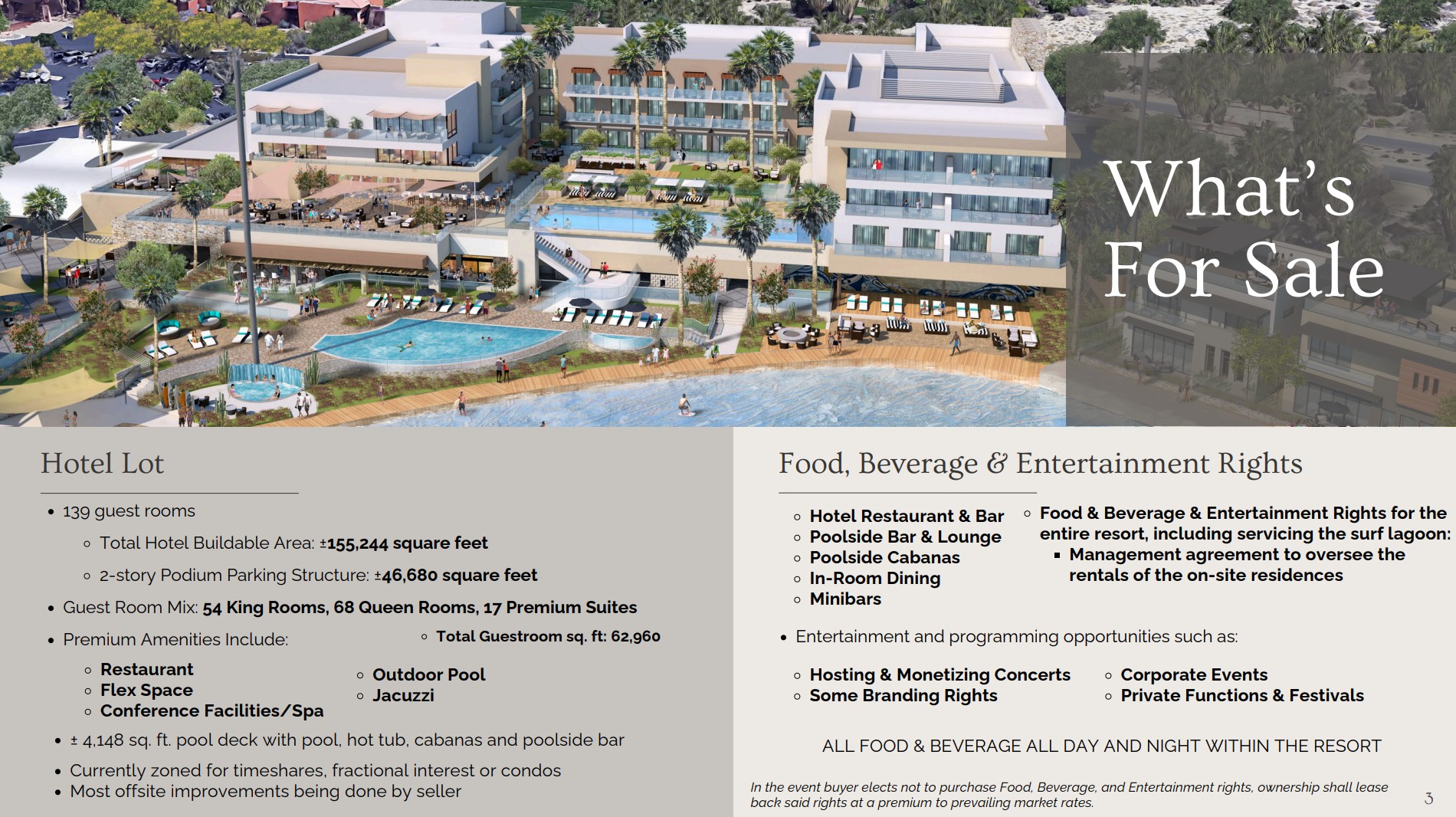
The 5.0-acre parcel within the DSRT Surf specific plan designated for a hotel is listed for sale on the Loopnet Commercial Real Estate Exchange along with food & beverage rights for the entire resort.
That distinction matters because a 5-acre commercial land listing for the DSRT Surf project at 38995 Desert Willow Drive has been on LoopNet since July 2025, offered at $8 million. In development terms, the listing does not necessarily mean the hotel component will be sold or abandoned. But it does signal that the hotel portion is clearly a longer-range piece of the project, subject to the same forces challenging new hotel development across the region: construction costs, financing costs, brand requirements, seasonal occupancy patterns and the need to generate average daily rates high enough to justify the capital investment.
Gerano emphasized that the opening of the surf lagoon should not be overshadowed by questions about later phases.
“The intention is fully to have a hotel,” he said. “We will build the villas. We will eventually have a hotel.”
A New Kind Of Summer Draw
DSRT Surf’s central proposition is that the desert can become a surf destination precisely when the coast is most crowded and expensive.
Gerano said the project has the potential to attract surfers who are frustrated by coastal crowds, inconsistent waves and peak-season room rates. In the summer, he said, Greater Palm Springs hotels can offer a more attractive value proposition than coastal markets, particularly for visitors who want guaranteed surf sessions in a destination setting.
“When it’s busy over there, their season offsets our season,” Gerano said of Southern California’s coast. “When we slow down historically out here in the hotels, they ramp up, and their rates go through the roof.”
The surf lagoon is designed to hold up to 70 surfers at one time, including surfers on the main wave and bay wave. During the summer period from Memorial Day to Labor Day, Gerano said the facility can operate from 6 a.m. to midnight, though actual hours will depend on demand. The same extended operating window is planned for weekends and holidays during other parts of the year, with regular operating hours otherwise expected to run from 6 a.m. to 10 p.m.
At full theoretical capacity, 70 surfers per hour over an 18-hour day would create a substantial number of surf sessions. But Gerano said actual daily volume will be dictated by demand. The project will also serve non-surfers through beach passes, food and beverage, cabanas, spectator areas and other recreational amenities.
That broader audience is important. DSRT Surf is not being positioned only as a place for skilled surfers. Its Wavegarden Cove technology can produce multiple wave types, allowing beginners and advanced surfers to use different sections of the lagoon. The technology is described as capable of producing up to 1,000 waves per hour.
Local Jobs And Local Interest
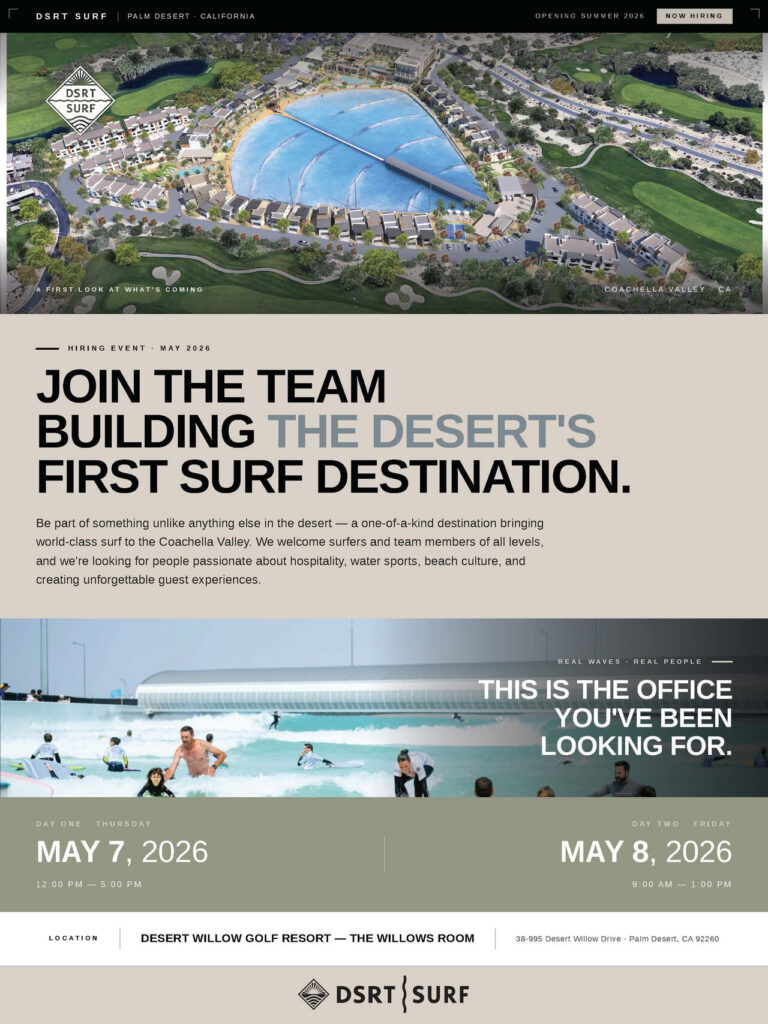
DSRT Surf is in full staffing mode, including holding a successful job fair in early May to fill roughly 125 positions.
DSRT Surf has already generated strong interest on the employment side.
Gerano said a two-day job fair held at the adjacent Desert Willow Golf Resort drew more than 750 people after only about six days of promotion. Most attendees, he said, appeared to be local Greater Palm Springs residents, although some people came from the coast, Northern California and other markets.
“That was an unbelievable turnout,” Gerano said. “We want to make sure we’re providing jobs locally.”
The initial operating team is expected to include lifeguards, surf instructors, surf coaches, guest services employees, facilities staff, food and beverage workers, marketing and sales personnel, human resources and other leadership roles. Gerano said the day-one employee count could be around 125, with total staffing growing depending on demand.
Beach Street Operations, which appointed Gerano to oversee DSRT Surf, described him as a leader with resort operating experience and a strong understanding of the Coachella Valley market.
“This is more than a single destination,” Gerano said in the company announcement. “It’s the beginning of a new category in hospitality.”
Water, Sustainability And The Desert Setting
The project’s location in the desert makes water use an unavoidable part of the conversation. DSRT Surf has sought to address that through what it calls its “Turf for Surf” program.
The program converted 30 acres of adjacent golf course turf into drought-tolerant and native landscaping. DSRT Surf says that conversion is expected to save 34.8 million gallons of water annually, compared with projected annual lagoon use of 23.8 million gallons. On that basis, the project says it will generate a net annual water savings of about 11 million gallons.
The city’s Specific Plan also frames DSRT Surf as a project intended to blend natural and man-made features, with architecture and landscaping designed to evoke both desert and surf environments. The plan calls for a resort atmosphere with gathering spaces, restaurants, bars and outdoor activities integrated around the lagoon.
That design vision is now becoming visible as the first phase nears opening. Gerano said the surf footprint will include food and beverage, rental and retail services, locker rooms, a pool deck, cabanas, pickleball and other amenities.
“Everything within the surf center and surf footprint will open in phase one,” he said.
The Hotel Question
Even as the lagoon moves toward opening, the hotel and affiliated villas remain the key long-range question.
Palm Desert’s public economic analysis for the project, prepared in connection with a transient occupancy tax sharing agreement, made clear why the hotel and villas were important to the city’s original view of the development. The city described the project as a first-of-its-kind facility with potential benefits including jobs, tourism spending, new recreation, health benefits tied to sports participation, and increased tax revenues.
The agreement contemplated a public participation package that included up to $16.1 million in hotel and villa transient occupancy tax sharing over 20 years, a city purchase of $20 million in public improvements upon completion, and a land subsidy valued at $454,900. The total subsidy identified in the report was approximately $36.45 million. The city’s analysis projected approximately $41.8 million in local TOT over the 20-year term of the agreement, with the city receiving 100 percent of the TOT after the rebate period or cap was reached.
That structure underscores why the hotel and villas matter. Surf sessions, food and beverage and day visitors can generate economic activity, but hotel rooms generate transient occupancy tax, one of the most important revenue streams for resort cities.
The challenge is that new hotel construction in Greater Palm Springs is rarely simple. Even with entitlements in place, a developer must stretch to make the math work. Today, construction costs remain high. Debt is expensive. Luxury or upper-upscale hotel brands typically require costly finishes, amenities and operating standards. The region can command strong rates in peak periods, but it also has pronounced seasonal softness, especially in summer.
That is where DSRT Surf could help change the equation over time. If the lagoon attracts visitors during slower months, it could make the surrounding hotel market stronger and eventually support the economics of an on-site hotel. But the fact that the hotel land has been publicly marketed for nearly a year suggests the hotel component is not on the same timeline as the wave lagoon.
Gerano acknowledged that the hotel is not imminent, while maintaining that the company’s plan has not changed.
“The full intention is to build a 139-key barefoot luxury hotel here with a major brand,” he said.
The villas appear to be moving sooner. Gerano said seven shoreline villas are expected to begin construction this summer, with the broader project planned for 57 villas. He said the villas and hotel are already covered by the project’s entitlements, but DSRT Surf is not yet releasing pricing or availability details for the residential component.
“All I can confirm is that we are building seven on the shoreline imminent this summer,” Gerano said. “Post those being built will then dictate, probably, the next steps.”
A Tourism Asset Before It Is A Full Resort
For now, DSRT Surf’s immediate significance is not dependent on the hotel being open. The lagoon itself could become a meaningful tourism and recreation asset from day one.
The project sits in one of the region’s most established resort nodes, near Desert Willow Golf Resort, The Westin Desert Willow Villas, the JW Marriott Desert Springs Resort & Spa, Marriott’s Desert Springs Villas and other lodging, golf and restaurant assets. That gives visiting surfers and spectators plenty of places to stay, eat and spend money even before an on-site hotel and the 57 villas are built.
Gerano said that proximity is part of the strategy. He described DSRT Surf as a true destination experience, but one that can plug into an existing hospitality ecosystem.
“The goal now for me and my team, and for our project, is to create the most fun surf destination in the world, right here in Palm Desert,” he said.

Bob Marra is the CEO/Publisher of GPS Business Insider. He has been studying, writing and giving presentations about business, economic and public affairs news and issues and the local economy in the Greater Palm Springs/Coachella Valley region for more than 20 years.