The Palm Desert nonprofit plans to shut down at the end of 2026 after a series of lost and delayed funding streams. Now the future of its signature Community Health Survey, a 20-year record used to guide grants, programs and public policy across the region, will have to be picked up by another organization or dropped altogether.
For two decades, one small Palm Desert nonprofit has quietly built something the Coachella Valley has few substitutes for: a long-running, locally focused record of how people here live, what makes them sick, where they struggle to obtain care, and how those conditions change over time.
Now the organization that built it is going away.
Health Assessment and Research for Communities (HARC) says its board decided in August to begin the process of dissolving the nonprofit after a series of funding sources were lost, reduced or postponed. HARC expects to close its doors by the end of 2026.
The immediate business question is what happens to the organization. The potentially larger regional question is what happens to its data.
HARC is actively seeking another organization to take over its triennial Coachella Valley Community Health Survey, including years of historical datasets, survey instruments, a data dictionary and the intellectual property needed to continue producing the survey.
That makes the next several months something more consequential than a nonprofit wind-down. They amount to a search for a new owner or steward of one of the Coachella Valley’s most established pieces of local health-data infrastructure.
HARC’s Closure Comes Just Months After Its Latest Coachella Valley Health Survey
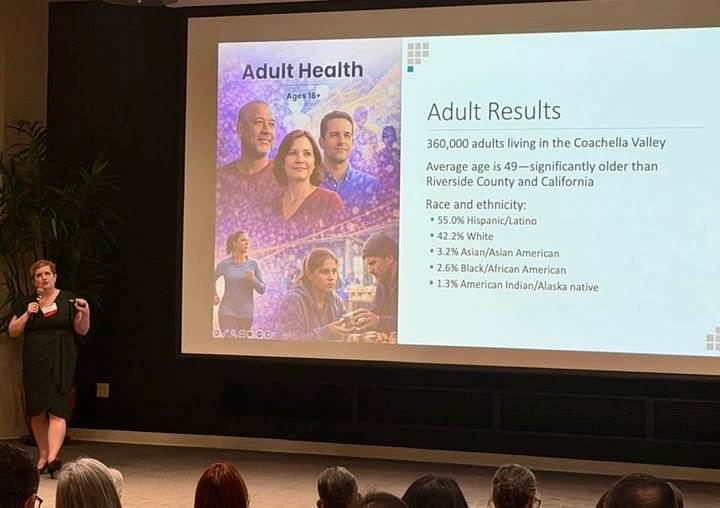
The timing is striking. In February, HARC released the seventh edition of its Community Health Survey, based on 2,807 responses and designed to describe conditions among roughly 447,000 Coachella Valley residents.
GPS Business Insider reported at the time that the survey functioned as much as an economic stress test as a public health report, documenting health-care access problems, food insecurity, financial strain, environmental conditions and other factors that affect the valley’s workforce and economy.
The survey dates to 2007, with subsequent editions in 2010, 2013, 2016, 2019, 2022 and 2025. The continuity of HARC’s work is part of what makes it difficult to replace.
Government databases can provide extensive statistics at the county, state and federal levels. Hospitals conduct required community health needs assessments. Riverside County maintains an expanding public-health data system.
But the Coachella Valley is only one portion of sprawling Riverside County, and the demographic and economic conditions of the desert can look substantially different from those of the county’s much larger western population centers. HARC was created in 2006 in large part to fill that gap.
Its surveys have allowed local organizations to examine health and social conditions specifically within the Coachella Valley and, in many instances, break results down further by geography or demographic group.
The Community Health Survey Became Part of the Valley’s Funding Infrastructure
The importance of the survey is not limited to health researchers. HARC says its data has been used to support grant applications, develop programs, set public policy and determine community priorities. That turns data into an economic asset.
A nonprofit trying to raise money for senior nutrition, behavioral health, disease prevention or health-care access is in a stronger position when it can document a problem with statistically credible local evidence instead of relying on statewide or countywide averages.
HARC says organizations using its research have secured millions of dollars in outside funding over the years. After the 2016 survey alone, the organization reported that local groups brought in more than $1.5 million during the first year after the results were released.
The latest survey also illustrates how widely the work has been supported.
Funders for the 2025 survey included the Desert Healthcare District and Foundation, Desert Care Network, Desert Oasis Healthcare, Inland Empire Health Plan, Molina Healthcare, First 5 Riverside County, the Regional Access Project Foundation, Riverside County’s Fourth District and the cities of Palm Springs, La Quinta and Desert Hot Springs, among others.
That broad funding base reflects the survey’s unusual place in the local ecosystem. It is neither solely a government data project nor a proprietary health-system study. It has functioned as a shared regional resource.
HARC’s Finances Show How Vulnerable the Model Had Become
HARC says a single lost grant or contract did not cause its closure. Instead, the organization said it lost, reduced or indefinitely postponed several funding streams over the past two years. Its most recent federal tax filing helps explain why several disruptions could be so damaging.
For fiscal 2025, HARC reported approximately $1.2 million in revenue against $1.3 million in expenses, producing a deficit of roughly $112,000. It finished the period with about $233,000 in net assets and approximately $201,000 in cash.
More importantly, roughly 87 percent of HARC’s revenue came from program-service revenue, meaning the organization depended heavily on paid research, evaluation and consulting work rather than a large permanent endowment or deep pool of unrestricted donations.
That structure can work when projects continue flowing. It leaves considerably less room for error when contracts disappear, grant decisions are delayed or major projects fail to materialize.
CEO Jenna LeComte-Hinely told the Coachella Valley Independent that HARC ultimately could not raise the roughly $500,000 it believed was needed to restore financial stability. The publication reported that more than half of the staff had already been laid off and the remaining team was working reduced schedules as the organization completed contracts.
HARC’s own announcement describes the same underlying problem in broader terms: too many funding streams weakened in succession.
Who Could Take Over the Coachella Valley Community Health Survey?
HARC has not announced a buyer or successor.
LeComte-Hinely told the Independent that discussions had included Riverside University Health System Public Health and Inland SoCal United Way’s 211 operation. Both already operate in the data and community-information space.
Riverside County Public Health produces community health assessments and manages epidemiological and public-health data. HARC has worked directly with the county before, including on Riverside County health needs assessments in 2021 and 2023. Those studies remain among the data sources supporting the county’s current Community Health Improvement Plan.
Inland SoCal United Way operates 211 across Riverside and San Bernardino counties and maintains a large database of health and human-services resources along with its own data and reporting programs.
Another organization with a long connection to HARC is the Desert Healthcare District and Foundation. The District provided nearly $400,000 toward HARC’s 2019 survey and later contracted with HARC to produce a valleywide Community Health Needs Assessment following the expansion of the District’s boundaries to encompass the entire Coachella Valley.
The issue is particularly timely because the District is itself moving into a much broader regional role.
As GPS Business Insider reported earlier this year, its new five-year strategic plan envisions the organization playing a larger role in regional health strategy, workforce development, access to care and measurement of outcomes.
There has been no public announcement that the District is seeking to acquire HARC’s survey.
Preserving the Survey Means Preserving More Than Old Reports
Finding a home for the existing reports is the easier part. Preserving the survey itself is more complicated.
HARC is offering historical data, survey tools, its data dictionary and intellectual-property rights associated with the project. A successor would also need to preserve enough of the survey methodology to allow future results to be compared credibly with previous cycles.
That longitudinal continuity is one of the survey’s principal values.
If questions, sampling methods, geographic definitions or analytical approaches change too substantially, a future survey may still provide useful information but become less valuable for measuring whether conditions are improving or deteriorating over time.
There are also questions about accessibility.
HARC has historically made its major Community Health Survey reports publicly available. That matters to smaller nonprofits, researchers, businesses and community organizations that could not afford to purchase proprietary health data.
A successor therefore would inherit decisions that go beyond simply storing files.
Among them are whether the survey continues every three years, whether the same geographic detail remains available, whether historical data stays publicly accessible, how future surveys are financed and whether organizations will have to pay for information they previously obtained without charge.
Those decisions could determine whether the asset remains a community resource or becomes primarily an institutional research tool.
HARC’s Data Has Already Been Built Into Regional Decision-Making
The valley will not suddenly become data-blind when HARC closes.
Riverside County has substantially expanded its own public-health analytics. Hospitals and health systems regularly conduct community assessments. The Desert Healthcare District commissions research. Universities, health plans, foundations and state agencies maintain increasingly sophisticated datasets. But those systems do not necessarily duplicate HARC’s function.
The distinctive value of HARC’s survey is the combination of local geography, recurring methodology and nearly two decades of history. Its 2025 survey, for example, examined health-care coverage and utilization, major diseases, mental health, food insecurity, demographics, economic conditions and environmental issues including extreme heat and air quality. That allows users to look not merely at a current statistic, but at how conditions have shifted from one survey cycle to the next.
The same research organization also produced specialized studies on Eastern Coachella Valley communities, environmental health, childhood asthma near the Salton Sea, seniors, veterans, uninsured adults, children and mental health.
HARC also served as a contractor for organizations that needed research and evaluation work beyond the triennial survey. The organization’s closure therefore removes both a dataset and a local research shop.
HARC Is Warning Users to Download Its Reports Now
For now, the HARC website remains online and continues to provide access to the 2025, 2022 and 2019 executive reports, along with numerous special reports and data briefs.
HARC is explicitly advising users not to assume that access will remain available indefinitely. The organization has asked community organizations and researchers to download reports they want to preserve while the website remains operating.
It is also accepting short-term research, evaluation and community-engagement assignments that can be completed during 2026, both to finish useful work and help sustain the remaining staff through the transition.

Bob Marra is the CEO/Publisher of GPS Business Insider and GPS Market Intel. He has been studying, writing and giving presentations about business, economic and public affairs news and issues and the local economy in the Greater Palm Springs/Coachella Valley region for more than 20 years.